Surrey Day to explore county's hidden treasures

 Alexa Rusakoff/BBC
Surrey Day 2026 will explore some of the county's hidden treasures.
The annual day, a celebration of life in Surrey, is taking place on Saturday.
Dame Maggie Aderin, best known for presenting The Sky at Night and her work promoting science to school children, was previously announced as an ambassador.
Woking is home to several hidden treasures, including the UK's largest cemetery and first purpose-built Mosque, and a tribute to the work of HG Wells.
An alien invader
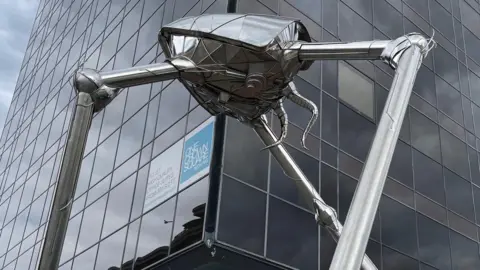
The town centre is home to a strange metallic figure, a Martian tripod standing sentinel on Chobham road.
In the novel the first landing of the aliens takes place on Horsell Common, and much of the early action takes place in Surrey.
Commissioned in 1998 to celebrate the centenary of HG Wells' famous tale The War of the Worlds, The Martian was created by sculptor Michael Condron.
Condron told BBC Radio Surrey: "The sculpture is as close as I could get it, based on the text from The War of the Worlds."
He completed the work between January and April 1998.
"It was just this mad two months of just going crazy welding these tubes and pipes and working everything out," he said.
"This was before I had any kind of computer design software.
"It was really rulers tape measures, spirit levels, plumblines, and maths."
 Alexa Rusakoff/BBC
In the novel, the Martians crush all human military efforts to stop them, but they do not conquer the Earth.
They die after becoming infected by bacteria, to which they have zero immunity.
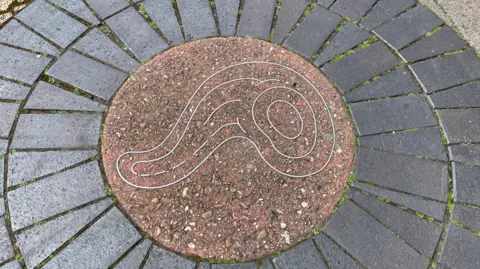
To honour Earth's smallest creatures who save the world, Condron inlayed metal panels into the walkway along Crown Passage depicting different bacteria.
Britain's first purpose-built mosque
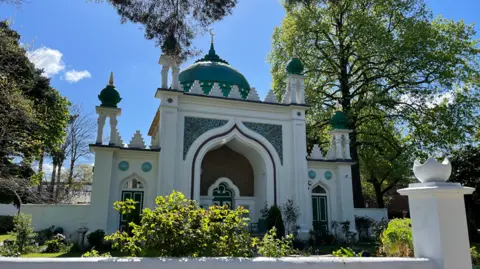
Screened from the road by trees and buildings, a piece of national history stands off Oriental Road.
The Shah Jahan Mosque is Britain's first purpose-built mosque, and a symbol of international and inter-faith collaboration.
Founded by Prof Gottlieb Wilhelm Leitner, a Hungarian from a Jewish family, the Mosque was built for the students of his Oriental Institute of Learning.
Manager of the mosque Mohammad Habib said it was built as a place of worship for Muslim students coming to study there.
William Isaac Chambers, the Guildford architect who designed the mosque, was a Christian and had never designed a Mosque before.
 Alexa Rusakoff/BBC
The building of the mosque was funded by the Begum of Bhopal, Princess Shah Jahan, and is named after her.
"I think the story of the mosque sends out a really strong positive message – you have people from three different countries, three different religions, they're all working together," Habib said.
Graves 'from paupers to notables'
At the time of its consecration in 1854, Brookwood Cemetery was the largest cemetery in the world.
It no longer holds the top spot but remains the largest in the UK and is a site brimming with "hidden treasures".
Kim Lowe, chairwoman of the Brookwood Cemetery Society, said: "Our hidden treasures could be measured by the wonderful memorials we have, what you can find behind some of our mausoleum doors when we open them up.
"And then there's the history of the people who are buried here, from paupers to notables."
Brookwood is the final resting place of many well-known figures, from actors to the infamous.
They include the Pre-Raphaelite artist Evelyn De Morgan, victims in the Thames Torso Murders of the late 1880s and portrait painter John Singer Sargent.
 Commonwealth War Graves Commission
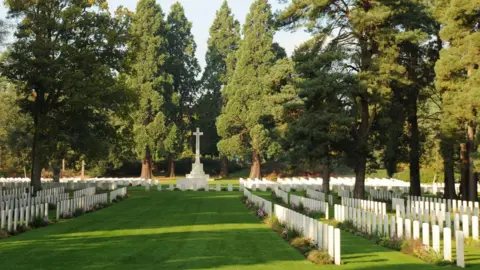
There is also a large military section, maintained by the Commonwealth War Graves Commission.
Soldiers from Australia and India are resting near German fighter pilots and Italian prisoners of war, and all graves are cared for with equal reverence.
Megan Maltby is head of public engagement, and a font of knowledge about the graves here.
"All of these individuals that had probably never heard of Surrey before they embarked on these missions overseas," she said.
"[They] have ended up in this little corner of Brookwood."
