What were aurochs? The prehistoric creatures that once roamed

 Getty Images
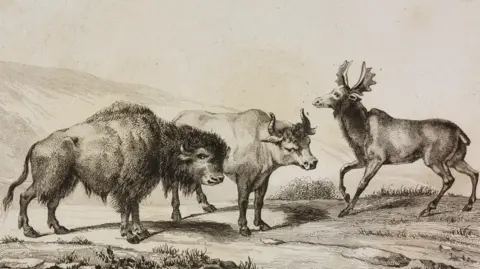
They once roamed grasslands across Wiltshire and provided food for hundreds of people but aurochs have since been widely forgotten.
The large horned cow was one of Europe's tallest land mammals, besides the woolly mammoth and woolly rhinoceros, and is thought to have been more than three times the size of modern cattle.
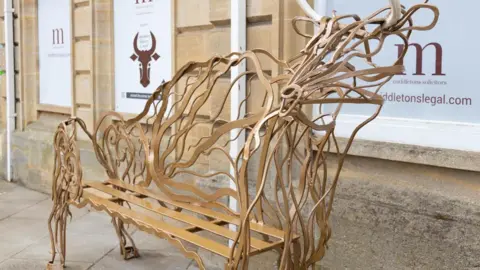
In Amesbury in Wiltshire - where a bench has been unveiled to commemorate the extinct animal - Mesolithic people relied on aurochs for food and survival.
"One aurochs could have fed about 300 people," Amesbury History Centre volunteer Julia Doig told BBC Radio Wiltshire.
"And then there would have been useful hides, sinew bones to make use of as tools. They were an excellent resource."
 Bertie Coy
Remnants of huge fires and aurochs bones have been discovered across Amesbury, proving people routinely hunted and feasted on the ancient animals.
Footprints of an aurochs were found in 2018 during an archaeological dig at Blick Mead. But preparation works for the controversial A303 Stonehenge tunnel caused them to be drilled through.
At the time, lead archaeologist Professor David Jacques described the situation as a "travesty" and said: "It was like putting a hole in the Bayeaux Tapestry."
 Getty Images
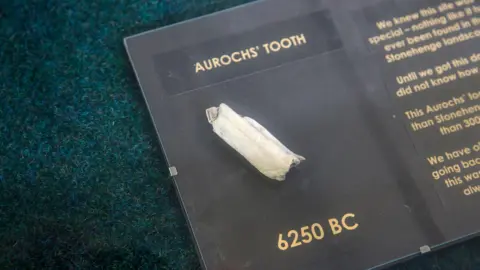
Aurochs, the wild ancestor of modern domestic cattle, vanished from Britain around 1300 BC, due to habitat loss and hunting. The last known aurochs died in 1627 in Poland.
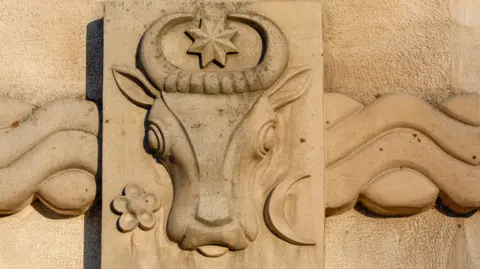
Amesbury History Centre adopted the prehistoric beast as its logo when archaeologists discovered there were more aurochs eaten in the Wiltshire town than anywhere else in North Western Europe.
"We're lucky enough in Amesbury to have had archaeologists dig since 2005 at Blick Mead, and we've evidence of actual butchering of bones and so we know that they were here," Doig added.
"We also know people were here, that they were hunting them and then feasting on them."
 Getty Images
Doig added it was "fantastic" the town's new bench would allow more people to recognise the animal's links to Wiltshire.
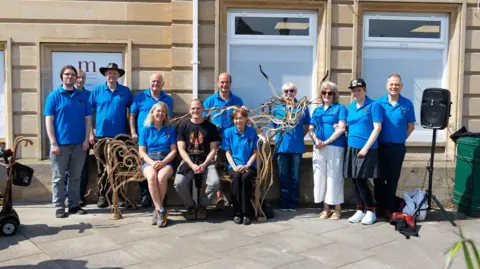
Created by sculptor Dan North, also known as Dan of Steel, the aurochs-inspired bench in Amesbury took seven months and 100 hours of work to complete, with the completed design drawing on archaeological finds from nearby Blick Mead.
"Learning the history helped with the dimensions," he said. "Once I had formed the outer shape, the rest fell into place. I used traditional blacksmithing techniques with my coal forge to shape each piece."
 Bertie Coy
North spent time sketching aurochs and incorporated the bench design inside one of his sketches.
He added: "It has made an excellent impact and has had a lot of people talking about it. It has also educated people about the aurochs' history and the fact they used to roam around this area all those years ago."
 Bertie Coy
The aurochs bench was commissioned by Amesbury History Centre with the support of Wiltshire Towns Fund and Amesbury Town Council.
Follow BBC Wiltshire on Facebook, X and Instagram. Send your story ideas to us on email or via WhatsApp on 0800 313 4630.
