Ramblers win fight to protect woodland paths

 The Ramblers
Woodland paths walked for generations have moved a step closer to being formally protected after a charity won a legal battle.
Under English law, a public right of way can be established where a route has been used "as of right" for at least 20 years without interruption.
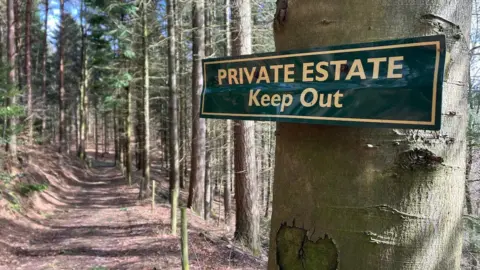
But in 2010, residents discovered fences, walls and barbed wire had been erected in Hayton Woods in Cumbria, as new landowners sought to restrict public access.
Landowner Roxlena Ltd argued a pause during the 2001 foot-and-mouth outbreak broke the required period of continuous use under rights of way law, but that argument was rejected by the Court of Appeal which upheld the case brought by The Ramblers.
In March 2025, Mrs Justice Lang ruled that a break of about four months during the crisis should not prevent a right of way arising when considering long-term historical use.
The ruling was upheld by the Court of Appeal on 7 May.
'Huge benefit to community'
Paths manager at The Ramblers charity Sophie Redmond said: "Cumbria was one of the worst hit places during the foot-and-mouth [crisis], and while people kept away from the countryside to protect the livestock and livelihoods of local farmers, they never thought this would be used to take away their rights to walk in the woods afterwards.
"[The] judgment confirms that the people of Hayton shouldn't be denied access to their local paths because they did the right thing during a time of national crisis."
Euan Cartwright, who has lived in Hayton for more than 45 years, was among those involved in the long-running dispute over the riverside routes.
He said: "We wanted our children to have the freedom to explore by themselves as they grew up, and Hayton Woods seemed perfect for that."
Fellow resident Matthew King added: "Losing access to these paths has had a huge effect on many residents of Hayton village, the surrounding areas and other ramblers.
"Reopening these footpaths for us all to enjoy again will be a huge benefit to the community and others."
Campaigners said a ruling in favour of the landowner could have had wider implications for access rights, potentially affecting paths unused during the foot-and-mouth outbreak and even during Covid-19 lockdowns.
Appeal plans
Public access to paths will not be restored until a decision to confirm a map modification order has been made.
A spokesperson for The Ramblers said the verdict brought that one step closer and the case would now be referred to the secretary of state for consideration.
In a statement to the BBC, Roxlena Ltd said it was "disappointed" the court dismissed its appeal, maintaining a 2021 public inquiry had found the legal test for establishing a public right of way had not been met and it would be applying to the Supreme Court for permission to appeal.
The statement added: "The case raises important questions of public law, in particular, the correct standard of review where Parliament has entrusted an evaluative judgment to an expert inspector.
"If the conclusions of a full public inquiry can be overridden in this way, the value of that process for landowners, for the public, and for all those who participate in it in good faith is fundamentally undermined."
The Ramblers recently launched a campaign to call for more blocked paths to be opened up.
"This is just one example of the thousands of miles of local paths across Britain that are missing, blocked or unusable, stopping people being able to access nature close to home," The Ramblers' spokesperson added.
