The little village with a big Viking past

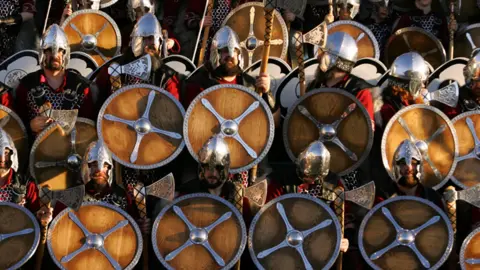 John D McHugh via Getty Images
Lincolnshire was once a major Viking stronghold, with the market town of Gainsborough serving briefly as the nation's capital after Danish ruler Sweyn Forkbeard was declared King of all England on Christmas Day 1013.
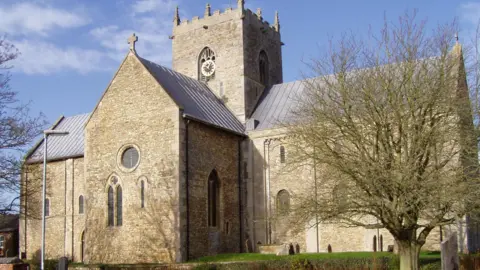
But lesser known clues to the region's Viking past can also be found nearby at Stow Minster - about eight miles (12km) south of Gainsborough.
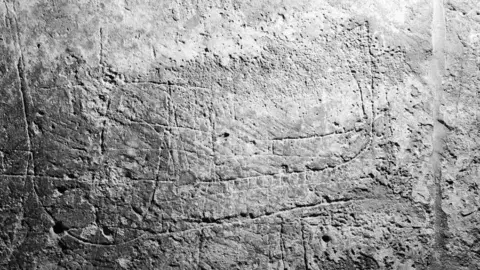
Church warden David Justham said the minster, which dates back to 975, had a "phenomenal history" - including graffiti depicting one of the earliest known carvings of a Viking longship in England.
He tells the Secret Lincolnshire podcast the etching, scratched into a chancel arch pier, was believed to date back more than 1,000 years.
Although it was not known who was responsible, Justham said it could have been done at about the same time Forkbeard was in Gainsborough.
"At that time it's possible the Vikings were also trading - bringing goods to be sold at the market place we had outside the west door of the church," he said.
"It's possible that one of the Vikings from that encampment [in Gainsborough] came and left his visiting card."
 Ashley Taylor, Push Creativity UK
Justham said it was also plausible that the etching was created by someone from one of the local farmsteads, which were occupied by settlers to the area.
"This would have been an important place for them," he said.
"In terms of the ship, it was just to say we are a trading nation," he added.
 David Justham
Justham said there was also evidence of an earlier wooden church at the location.
"Archaeology carried out in 1983 showed there was a layer of charcoal in the ground - which could have been a wooden church that was burnt in 871 - when the Vikings had their big encampment at Torksey," he said.
The Vikings came into contact with Christianity through their raids, with notable figures such as Forkbeard's son, Canute, embracing the religion to legitimise his rule and to unify Anglo-Saxon and Danish populations.
"In the early part of the Viking era they were pagans, but by the time of Sweyn Forkbeard and the possible creation of the graffiti they were Christianised, Justham added.
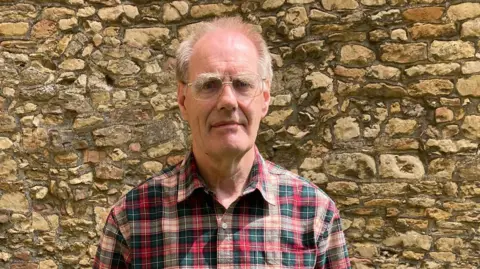
The Reverend Jane Foster-Smith said Stow was a place of great significance in the past.
"This minster was built as the heart of the diocese of Lincoln," she said.
"In the past, we had a lot of travel by boat and our proximity to the River Trent and the Fossdyke meant this was a good place.
"But as things changed Lincoln became the place where people wanted to be and Lincoln Cathedral was then built," she said.
Listen to highlights fromLincolnshire on BBC Sounds, watch thelatest episode of Look North.
Download the BBC News app from the App Storefor iPhone and iPad orGoogle Play for Android devices
