'We exist because of the kindness of strangers'

 BBC
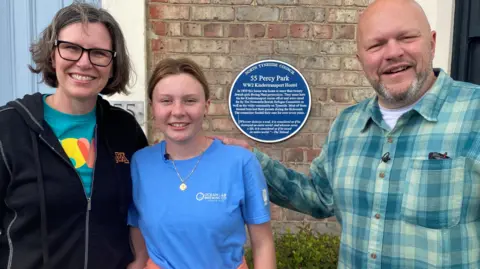
BBCIn 1939, Ilse Camis was among a group of girls given refuge from the Holocaust by a Jewish community in the north-east of England. Nearly nine decades on, her American grandson and great-granddaughter have travelled 4,000 miles to pay homage to the strangers who gave her sanctuary.
Luciana Camis, from Kansas in the United States, is standing in one of the bedrooms of 55 Percy Park in Tynemouth, one of a row of Georgian houses in a terrace which sweeps graciously down to the North Sea.
"It's pretty crazy," the 13-year-old says. "I never thought I would come here and see the room where my great-grandma slept in when she was, like, 13."
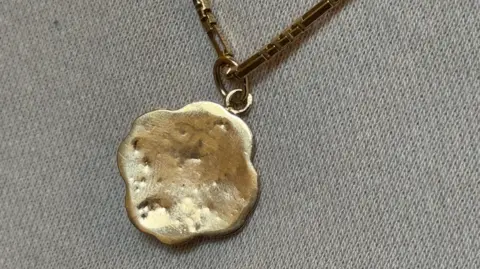
As she talks, Luciana fingers a gold pendant she has on a chain around her neck.
"She wore this when she was traveling," she explains. "It has the national flower of Austria on it and when she was nervous she would bite on it, so her teeth marks are on the back."
Luciana's great-grandmother was one of approximately 10,000 children who escaped Nazi Germany and came to the UK mostly by train on what was known as the Kindertransport.
There were strict conditions, though, and adults were not allowed to accompany them.
Ilse's father had died when she was very young and her mother worked away, so she was largely raised by her grandparents in Vienna. When Hitler's troops arrived in March 1938 her family put her forward for evacuation. She never saw her grandparents again.
 Jason Camis
Like many Holocaust survivors, Ilse rarely spoke about her early years of loss and trauma. But, in a 1996 USC Shoah Foundation interview, she described how she had been taken to Vienna train station by her uncle.
"My grandmother just couldn't face taking me and parting with me," Ilse had said. "But I do remember seeing her behind the pillar at the train station and she watched me get on the train.
"That is not a memory I will ever forget."
 Jason Camis
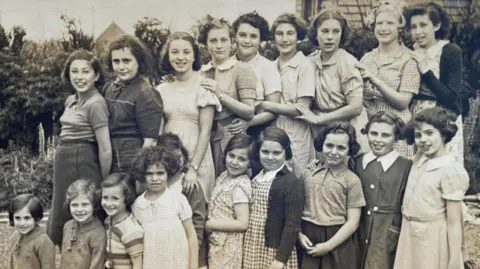
Faced with the arrival of dozens of children on Tyneside, a committee was formed to try to help, led by jeweller David Summerfield and his wife Annie, and a home was found for them at Percy Park in a house owned by one of the community.
Jason Camis admits to "emotion and tears" when he saw where his grandmother had lived.
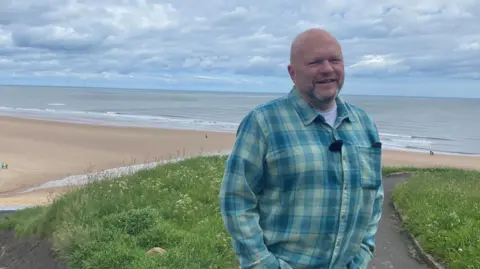
He had been walking, he says, on the long sweep of Longsands beach and thinking "Wow, almost 100 years - 90 years - ago, this is where Grandma ended up".
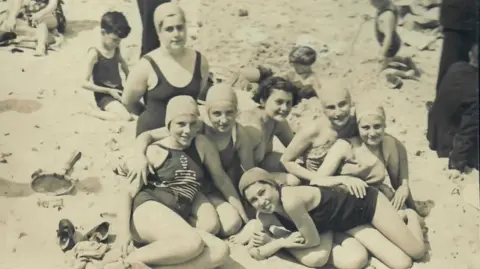
The family still has pictures of his grandmother and her friends having fun on the beach, he says.
"The town here took care of them and made it possible for them to have a life."
 Jason Camis
After war broke out, the entire household of more than twenty girls and two matrons moved to Windermere in Cumbria's Lake District, where they were to spend the next six years.
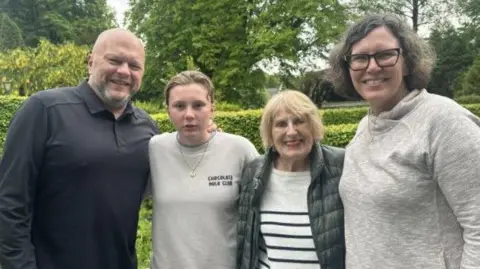
Joan Carus, who lives not far from the rented house they moved to - a Victorian villa called Southwood, offered to show the Camis family some of the places Ilse lived and worked. This included a shop which used to be the branch of Boots she was employed in as a teenager and a house where she was eventually reunited with her mother.
The area is well-known for hosting 300 children - mostly boys who had survived the concentration camps - but the arrival in Windermere of this group of Jewish girls five years beforehand is a less familiar story.
Trevor Avery, who runs the Lake District Holocaust Project, says the girls "set the scene" for the arrival in August 1945 of the children who had been in the camps.
"Windermere already had a lot of experience with the Jewish community through these girls," he says.
Visits like the one made by the Camis family are not unusual because often grandparents do not speak of their experiences and so the next generations come themselves to "walk in their footsteps", he says.
"We try to piece together what we can from what we know of their mothers' and their fathers' lives to help them on their way to begin to understand what went on."
 Dayve Ward / Photography by Ward
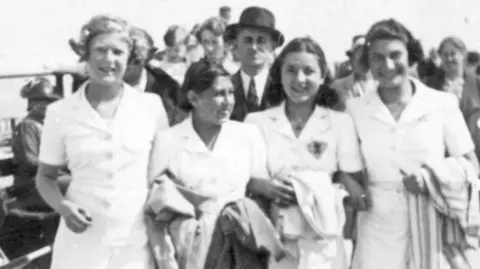
One of two matrons charged with looking after the girls was Paula Sieber, and her granddaughter Vivien says the girls were treated with "enormous generosity" by the people of Windermere, including being given free trips to the cinema.
"There wasn't that much food, and yet people came with root vegetables and things like that, that was off rationing for them," she says.
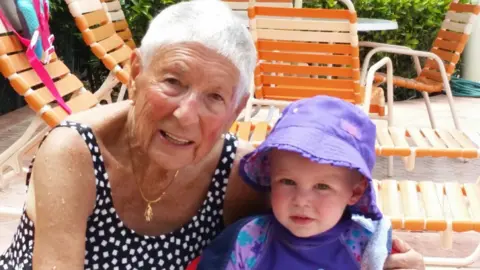
After the war, some girls moved to other countries but most stayed in the UK. Ilse Gross, as she was then, got a job as a librarian in Windermere before becoming a flight mechanic with the RAF and meeting her husband, a British man called Ernie Camis. The pair later settled in the US where Ilse worked as a dental nurse.
 BBC/Jane Fellner
Jason Camis says his grandmother was not bitter about what had happened to her.
She would say "you do what you need to do, because lots of people have it way worse than you", he says. "That's a lesson that we learned in our family from a very young age."
He also recognises what it must have taken for her grandparents to put Ilse on the train. "When I look at my 13-year-old daughter, I can't imagine ever having to make that decision, the one her grandparents had to make to send her here," he says.
He hopes his and his daughter's visit to the UK will "plant seeds" for her, as she wants to learn more.
"My grandmother was just shy of 13 when she came on the Kindertransport, obviously the defining moment of her life, and it saved her of course," he says.
"The fact is, we exist because of the kindness of strangers 87 years ago."
