How a Troubles ruling could impact court's definition of a woman

 Getty Images
A recent ruling by the Supreme Court has made it harder to use Northern Ireland's Brexit deal to bring human rights challenges against the government.
The case concerned the last Conservative government's plan to allow immunity for some Troubles-related crimes.
The Labour government dropped that plan, but still wanted the court to clarify the scope of the human rights aspect of the Brexit deal. The government won a partial victory which could have a much wider impact.
It is likely to be significant in deciding whether the 2025 Supreme Court ruling on the definition of a woman applies in Northern Ireland in the way it does in the rest of the UK.
What has the NI Brexit deal got to do with human rights?
The deal, known as the Windsor Framework, is mostly about trade but also includes an important human rights element.
Article 2 of the framework commits the UK not to water down human rights provisions, underpinned by EU law, that flow from the Good Friday Agreement.
It means a citizen's rights in NI which are derived from EU law should not be diminished as a result of the UK's withdrawal from the EU.
Since Article 2 came into effect in 2021 it has featured in Northern Ireland court cases tackling some of the most controversial areas of public policy: abortion, immigration and the legacy of the Troubles.
What has its impact been?
It has been significant, particularly since 2024 when the High Court in Belfast ruled Article 2 has "direct effect".
That means that individuals can use Article 2 in the UK courts to challenge and potentially dis-apply, or strike-down, UK laws.
Without direct effect, the courts could only issue a "Declaration of Incompatibility", which is essentially a note to MPs warning that the UK is in breach of its international obligations.
In 2024 the NI courts ruled that Article 2 could be used to dis-apply two significant UK government policies.
It looked as though Northern Ireland was starting to develop a significantly different human rights landscape from the rest of the UK.
What did the Supreme Court decide in May?
It has put stricter limits on the circumstances in which an Article 2 challenge is likely to succeed.
The legal scholar Prof Colin Murray says the court has "radically narrowed" the range of cases in which Article 2 can be applied.
Central to the court's ruling was its view that the human rights provisions of the Good Friday Agreement are generally too vague to give rise to directly enforceable rights in most circumstances.
For example it notes that the agreement refers to "the suffering of the victims of violence and to their right to remember and to contribute to a changed society".
But it adds that such language is "far too general to give rise to any directly enforceable rights in relation to inquests, civil proceedings or prosecutions".
It says that to succeed a challenge would need to "identify a clear and precise obligation in EU law".
Prof Christopher McCrudden, a human rights expert at Queens University, has emphasised that the government did not succeed in its principal aim.
"The government clearly wanted to render Article 2 effectively unenforceable. That attempt has now failed and that has major constitutional implications," he told the BBC.
"It means that in those cases which do satisfy the criteria, primary legislation and government decisions are challengeable directly."
What sorts of cases might still succeed?
The Supreme Court draws attention to part of the Windsor Framework (Annex 1) which explicitly lists six EU laws which remain in effect in Northern Ireland.
These all concern the prevention of sexual or racial discrimination in areas like employment and access to services.
"In a nutshell, anything that's not in the Annex 1 directives, the court is basically saying we're not interested in hearing that," Prof Murray told the BBC.
"I don't think any lower courts, so any Belfast courts, are going to depart from the position that the UK Supreme Court is asserting."
That view is shared by the Traditional Unionist Voice MP Jim Allister, who said the Belfast courts had "been put back in their boxes".
"This judgement is very clear, and thankfully though so in setting strict parameters to Article 2."
Prof McCrudden disagrees and said a close reading of the judgement allows for a wider range of cases.
This is because the court ruled that Article 2 is capable of direct effect where, before Brexit, EU law operated within the ambit of eight rights in the Good Friday Agreement, laid out as a list of bullet points.
These rights include, but go significantly beyond, issues of discrimination.
"The question then becomes how far that extends," he added.
He acknowledges this is complicated as the Supreme Court suggests these "bullet point rights" may only come into play in relation to Troubles issues, but this part of the judgement is only advisory.
"If subsequent courts say: 'Yes they all have to read as only relating to the sectarian conflict' then that would be a significant limitation. That can't be right."
What are the implications for the legal definition of a woman in Northern Ireland?
The Scottish government had asserted that transgender people with a gender recognition certificate (GRC) were entitled to the same sex-based protections as biological women.
NI has different equalities laws from the rest of the UK so the NI Equality Commission is seeking a High Court ruling on how that Supreme Court ruling should be interpreted.
It is specifically asking for the court to rule on the impact of the Windsor Framework, as this was not considered in the original Supreme Court judgement.
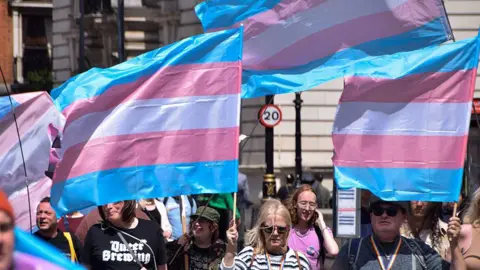
Allister thinks the strict parameters set by the Supreme Court mean anyone trying to convince the courts that Northern Ireland can take a different path on trans rights will face "great difficulties".
 Getty Images
However Prof Murray argues that while legacy cases might fail the new test, the trans rights case is fought on entirely different legal terrain.
He said that because it deals with sex and gender, it sits firmly within the specific EU anti-discrimination laws protected by Annex 1.
The Equality Commission said: "As part of our application to the court, to clarify how the judgment in 'For Women Scotland' should be applied in Northern Ireland, we stressed that this matter should be held until the Supreme Court handed down its judgment in 'Dillon and others' (the legacy case.)
"This is a detailed judgment, and the Commission will take time to consider its implications in relation to our remit."
The case may be discussed in the High Court in just a few weeks time.
What started as a legal battle over how Northern Ireland deals with its past has now become the blueprint for how it decides its future on human rights.
