'It'll be really sad if they disappear' - Are seaside donkey rides doomed?

 Getty Images
What does a trip to the seaside mean to you? Sun, sand, splashing in the waves? Candyfloss and amusement arcades?
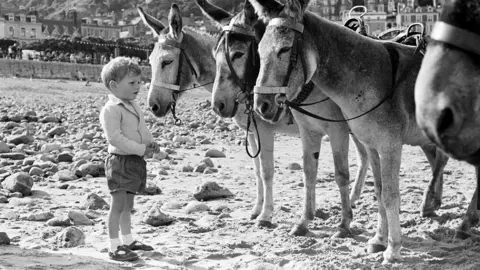
Once upon a time, the answer would have included a ride on the back of a donkey.
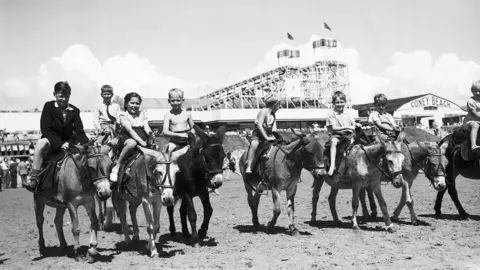
But earlier this month, Bridgend council banned all animals from Porthcawl's Coney Beach, meaning the operator of donkey walks - a fixture in the town for 100 years - could no longer get a licence.
From Barry and Aberavon in the south, to Tenby and Borth in the west and Llandudno and Rhyl in the north, Wales most popular seaside resorts all once had resident donkeys plodding up and down the sands in the spring and summer - weather permitting, this is Wales.
But is that now looking like a bygone era?
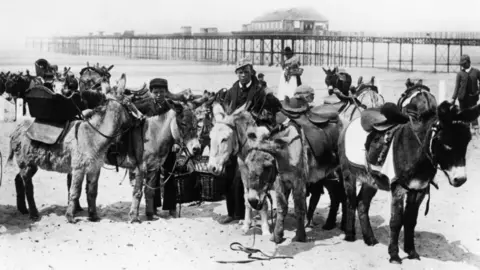
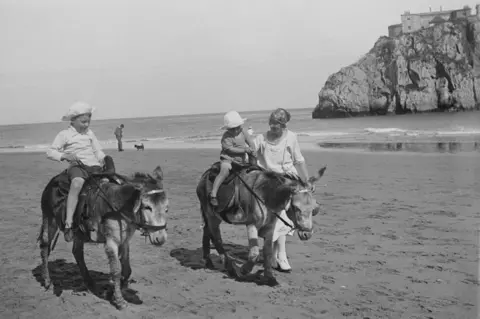
Paintings and photographs dating back to the 19th Century show adults and children alike enjoying a spin on the back of one of these sturdy beasts of burden.
According to one retired operator, the heyday of the donkeys was the 1960s and '70s, before cheap foreign holidays to Mediterranean coasts slashed the numbers of summer holidaymakers to UK resorts.
But a few are still carrying on.
 Getty Images
Ceredigion council said it had only issued one licence to operate donkey or pony rides in the county - from Aberystwyth promenade - while Denbighshire has none.
In neighbouring Gwynedd, Stephen Staff is the sole licensed operator, according to the council.
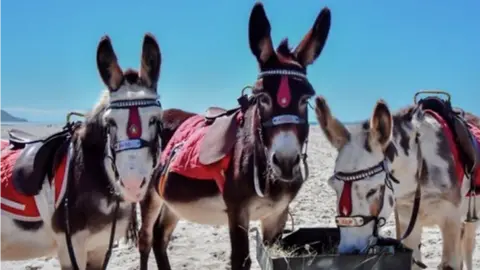
His herd of donkeys are on the beach at Barmouth at the Easter, Whitsun and summer holidays and every weekend up to the end of September, and have been for the past 40 years.
Unlike some operators, who pass down the tradition from generation to generation, Stephen had no background in equine husbandry when he started out, but had realised he did not want to work indoors.
But after a gap of a few years when the previous operator finished, he "thought I'd give it a go".
People don't always realise they can be taking on a near-lifetime commitment, he said, as a donkey foal can live for up to 50 years.
 Stephen Staff
Stephen has 11 donkeys, with six on the beach at any one time, and they work from 11:00-15:45 on days with the right weather.
In the heat, the donkeys are covered by a shade, with plenty of fresh water to keep them cool, and when at home they live in a "huge shed" or out at pasture.
He said the industry was "well-regulated by the local authority", with checks by a vet before the season begins each year.
They are not his only source of income.
"I have got other little attractions on the beach. They are still as popular as when I started [even though] I do have parents now saying they struggle to get kids off their phones and out of the car.
"But people come to the seaside to see traditional attractions. We have had customers who are now bringing their own grandkids to ride them."
But he is not confident the donkey rides will endure once his time comes to an end.
He said one woman who ran the donkey rides in Llandudno carried on into her mid-90s, but he has no intention of emulating her.
Now 64, he is not sure either of his sons will follow him into the business.
"I'd love to carry on but it all depends on your health. I spend three to four hours a day looking after them."
He thinks the cost might deter potential replacements: "You're looking at £10,000 a year in feed and other costs for the donkeys before you've got down and got your £4 for a ride.
"People look and say 'it's easy money, you've just earned £24 for six donkey rides', but there's so much behind it."
 Getty Images
Twelve miles down the coast is the little resort of Aberdyfi.
Full of second homes and holiday lets, it is a popular bolthole for visitors, with some families staying for the whole summer.
Louise Peeters was the beneficiary of those visitors for the 15 years she ran a beach donkey service.
Unlike Stephen, she did have prior experience, although it was horses rather than donkeys.
She decided to take over when the previous concession holder, who she said ran an "ad hoc" service, stopped operating.
"I started with two donkeys and it was very obvious over that Easter period that it was something people were really interested in," she said.
"Take-up was really good and I was well aware that my two donkeys are going to have no legs at the end of the season if I carry on in the way I was carrying on."
By the end of that season, she had six donkeys, meaning each pair would work one in three days.
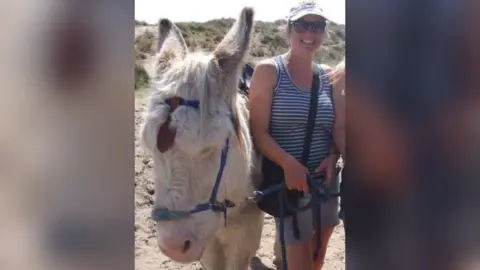 Louise Peeters
With a background in equine welfare, she saw part of her role there as educating people about donkeys.
Louise ended her operation in 2019 for two reasons: One was she didn't make a living out of it.
"It paid for me to have donkeys and a little bit more to feed and look after my two horses. [But] I was lucky enough to have additional source of income elsewhere," she said.
The other was from watching how people interacted with the donkeys - as a coach for Riding for the Disabled with a therapeutic background, she said she noticed the "profound" reaction children with additional needs had with the animals.
This led her to open up her farm for non-riding visits to see the donkeys and she trained as an equine assisted learning facilitator.
Eventually, doing both things was too much and, with the donkeys ageing, she decided to end the beach rides.
She thinks the tradition is largely on its way out "probably because commercially it's not viable".
"You've got to sustain them all year round, feed them all year... you've got your insurance and your vet bills."
She said it would be "really sad if beach donkeys disappear".
"It's that ability for people to access large animals in a safe environment. And donkeys are really easy to be accessible.
"They've definitely got a place. It's very innocent fun and it's amazing the impact it has on kids."
 Getty Images
The question of whether donkeys have any place on a hot sandy beach today draws differing opinions.
In 2019, 40,000 people signed a petition calling for donkey rides on Coney Beach to be banned, citing concerns over heat.
Louise thinks, as the number of operators have fallen and regulations governing animal welfare have strengthened, the remaining operators are generally much better at caring for their animals.
The Donkey Sanctuary's head of welfare Hannah Bryer said that while the charity "does not encourage the use of donkeys in tourism, we recognise that donkey rides have long been a tradition and provided livelihoods in the UK".
She added that, as "intelligent, sensitive animals", any activity involving donkeys must always prioritise their welfare.
"This is why education and well-informed licensing is so important."
