It's been a Holyrood election of disputed claims - BBC Verify fact-checked them

 Getty Images
With just two days to go until the polls open, the claims and counter-claims made during the Holyrood election campaign are coming into sharp focus.
BBC Verify has been fact-checking the political parties and seen some questionable claims at the forefront of the debate.
The main parties' spending promises have been assessed in the context of what economic experts have warned will be a tough financial climate for whoever is in charge after 7 May.
And claims on everything from energy bills to the NHS have also been checked, and given more context where needed.
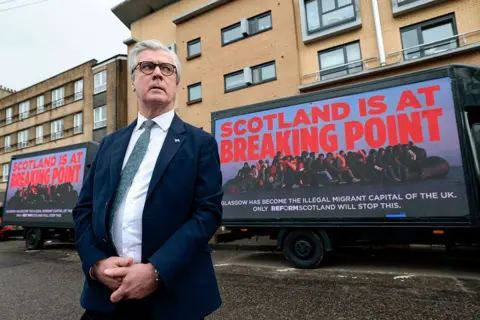
Reform link immigration with crime in Glasgow
Immigration is not directly a matter for the Scottish Parliament, but it has been one of the most contentious elements of the election campaign.
It has been a big issue for Reform UK and the party's Thomas Kerr issued a comment which appeared to link immigration with crime in Glasgow.
In it, he said: "Under the SNP we've seen our city become lawless with a rapid rise in rapes and sexual assaults - mass illegal migration is pushing Glasgow to breaking point and anarchy."
This follows the party's Scottish leader Malcolm Offord previously saying that police had been put under pressure by "a record number of strangers coming to Glasgow with different cultures and values to our own, making the city less safe for women and girls".
Looking at Glasgow, when the SNP took control of the council in 2017 the total crime rate was 901 per 10,000 people. This has since fallen to 829, according to Scottish government figures.
Last year, police recorded 800 sexual assault crimes in Glasgow and 494 crimes of rape and attempted rape.
Not all crimes will have happened in the same year they were reported - Police Scotland has said that across Scotland, 25% of sexual crimes reported in 2024/25 had occurred at least one year previously.
Overall, the sexual assault crime rate in Glasgow was 13 per 10,000 people last year, the same level as 2017/18, while the crime rate for rape and attempted rape was eight per 10,000 last year, up from six in 2017/18.
There is no way to prove or disprove a link between these figures and "illegal migration".
 Getty Images
The Scottish government does not publish data on the immigration status of offenders, and Police Scotland's crime reporting system also does not include a marker for asylum or immigration status.
BBC Verify has previously asked Reform for statistics to back up its claim and received no response.
You can read more about the claims made by political leaders about the impact of asylum and migration on housing here.
The SNP claims electricity bills could be reduced by one third if Scotland was independent
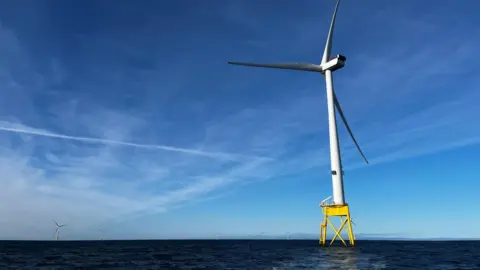
The SNP manifesto claims that the party could reduce household electricity bills by one third.
This relies on Scotland becoming independent, deciding its own energy policy and setting up its own electricity market, and is based on this SNP report.
Clearly there are a lot of hypotheticals involved depending on when Scotland became independent and how the new systems were designed, which means the level of any savings are highly uncertain.
The ownership of North Sea oil and gas was a key part of the 2014 Scottish independence referendum debate, and it's possible that the ownership of offshore wind generation would be contested by the Westminster government.
One of the key points is that the wholesale electricity price in the UK is often set by the price of gas, which the SNP claims would happen less often after independence because Scotland produces so much of its electricity from renewables.
But the UK government is also aiming to generate almost all of its electricity from low-carbon sources by 2030, which would begin to have a similar effect.
The plans also include saving money by not building any new nuclear power stations, although the SNP said there would be additional spending on power storage.
And there are also savings factored in from changing the way generators in remote areas are charged for energy transmission.
Since the launch of the SNP manifesto, the UK government has also announced a planned major shake-up in the way electricity is priced.
The Tories claim 1,000 jobs a month are being lost in the North Sea
The future of Scotland's oil and gas industry, and specifically how quickly the transition into renewables jobs will take, has featured heavily in the Holyrood campaign.
The Scottish Conservative leader Russell Findlay has been making the case for more drilling for oil and gas in the North Sea, claiming 1,000 jobs a month are currently being lost in the sector.
The figure comes from a forecast made by the Energy Transition Institute (ETI) - a think-tank based at Robert Gordon University in Aberdeen.
It has predicted that 1,000 North Sea oil and gas jobs will be lost every month until 2030.
We spoke to the ETI about this figure and they said they expected 600 to 800 oil and gas jobs a month to go.
The remainder - they told BBC Verify - would be "indirect" job losses, meaning people that benefit from the oil and gas industry indirectly such as taxi drivers and hospitality workers.
In all, 70,000 jobs have been lost over the last decade according to a report by the Scottish Affairs Committee.
That works out at 7,000 job losses a year or 583 a month.
Labour claims it can build 125,000 homes in five years
In its manifesto, Scottish Labour has set a goal of seeing 125,000 houses built in Scotland over the next Holyrood term.
This covers all categories across the public and private sector and works out as 25,000 houses in each year of the parliament.
Is this a realistic target?
House building has fallen, with 17,336 new homes completed in 2025 - down 13% on the previous year - and 14,999 homes started - down 6%.
Industry body Homes for Scotland says this is part of a "sustained downward trend", which is being exacerbated by "a chronic shortage of effective housing land".
The group said completions could fall to 5,000 per year by 2031 unless urgent action is taken to reform the planning system and address what it calls the "land supply crisis".
These kind of reforms might require changes to the law, which would take time to pass and then to implement.
So any party making big promises about housebuilding may have their work cut out when it comes to delivering.
The Lib Dems claim 800,000 Scots are on an NHS waiting list
During a special BBC TV debate, Scottish Liberal Democrat leader Alex Cole-Hamilton claimed that "800,000 Scots are currently on an NHS waiting list".
However, Public Health Scotland (PHS) says there is no single database for all patient data so it is not possible to definitively say how many people are on an NHS waiting list in Scotland.
In the PHS waiting list data a single patient could be on multiple waiting lists.
It estimates that 571,054 individuals - around one in 10 of Scotland's population - were on at least one new outpatient, inpatient or day‑case waiting list as of 31 March.
This also doesn't include all types of waiting lists, such as those for key diagnostic tests.
The number of long waits of over a year for a planned hospital appointment or procedure in Scotland has been falling since July.
But a target to eradicate long waits by the end of March was missed by the Scottish government.
More social care vacancies than school leavers, the Greens claim
In the same BBC Scotland debate, Scottish Greens co-leader Ross Greer called for more immigration "to meet the needs of this country".
He also claimed: "If every young person leaving school in Scotland today went to work in social care, there still wouldn't be enough care workers."
The party told BBC Verify that Greer was repeating a reference to a comment, said to have been made by Donald Macaskill, boss of the private care home trade body Scottish Care, about the scale of vacancies.
The number of Scottish school leavers in 2024-25 was 55,801 pupils.
An annual vacancies survey of care providers is jointly published by the Scottish Social Services Council and watchdog the Care Inspectorate.
The latest available one is for 2024 and suggests 44% of registered care services reported having staff vacancies, and that in nine of the 32 local authority areas, 50% or more services reported vacancies.
But the survey, which is published more than a year after it is gathered, does not provide numbers of social care vacancies.
The report does state that the vacancies are 6.4% of the total workforce on a whole-time equivalent basis.
Census and market data suggest the number of people working in the social care sector in 2024 was between 150,000 and 200,000.
This implies that the number of school leavers would be more than enough to fill those vacancies.

