Scotland's vape capital - what's behind the boom?
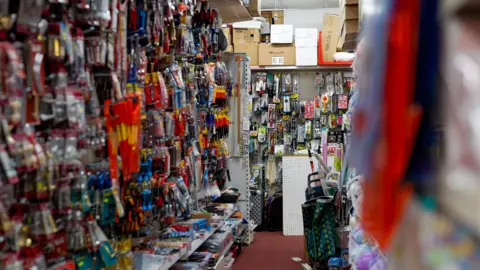
Sofy Saleem decided to shake up the stock in his Greenock hardware shop a couple of years ago.
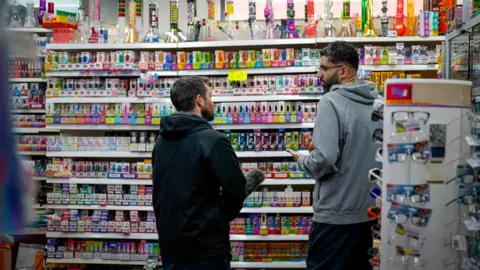
He still sells screws, nails and DIY products, but now he has a huge section dedicated to vaping.
Initially, it started out as one small corner, but grew and grew. Now the majority of his sales come from vapes.
It's all about "supply and demand", he said. He sees it as simply providing his customers with what they want.

And he was happy to admit "there's good money to be made" in moving towards vapes.
The vape section of his shop is a wall of colour which needs constant restocking. Flavours ranging from gummy bears to lemonade fill the shelves.
"This one flies out," he said, pointing at a strawberry vape.
Cigarettes have to stay out of sight, but with vapes he can display the "nice colours" which he explained is "attraction - it gets customers talking".
Sofy's business shift isn't unique. New figures from the University of Edinburgh, shared exclusively with BBC News, highlight the growth of outlets selling vapes in Scotland.
With no licensing regime, a retailer simply has to register on a Scottish government online portal and then they can stock these products.
In 2020, there were 5,573 shops selling vapes in Scotland. By 2024, that was up to 7,069 – an increase of 28%.
This growth of 1,500 outlets has not been even across the country. It's concentrated in the most deprived communities.
We visited Greenock because, according to the research, its town centre has the highest density of shops registered to sell vapes per head of population in Scotland - by quite some distance.
It's also the most deprived part of the country.
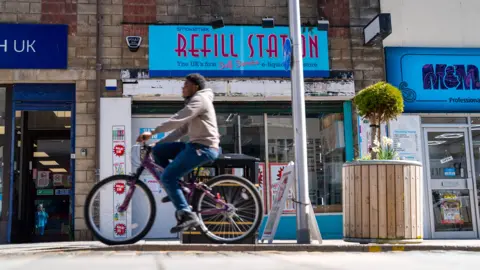
A short walk up one of the main streets makes it obvious that vaping is big business here.

We counted at least 20 outlets selling e-cigarettes within the town centre. And that's not including the nearby prison, which is also registered to sell vapes.
Some shops are dedicated solely to vaping. Other shops – such as phone repair outlets and convenience stores – have also decided to stock them.
It's a change in retail focus that doesn't seem to be particularly popular locally.
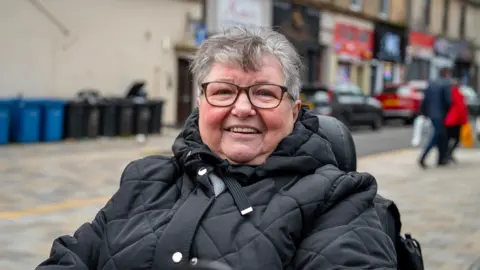
Edna Thornton is "born and bred" Greenock. She used to work behind the bar in the local football team's social club.
But her current assessment of the area is somewhat scathing: "This used to be a lovely town. But it's rubbish now".
Cruise ships regularly dock in Greenock, but a common complaint we hear is that the passengers get straight onto buses for Glasgow or Edinburgh.
"There's no shops for them to shop in apart from vape shops, second-hand clothes shops, and that's about it," Edna said.
David Miller, who vapes himself, is more sympathetic about the changes he has seen.
The builder concedes there are probably too many shops selling vapes, but said "you'd rather have something than nothing".
He added: "If it wasn't for vape shops opening what sort of shops would open? Look at how many shops are just sitting empty.
"Would you rather have a high street that's just empty shops?"
But the majority of people we spoke to felt the prevalence was too high.
Even two shop owners who were selling vapes said that too many outlets in Greenock were going down this route.
Many residents also expressed concern about the recent fire at central station in Glasgow, which started in a vape shop. An investigation into the cause of that incident is ongoing.
Prof Jamie Pearce led the research at the University of Edinburgh that has tracked the growth in Scottish outlets.
He said the rise had been "rapid" in recent years, and was concerned by a pattern emerging.
"Neighbourhoods that have high levels of deprivation seem to have a particularly high number of vape retailers, and they've been increasing," he said.
He put this down to big numbers of people using the product, combined with a particular concentration of convenience stores.
This means there are profits to be made in these communities.

Research by the University of Edinburgh suggested that in September 2022, the average profit margin for vapes was about 37%, compared with 8.5% for tobacco.
Pearce warned that the increase in availability could normalise vaping - though the vaping industry points out that research says it is less harmful than smoking.
He said it could well be seen as a positive if existing smokers were changing habits. But he is particularly concerned that more outlets will lead to more children taking up the habit.
And he warned that we still don't fully understand the long-term health implications of vaping.
"I think we need to be very concerned because of the unknown damage this could be doing to children's health," he said.
The academic said a licensing regime – similar to the sale of alcohol - could result in positive health benefits, including being able to cap the number of outlets in a certain area.
Some vape retailers echo his views. Richard Begg works for VPZ, who have about 200 shops across the UK.
We met him at the firm's Kilmarnock branch. The high street there is similar to Greenock's, with a high number of shops selling e-cigarettes.
He said youth vaping had reached a "crisis" point, and that many products available on the high street were low quality.
"[These shops] would never get away with selling alcohol, so why are vapes allowed to be sold everywhere?," he said.
'It's absolutely a cash cow'
Single-use vapes were banned across the UK last year, but Richard said the availability of cheap products – which are technically refillable and rechargeable – meant that consumers just threw them away and bought new ones.
He shared the view that the growth in vape retailers was ultimately down to one factor – money.
"You go and spend a couple of thousand pounds and you double, or triple, your money. It's absolutely a cash cow," he said.
Legislation recently passed by MPs resulted in the tightening up of the rules around vaping.
There are policies being proposed for Scotland as part of the ongoing election which could result in changes.
It is also possible that we reach saturation point in the near future, where there are not enough people vaping for more shops to keep opening.
But the recent trend is clear. More and more retailers are turning to vapes – which remain a straightforward and profitable product to sell.
As these outlets grow, so do the voices sounding the alarm about what this could mean for health and inequality.
Data visualisation and additional reporting by Andrew Picken

