The city caught in the middle of the big energy shift debate


 BBC
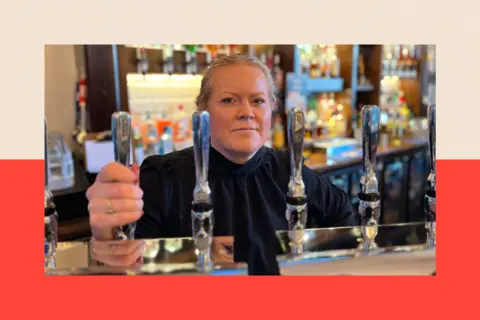
BBCWhen Iona Macdonald graduated from Aberdeen University in 2000 with a degree in chemistry, there was only one show in town. Iona recalls that she "inevitably slid into the oil and gas industry" where, like thousands of others, she built a successful and lucrative career.
Back then, the sector was swimming in money, she remembers. "You would see a lot of Ferraris and Lamborghinis," says Macdonald of Aberdeen at the time.
But after a quarter of a century, that journey - working both on and offshore as a production chemist and later a training manager - came to an abrupt halt when she was made redundant two years ago.
Having tried and failed to secure employment in the renewable energy sector, the 48-year-old is now working on the minimum wage in a Glasgow pub. Iona enjoys the job and finds being part of the community worthwhile - but she's conscious she's not using any of her skills and experience. And she says she isn't alone: "I have friends who've gone from six-figure salaries to stacking shelves in a supermarket overnight."
Iona adds: "It's been quite the struggle to transition out of what's a very heavily specialised technical industry."
The transition from oil and gas jobs into renewables jobs has been on the lips of many politicians in recent years - including during the current Holyrood election campaign.
Specifically, the talk has been of a "just transition" at the heart of the energy policy - the idea of a smooth and equitable shift of labour from dirty old oil to a bright green future.
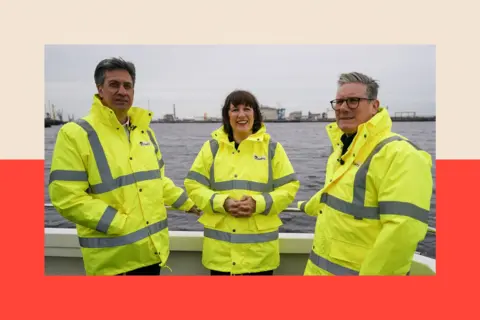
UK Energy Secretary Ed Miliband presents this as both a moral and practical duty, repeating warnings from climate scientists that burning every last drop of oil will accelerate catastrophic global warming.
"Our position is rooted in a plan for a just transition and a fair-minded analysis of what the science demands", he insisted in a speech on 21 April.
But Iona says she has not experienced a just transition. Nor, she says, have thousands of other workers in the industry.
So what has gone wrong for her and others? Are Scotland and the UK fumbling the shift away from oil and gas jobs? And, if so, what does that mean for places like Aberdeen, the wider economy and even the future of the UK itself?
Silver darlings and black gold
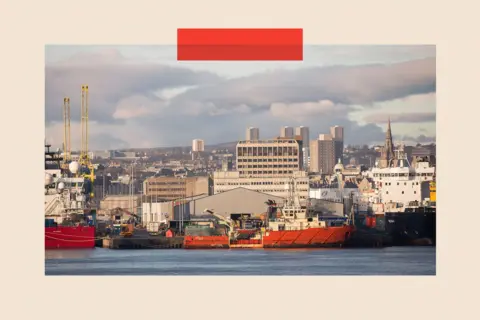
Aberdeen has always looked to the sea, from medieval trade with Scandinavia to landing and processing millions of barrels of herring during the 19th and 20th Centuries.
The "silver darlings", as they were known, brought wealth but it was the discovery of black gold in 1969 which transformed the city and the nation.
"The nightlife was very vibrant," recalls Iona of her time in the industry there three decades on. "There was a lot of drinking and eating and partying."
 Bloomberg via Getty Images
Extracting oil and gas could be dirty and dangerous but huge profits drove up wages, property prices and the standard of living in north-east Scotland.
There were busts as well as booms - oil has always been a volatile commodity - but on the whole Aberdeen prospered, with the Granite City acquiring a new nickname: Europe's oil capital.
We now know that North Sea production peaked just as the young chemist was embarking on her career, reaching 4.5 million barrels of oil (or equivalent) per day (BOE) in 1999.
Today's North Sea is what geologists call a mature and declining basin. Production in 2024 was just over one million BOE.
Green energy, by contrast, is still relatively young.
The UK Labour government says "homegrown renewables" - that is, domestically generated energy and heat from sources like wind and solar - have gone from generating around 7% of electricity in 2010 to more than 50% today.
But the road to that point has been a rocky one.
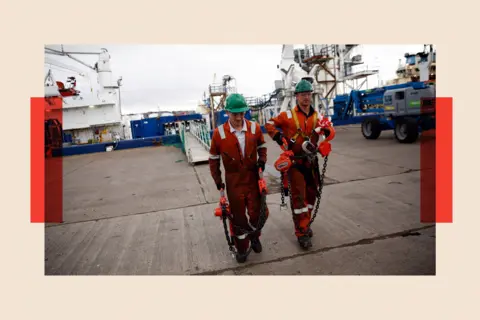
Over the past decade, the UK's oil and gas workforce, about half of which is based in Scotland, has fallen by 70,000 to 115,000, according to Paul de Leeuw, director of the Energy Transition Institute at Robert Gordon University.
In the same period, he adds, only 39,000 posts have been created in renewables.
He says fiscal instability, with "five tax changes in four years", has damaged confidence in the UK North Sea, with many investors shifting their money elsewhere, including to Norway.
Industry leaders have been lobbying the Chancellor Rachel Reeves to move to a system under which windfall taxes only apply when the oil price is above a certain threshold.
"Oil and gas is declining faster than many of us were expecting, but the renewables industry is simply not ready to take all the jobs," says de Leeuw, who predicts that between 600 and 800 posts will be lost in oil and gas every month for the next five or 10 years.
With around a quarter of all the UK's energy jobs based in north-east Scotland, the net loss has, in turn, already harmed builders, taxi drivers, lawyers, accountants and hospitality staff in the region, says Russell Borthwick of Aberdeen and Grampian Chamber of Commerce.
As well as changes to oil and gas taxation, he wants to see measures to encourage the further growth of renewables, such as upgrading the UK's electricity grid and speeding up planning for windfarms.
"We need to build a bridge from the old North Sea to the new North Sea," argues Borthwick.
But doing that will require significant societal change, says Dr Ewan Gibbs, an expert in energy policy at Glasgow University.

If we want to move towards renewables, he says, we need to be getting rid of petrol-powered cars and gas-fired heating systems far more rapidly.
And so far, he says, "the transition hasn't happened, not just in terms of jobs, but actually in terms of the electrification of the British and Scottish economy".
Net zero under attack
But there are still some powerful supporters of fossil fuels who scoff at the very idea of a transition to greener power. Indeed, critics of Scotland's shift to renewables go all the way up to the White House.
In a social media post on 14 April, US President Donald Trump urged the UK to "DRILL, BABY, DRILL!!!", adding: "AND, NO MORE WINDMILLS!"
"Europe is desperate for Energy, and yet the United Kingdom refuses to open North Sea Oil, one of the greatest fields in the World. Tragic!!! Aberdeen should be booming," wrote the US president.
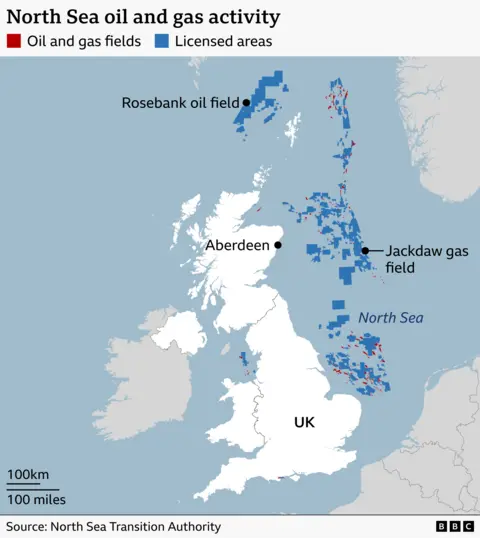
That sounded like an attempt to pressure the UK Labour government to approve both the Jackdaw gas field, east of Aberdeen, and Rosebank, the largest untapped oil field in British waters, which sits off the Shetland Isles in the North Atlantic.
Nigel Farage's Reform UK party agrees with Trump and is campaigning for the 7 May Scottish parliament election on a platform of maximising domestic fossil fuel production.
"Shutting down North Sea oil and gas is the biggest act of self-harm," says the party's Scottish leader Malcolm Offord, who promises, if elected, to "reverse the madness of net zero".
Net zero is the point at which a country, company or other entity is removing from the atmosphere as much planet-warming greenhouse gases as it is adding.
Both the Scottish National Party and Scottish Labour support a net zero target for Scotland of 2045.
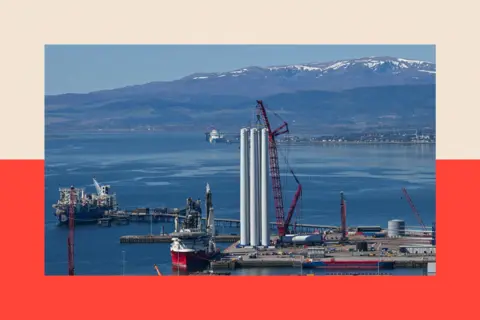
Anas Sarwar, the Scottish Labour leader, says oil and gas will have a role to play "for decades to come" but there needs to be more investment in renewables and in new nuclear power, which the SNP opposes as expensive and potentially environmentally damaging.
 AFP via Getty Images
The Scottish Conservatives used to support the 2045 net zero target but have since changed their minds.
"What we have to do is have a just, affordable transition," says Scottish Tory leader Russell Findlay.
"You can't just turn off the taps and expect these jobs to appear magically in renewables."
The Scottish Liberal Democrats are calling for investment in green energy, nuclear power and the grid, but they also argue that Rosebank and Jackdaw should be approved "if it makes more environmental sense" than relying on imported fossil fuels, a process which could generate even higher levels of greenhouse gases.
With ongoing conflict in the Gulf, energy security is an issue.
"We still have massive reliance on oil and gas. We're still exposed to energy price shocks," says the party leader, Alex Cole-Hamilton.
The Scottish Green Party wants to see far greater urgency.
"We know that it's a declining basin in the North Sea," says co-leader Gillian Mackay.
"We should have been putting a just transition in place decades ago," she adds.
According to Glasgow University's Ewan Gibbs, recent conflict in the Middle East has altered the debate. "I think the immediate result of the war in Iran has been increased pressure to support new North Sea exploration and development," he says.
"On the other hand," he adds, "I think we are in a long-term downward trajectory [in terms of production] and really the debate is over how we manage that."
The Norway factor
That debate has played out at the top of the pro-independence Scottish National Party, which has run the devolved government in Edinburgh since 2007.
Oil is totemic for many in the nationalist movement who say it could have made an independent Scotland as wealthy as Switzerland. In October 1974, the slogan "It's Scotland's Oil" propelled the SNP to its best-ever general election result up until that point: 11 seats at Westminster on 30% of the Scottish vote.
And today many Scottish nationalists point to Norway's handling of its sector of the North Sea as evidence of how Scotland, with a similar population, could have thrived outside the UK.
In London, the Treasury collected billions in taxes on North Sea producers but largely left investment, development and ownership in private hands, especially after Margaret Thatcher became prime minister in 1979.
Oslo, in contrast, was far more interventionist, retaining control of most Norwegian production, and investing the returns in one of the world's largest and most profitable state‑owned investment funds (also known as sovereign wealth funds).
The result was that Norway got rich. Very rich. Last year the fund generated $247bn (£183bn) in profit, roughly three times the Scottish government's entire budget.
And the gulf between the two nations is widening.
Last year, for the first time since 1964, the UK did not begin drilling any exploration wells while 29 were started in the Norwegian sector of the North Sea.
 Getty Images
As SNP first ministers, both Nicola Sturgeon and Humza Yousaf, supported by the Scottish Greens, attempted to wean the nationalist movement off its support for crude, crafting a policy presumption against new drilling licences.
That was largely symbolic as the issuing of licences is a matter reserved to Westminster, along with offshore health and safety regulations and North Sea taxation.
Licensing of onshore infrastructure such as terminals and pipelines is devolved to the Scottish Parliament, while oversight of renewable energy is a complex mix of devolved and reserved powers.
When he took over as SNP leader and first minister in 2024, John Swinney softened his party's North Sea stance against approving new fields, suggesting that the UK government might consider doing so if they were compatible with the 2045 net zero target.
In recent weeks he has added that energy security should also be taken into account, although not to the extent of overriding climate compatibility assessments.
"The decline in oil and gas has happened at too fast a rate," says the SNP leader who, having joined the party in 1979, knows very well the crucial role that the North Sea has played in the rise of Scottish nationalism.
Nonetheless, the first minister appears to believe that Scotland's future prosperity lies in renewables.
More than half a century later, Swinney has adapted his party's 70s slogan to "It's Scotland's Energy," suggesting that an independent Scotland could now thrive thanks to abundant wind, wave and solar resources.
How mining's legacy looms large
The shadow of another fossil fuel is hanging over this debate - coal.
Scottish politicians are mindful of the economic, social and political calamity that accompanied the closure of coal mines under Thatcher.
All parties agree that they want to avoid such a fate, or in other words, they want to prevent an unjust transition.
And yet last year's closure of Scotland's only oil refinery at Grangemouth looks like another warning to both the UK and Scottish governments.
More than 400 jobs were lost directly at the refinery - which is owned by Petreoineos, a consortium of Petrochina and Sir Jim Ratcliffe's Ineos - while a supply chain employing an estimated 2,800 more workers was dislocated, says Gibbs. In February 2026 another 400 jobs were put at risk when production ended at ExxonMobil's Mossmorran chemical works in Fife, too.
 Bloomberg via Getty Images
"I've seen what's happened in Grangemouth, my hometown," Gillian Mackay of the Greens says. "It's decimating for these communities."
The closure "really did a lot of work to discredit the notion of a just transition", Gibbs believes.
"It's damaged the faith of workers, communities and trade unions in any hope for a future that uses the skills base that we have in our carbon-heavy engineering and manufacturing sectors to make a greener future."
A finite resource
The transition might not be working out for Iona Macdonald - but she has no intention of going back to the industry where she toiled for a quarter of a century.
It is now time to accelerate the move away from oil and gas, says Iona: "For most energy, we have clean alternatives and we don't need to be burning what is a finite resource."
In the meantime, she thinks the transition is being fumbled, leading to "a drain of all those skills and experience, which is a negative thing for the economy overall".
For all those politicians pronouncing on the so-called just transition, uttering political slogans is the easy bit but delivering real change will be much harder.
Additional reporting: Paul Ward
Top picture credit: Getty Images

BBC InDepth is the home on the website and app for the best analysis, with fresh perspectives that challenge assumptions and deep reporting on the biggest issues of the day. Emma Barnett and John Simpson bring their pick of the most thought-provoking deep reads and analysis, every Saturday.Sign up for the newsletter here
