'Pickleball means my wheelchair stays in the shed'

 Jamie Niblock/BBC
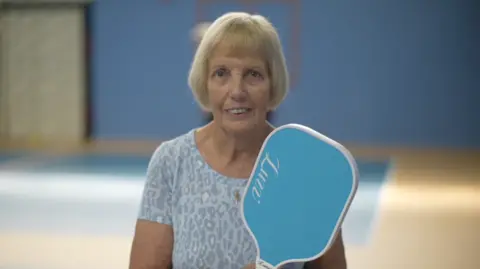
A woman who was "shattered" after receiving a Parkinson's diagnosis said her wheelchair was never coming out of the shed again after feeling the benefits of pickleball sessions for people with the condition.
After her diagnosis eight years ago, Gill Jeffrey relied on mobility aids. However, she said pickleball at Hingham Sports Centre, Norfolk, had helped her legs "tremendously".
It is recognised by Parkinson's UK and organisers believed the sessions helped people maintain mobility and stimulate their minds.
"It's helped tremendously. Now I'm not using a chair at all. I'm not using my sticks... I'm walking further, it's just brilliant and it helps me every day," said Jeffrey.
According to Parkinson's UK, about 166,000 people live with the progressive neurological condition.
There are more than 40 symptoms of the condition, including tremors, slowness of movement and rigidity, and three main forms of parkinsonism — idiopathic, vascular and drug-induced.
The free "Pickleball for Parkinson's" sessions have been running for 10 weeks with 16 people taking part.
 Getty Images
Before picking up a racquet, Jeffrey played bowls. However, she stopped playing after being unable to bend down to pick the ball up as the condition affected her legs.
After being diagnosed, she said she decided she "wanted to live" and not give up.
"It's helped my legs tremendously — that's really important to me," she said.
"[The] wheelchair is in the shed. It's staying there. I am never using it to go on holiday again or anywhere. I don't use the sticks."
While the charity said it was not possible to stop symptoms progressing, regular exercise was a "key element" of living with the condition.
While the condition can affect people differently, Dr Devendra Mahatme, a recently retired GP from Watton, said the sport not only helped people stay active, but gave them purpose.
"What we are seeing so far is people seem to be improving," he said.
"We don't know which part is benefitting them — whether it is the exercise, the wellbeing, socially and mixing or having a purpose to go to.
"Irrespective of that, what we are seeing is benefit and really we just want to keep going."
 Jamie Niblock/BBC
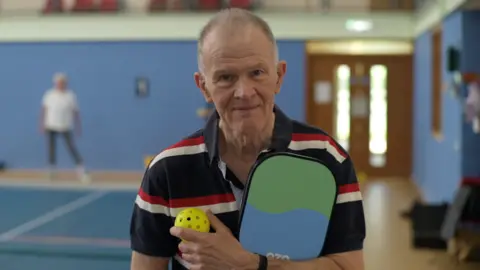
For Jonathan Burney, his Parkinson's diagnosis in 2016 came as a "shock".
While he has good days and bad days, he said through sport he had met "some really interesting people" and he would not have done so if he had stayed at home and "been grumpy about it".
He was only six weeks into his pickleball "career" and said that while it did not "keep the shakes away" it had helped with the rough periods.
"I used to play bat and ball on the beach for hours with my children on summer holidays. The great thing about pickleball is it's not that difficult," he said.
"You can get to a stage of competence after you've only played two or three games... it's a lot of fun as well.
"I would say it's a great game for people struggling with illness like Parkinson's."
The group was formed by Helen Grover who had heard reports of people with Parkinson's in the United States playing pickleball feeling "more energised, more mobile, more balanced and generally having a good overall feel".
"I hope it inspires other people. I believe we are the only people offering these sessions specifically for people with Parkinson's. I'd love for that to be expanded more widely across East Anglia," she said.
Do you have a story suggestion for Norfolk? Contact us below.
Follow Norfolk news on BBC Sounds, Facebook, Instagram and X.
