Hospital ranks top for clinical trial recruitment

 BBC
BBCThe biggest hospital in south-west England has more patients involved in clinical trials than any other in the country.
More than 45,000 patients at Derriford, in Plymouth, are enrolled in lifesaving research for conditions including Parkinson's disease, Huntington's disease and strokes, putting them at the top of the National Institute for Health and Care Research rankings.
The studies aim to discover better treatments and drugs while improving the quality of life for those involved.
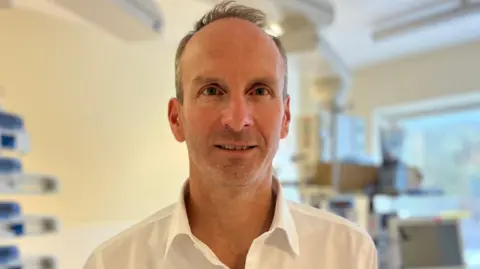
Prof Dan Martin, consultant in intensive care medicine at the hospital, said the volume of research would "improve overall care for all patients".
 John Houghton
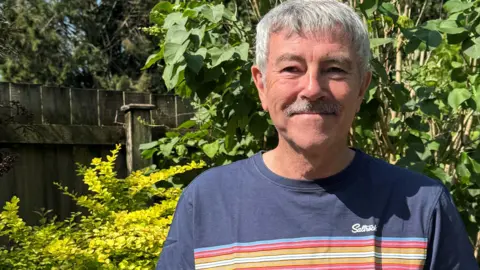
John Houghton, from Tavistock, has lived with Parkinson's for five years.
The fitness enthusiast first realised there was a problem when he began to have trouble with his right side during a Taekwondo training session.
Houghton was soon diagnosed with Parkinson's, a disease in which the brain becomes progressively damaged, but believes his condition has not worsened as much as expected thanks to a trial he has been part of at Derriford Hospital.
"The tremor in my right hand is slightly worse - that's to be expected," he said.
"But the control in my hand has got better and my right leg doesn't drag anymore.
"If that's all there is after four years - I'm smiling."
Income to the trust
Houghton is involved in testing a new drug for Parkinson's - one of several clinical trials overseen by the hospital's neurology team.
Dr Stephen Mullin, a consultant neurologist at the hospital and assistant professor at Peninsula Medical School, said the research will hopefully lead to treatments "which will either improve the symptoms or slow down the progression of the disease".
"It also brings income into the trust, money that has been put back into the clinical services that deliver the trials and that results in day-to-day improvements in clinical care," he added.
Lucy Wright from Newquay has Huntington's disease - an inherited genetic condition that affects the brain.
 Family handout
Her father and brother have also been diagnosed with the disease. Her dad's deterioration means he now needs full-time residential care.
The civil servant is hopeful her involvement in a trial at Derriford will mean she has a different outcome.
"I have to have a procedure called a lumbar puncture, 10 times over the year, then a couple of brain scans, and regular blood is taken," she said.
"But if it means we can slow down the disease or even improve things - it's more than worth it."
The figures for trials at Derriford are a 35% rise on the previous year after recruiting significantly more patients than any other organisation.
The research is also boosted by a series of local clinical trials in which scientific staff from Derriford run studies at the hospital.
Plus patient samples are processed by the laboratories at Derriford so as much research as possible is kept on site.
'Global recognition'
Martin has recently involved Derriford patients in the biggest intensive care trial in the world and he is now overseeing what happens locally.
The professor said: "We know in any institution which is delivering a high volume of research, overall the care becomes better for patients.
"And then there's the actual interventions themselves. Many of these will be lifesaving.
"The people receiving those treatments could arguably get a better or a more improved intervention sooner than would otherwise be available to them – and all here in Devon."
More than 200 studies are currently ongoing at Derriford, from neonatal research to world-first trials for various diseases.
The trust said it was leading to global recognition, allowing it to attract leading clinicians and more funding.
Experts believe the benefits of this work will also be seen beyond the hospital and into the community through job opportunities to better health.
The hope is to expand the trust's research further by giving all patients who come through the doors at Derriford the option to be part of a clinical trial.
