My 'fit and healthy' son's heart stopped for 15 minutes

 BBC
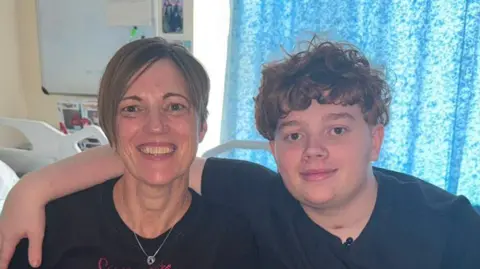
BBC"You don't think your fit and healthy 17-year-old son is going to have a cardiac arrest," said mum Melanie.
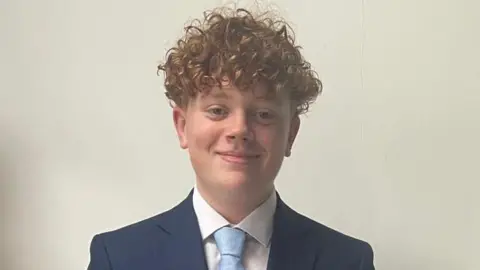
She found her son Flynn collapsed on his bedroom floor in the early hours of 2 April while he was studying for his A-levels.
Flynn's heart had stopped for 15 minutes, leaving his brain starved of oxygen, and caused brain damage that left him unable to walk and affected his sight.
Doctors said Flynn might never fully recover. But he is determined to get his life back, and he continues to undergo rehabilitation while hoping to return to sixth form.
It was discovered that Flynn had a fault which caused the signals making his heart beat to travel incorrectly.
He underwent a procedure to correct the problem with his heart and had an implanted defibrillator fitted to protect him if his heart was to stop again.
Melanie said she wanted to raise awareness of hidden heart defects in young people, which she called a "silent killer".
 Family handout
Melanie, from Sherwood in Nottingham, heard a loud bang before she found Flynn collapsed.
"I went into his bedroom and he was lying on the floor and I immediately, obviously, knew something was wrong," she said.
It was not until she called 999 and was asked if Flynn's chest was moving that she realised he was not breathing.
Melanie was guided by a call handler to perform CPR on her son until paramedics arrived.
"I just needed to keep him alive," Melanie said.
Paramedics resuscitated Flynn before he was taken to the Queen's Medical Centre, in Nottingham, and sedated by doctors.
"They found that he had hypoxic brain damage, which was devastating at the time, absolutely devastating. I was heartbroken," Melanie said.
 Family handout
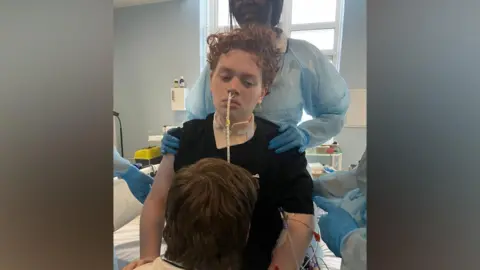
Coming out of sedation, Flynn remembered little about the night his heart stopped.
"I was just really confused. I didn't know what had happened, I couldn't speak at that time so I couldn't communicate with my mum and ask questions.
"It was difficult to try and understand what happened. I felt like I couldn't get across what I wanted to get across," he said.
Before the cardiac arrest, Flynn was studying biology, psychology and English literature at sixth form, spending time with friends and supporting his football team, West Ham United.
But after waking up in hospital, he could not see properly, was unable to walk and was initially unable to speak.
Melanie said: "He started slowly putting his thumb up and putting his thumb down.
"That was a huge day when the physio came in and said 'can you tell me if you can hear me?' and [Flynn] put his thumb up.
"For me that was huge because it meant that he was still in there and he could communicate."
 Family handout
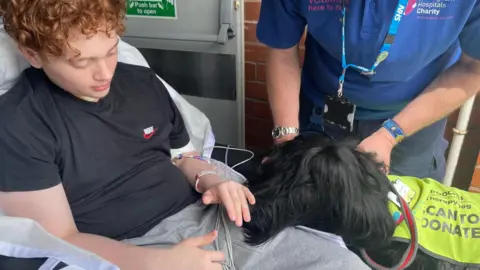
Flynn is now continuing rehabilitation at Nottingham City Hospital, where therapists say his progress has been "remarkable".
When he first arrived at the hospital, Flynn needed the support of several people to move his limbs and had temporarily lost his sight because of the brain injury.
He can now take part in everyday activities, including preparing food, and is working towards becoming more independent.
Flynn hopes to return to sixth form and eventually walk into the London Stadium to watch West Ham play.
His mum says his determination has driven his recovery.
"For Flynn, failure's not an option," she said.
Melanie said she hoped more young people would be screened for heart problems.
"For the sake of an ECG [electrocardiogram], they could spot so many things that could save people's lives, she said.
She said she also wanted more people to learn CPR and added that it gave her the confidence to act when her son needed her.
"You're probably going to have to do CPR on someone you know and love," she said.
"And you could save their life."
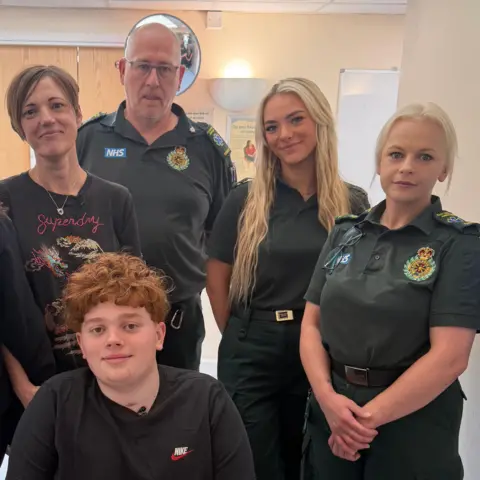
Months after the incident, Flynn and Melanie were reunited with some of the East Midlands Ambulance Service staff who helped save his life.
Melanie thanked the crew for "not giving up" on her son as they spent 15 minutes trying to resuscitate him.
Paramedic Jessica Czykita said: "We don't really get to reunite with patients especially in a situation like this.
"Flynn's the youngest cardiac arrest I've been to.
"I've got children who are a similar age, so it's quite emotional then seeing Melanie and seeing Flynn."
For Melanie, she said seeing the crew brought back memories of the night she thought she might lose her son.
She told the BBC: "Don't be scared to pick up the phone and dial 999. They saved my son's life."
Listen to BBC Radio Nottingham on Sounds and follow BBC Nottingham on Facebook, on X, or on Instagram. Send your story ideas to eastmidsnews@bbc.co.uk or via WhatsApp on 0808 100 2210.
