Live video help for 999 callers will run every day

 NIKKI FOX/BBC
A scheme offering live video support to 999 callers reporting a cardiac arrest will be extended for another year.
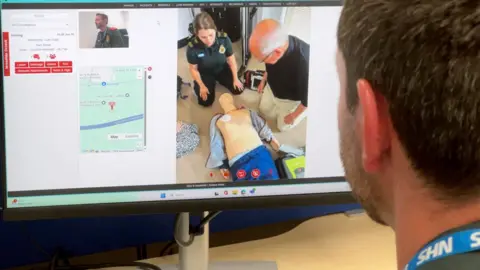
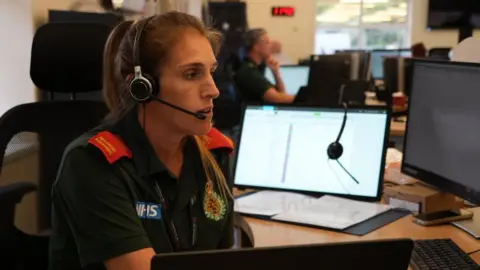
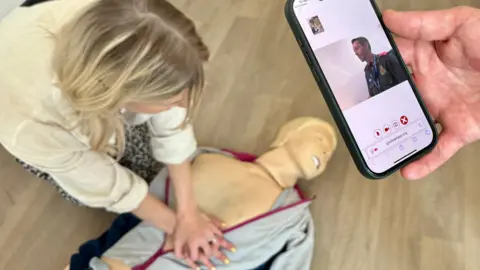
Since last summer, East of England Ambulance Service Trust (EEAST) control room staff and advanced paramedics trialled coaching callers on cardiopulmonary resuscitation (CPR) via a streaming platform.
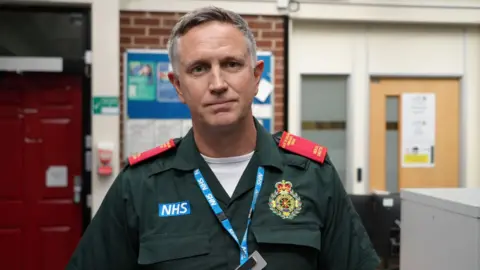
EEAST medical director Dr Simon Walsh said: "What's happening live through the video calls is making a real difference to the quality of chest compressions and the correct use of defibrillation."
Following the pilot, it will now be extended from four days a week to seven days.
Some 20 advanced paramedics have been trained to instruct people via their mobile phones on how best to resuscitate a patient.
Advanced paramedic Zoey Spurgeon works on the EEAST call desk. Speaking about a recent phone call, she said: "We were able to dial into the scene, improve CPR of the bystanders around the patient.
"We changed the defibrillator pads to the right position, and we managed to get a return of spontaneous circulation on scene prior to the ambulance crew."
She said being able to see the situation meant she could guide chest compression and improve hand positions, "so the patient's able to then have a cardiac shock in that position to get an effective outcome".
 Shaun Whitmore/BBC
 STEVE HUBBARD/BBC
During the initial six-month trial, paramedics carried out 280 video calls out of some 1,100 cases involving a suspected cardiac arrest.
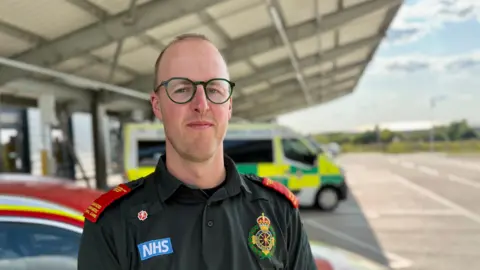
Liam Sagi, an EEAST advanced paramedic for the past 10 years, said: "What we have seen is that we've definitely got at least 10 people who have survived a cardiac arrest who've had a video call with us, and they've gone home neurologically intact, which is the really important thing."
Sagi said survival rates for cardiac arrests had not "really changed in 40 years" with only one in 10 people leaving hospital after a cardiac arrest.
"Those crucial minutes right at the beginning of the cardiac arrest really make the difference to whether someone does go home to their family," he added.
According to the National Institute for Health and Care Excellence, starting resuscitation immediately could quadruple the chances of survival.
 NIKKI FOX/BBC
"We're early days at this point, and ultimately, when we have enough data, we hope to be able to demonstrate improved survival for patients in cardiac arrest," Walsh said.
Appropriate video technology has been available for several years, but barriers to its use in the NHS included "consideration for privacy and the security of that data", Walsh added.
He said overcoming those considerations meant the ambulance trust was now the first in the UK to use video technology in this way.
It also meant ambulance crews could be deployed more efficiently across the counties served by the trust, namely Bedfordshire, Hertfordshire, Essex, Norfolk, Suffolk and Cambridgeshire.
 Shaun Whitmore/BBC
Follow East of England news on X, Instagram and Facebook: BBC Beds, Herts & Bucks, BBC Cambridgeshire, BBC Essex, BBC Norfolk, BBC Northamptonshire or BBC Suffolk.
