Two-tier policing needs to be taken seriously, Badenoch says

 PA/ Joe Giddens
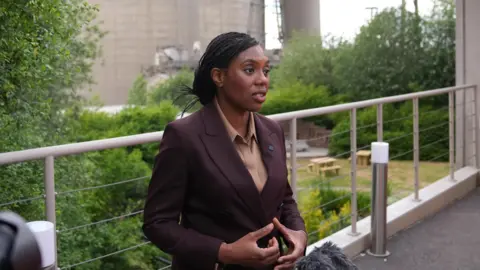
The Conservative Party leader Kemi Badenoch has told the BBC she disagrees with the Acting Chief Constable of West Midlands Police, after he said there was no two-tier policing in the West Midlands.
Scott Green's comments came in the wake of the murder of Henry Nowak, the 18-year-old student stabbed to death by 23-year old Vickrum Digwa in Southampton.
However, speaking to the BBC on a visit to the Cemex cement factory in Rugby, Warwickshire, Badenoch said: "Police don't set out to carry out two-tier policing, but that is what many people are experiencing and we need to take people's experiences seriously.
"It is quite clear that something is not right."
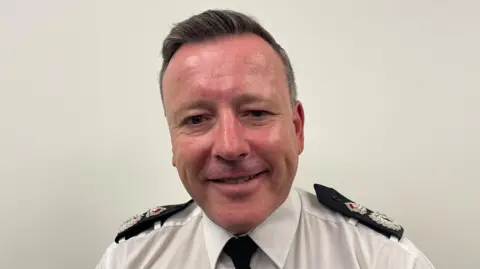
In an interview with BBC Radio WM, Green said he could only speak for his force and they tried to police "without fear or favour" but that it was difficult in what he said was a "more polarised society".
However, while on a visit to Rugby, the Conservative leader said: "We only need to look at that devastating bodycam footage of what happened to Henry [Nowak], where an allegation of a racial slur was treated more seriously than a stabbing."
 BBC/ Adam Pinder-Smith
She said many people in rural areas of England and Wales felt they got a two-tier service, even though their local police force would claim that is not the case.
Badenoch also said she had witnessed it in the treatment of pro-Palestinian protesters and Jewish protesters.
"I believe many of these issues come down to a lot of the guidance that's put out by the College of Policing or by the Police forces themselves. Let's look at how we fix it," she said.
"But if you don't accept that there is a problem, we can't fix the problem. And that's my issue with what the Acting Chief Constable has said."
Her comments came hours after Green told BBC Radio WM's Ed James that West Midlands Police, which covers Birmingham, the Black Country and Coventry, tries "every single day to simply police without fear or favour, to do the very best we can with the resources we have got to keep 2.9 million people safe."
High energy charges
The Conservative leader was in Rugby at the Cemex cement works, calling on the government to create a level playing field for UK industries that say they are not able to compete with their international rivals because of over-regulation.
Craig Williamson, from Cemex, said his industry was facing "significant" threats from high energy charges, employment costs and the increasing taxation on business.
"We're seeing more cement imports from Europe and outside Europe and it's a real threat to the investments we have here in the UK," he said.
"We're not asking for special treatment, we want fair energy pricing, we'd like burdens around employment costs reviewed and we'd like the net zero policies clarified quickly so it's water-tight and really effective."
Badenoch said: "We have put lots of onerous regulations on our companies, for good reasons - we want a sustainable environment. But other countries are polluting even more, we're sending jobs abroad and we're de-industrialising the UK."
She also said the Conservative party would bring down energy costs, scrap the carbon tax and drill oil and gas in the UK instead of importing it from Norway or Russia, which she said should be subject to sanctions.
The government has said it will expand its scheme to help energy-intensive manufacturers in the UK, expanding a programme that could cut bills by 25% from next April.
From 2027, eligible firms will be exempt from some electricity charges that finance the net-zero transition, worth about £35–£40 per MWh.
Qualifying businesses will also receive a one-off payment in 2027 that will cover the support they would have received if the British Industrial Competitiveness Scheme had been in place from April 2026, the government said.
Follow BBC Coventry & Warwickshire on BBC Sounds, Facebook, X and Instagram.
