Wife joins study to boost dementia carer support

 Sue Meese
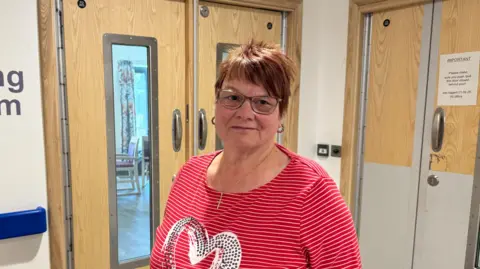
A woman who cares for her husband living with dementia has been taking part in a pioneering study to help improve support for carers.
Mick and Sue Meese have been married for 53 years, but life for the couple drastically changed in 2024 when he was diagnosed with the syndrome associated with an ongoing decline in brain functioning.
Up until then, he was fishing, gardening and making jokes, but now requires round-the-clock care at their home in Lower Gornal, Dudley.
"He was good until this hit, and this hit hard. He's not going to get better — they've told me that — and that's the hard part," Sue said.
Those with dementia may suffer from problems with memory loss, language and understanding, according to the NHS.
Recalling an occasion when her husband went missing, Meese added: "We'd lived by the woods for 40-odd years and he went over to the woods and I couldn't find him.
"He'd got a tracker with him and I could see where the tracker was in the street, but I couldn't see him. My son said to me, 'Mom, he's in the woods,' and it took us two hours to find him."
As she was struggling to cope with his care alone, Mick was admitted to Dorothy Pattison Hospital (DPH) in Walsall, which specialises in care for older adults with dementia and other mental health conditions.
She described his mood and behaviour as "unpredictable" and said it "can change dramatically".
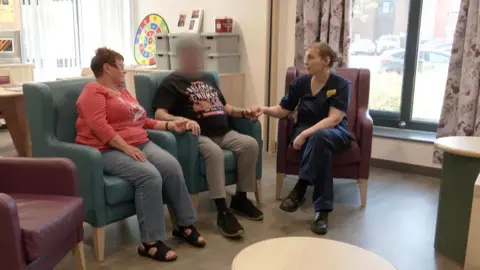
His wife tearfully added: "I came here the other day and, as I walked in, he told me to get help.
"He said he never wanted to see me again and he was really swearing at me. Today, he's lovely. What will he be like tomorrow? I don't know."
The hospital has been taking part in the Find Me (Family Interventions in Dementia Mental Health Environments) study conducted by the University of West London that aims to find ways to involve carers in a patient's treatment, and in turn offer more support for both.
'Life story book'
"The impact of dementia on families is profound and this research has really reinforced what we have always tried to do," said Dr Sharada Abilash, deputy chief medical officer at Black Country Healthcare NHS Trust.
"We want to learn from their experiences and keep improving,"
The trust covers patients across Wolverhampton, Walsall, Sandwell and Dudley.
Across the Black Country, there are more than 14,200 people living with dementia and one in three people will be touched by dementia in their lifetime as a carer, data collected by the Black Country Integrated Care Board show.
Dawn Brady, activity coordinator at DPH, added: "I spend a lot of time with families to get to know the patient. I find out what activities they like, their interests and their hobbies, and I also make a life story book with the help of the families.
"It helps everyone caring for that patient to get to know who they are and helps us provide the best care possible."
Follow BBC Birmingham on BBC Sounds, Facebook, X and Instagram.
