Nurses referred to regulator over attacks killer

 Nottinghamshire Police
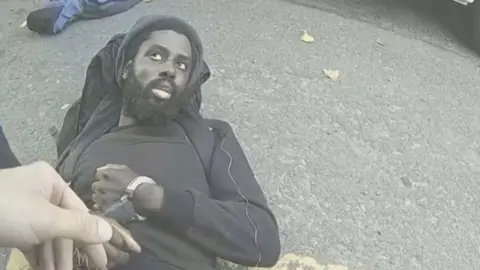
Three nurses have been referred to the nursing regulatory body in relation to Nottingham attacks killer Valdo Calocane, a public inquiry has heard.
Calocane, who was diagnosed with paranoid schizophrenia in 2020, killed students Barnaby Webber, Grace O'Malley-Kumar and grandfather Ian Coates on 13 June 2023.
Nottinghamshire Healthcare NHS Foundation Trust, which was responsible for Calocane's care between 2020 and 2022, has been giving evidence at a statutory public inquiry examining the attacks.
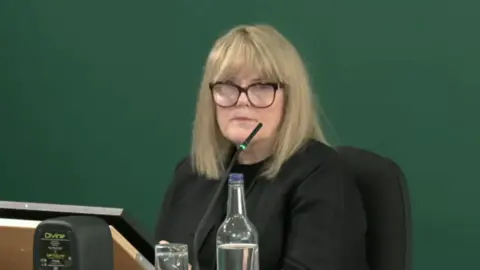
On Thursday, the trust's chief nurse, Diane Hull, told the inquiry the organisation had referred three nurses to the Nursing and Midwifery Council (NMC) in relation to Calocane's case.
Calocane, who also seriously injured Wayne Birkett, Sharon Miller and Marcin Gawronski on the day of the killings, had six Mental Health Act assessments, which led to four hospital admissions, between May 2020 and February 2022.
He was discharged in September 2022 due to a lack of engagement - a decision that has been scrutinised by the Nottingham Inquiry.
The inquiry has heard how problems with the risk assessment of patients and discharge processes were systemic in the years leading up to the attacks.
Hull joined the trust as chief nurse in July 2023, shortly after Calocane's attacks.
 The Nottingham Inquiry
The trust undertook its own investigation following the attacks, while it also became the subject of numerous expedited reviews by the Care Quality Commission and an independent review commissioned by NHS England, which found numerous failings in Calocane's care.
In Wednesday's evidence, the inquiry heard one doctor involved in Calocane's care had self-referred to the independent regulator, the General Medical Council (GMC), but was considered not to have met the criteria for referral. A second doctor had also been referred.
Addressing Hull on Thursday, counsel to the inquiry Rachel Langdale said: "Have any others, are you aware, been referred by the trust to the GMC?"
"I don't know about doctors, I can tell you about nurses," Hull replied.
She added: "Three people have been referred to the NMC. We regularly consult with the NMC.
"We've also committed... to do a further review of professional standards and practice following the inquiry as well."
 Supplied
Gary Carter, a former mental health nurse, who was part of the Early Intervention in Psychosis team which cared for Calocane, left the trust before an internal investigation into him had concluded, the inquiry heard previously.
In his evidence to the inquiry, he claimed Hull told him during a meeting "there's no way we could have predicted [the attacks] and there's no way we could have prevented it".
Hull said that she did not recall saying that.
She told the inquiry: "I don't remember those exact words. I know that what I would've said is that there is seldom a single point of failure, this will be systemic and there will be huge amounts of learning.
"And we accepted all of the learning from all of those reviews."
Langdale asked Hull: "Well do you think it was predictable or preventable?"
The chief nurse said: "I think it would be difficult, and I don't think I could say that the terrible events of June 13 2023 could have been prevented.
"But what I can say with absolutely clarity is that we failed to exhaust all of the options and all of the interventions available to us.
"And given the kind of things we've heard particularly through the inquiry, it does lead me to think that had we - at different points during his care and our contact points - had we and others taken different action it might have impacted the outcome."
Langdale said: "Well, very likely impacted the outcome, not 'might'."
Hull replied: "It may have."
The inquiry continues.
Listen to BBC Radio Nottingham on Sounds and follow BBC Nottingham on Facebook, on X, or on Instagram. Send your story ideas to eastmidsnews@bbc.co.uk or via WhatsApp on 0808 100 2210.
