NHS trust to reconsider disciplinaries over inquiry

 Reuters
An NHS trust will reconsider disciplinary action against medical staff who treated the Nottingham attacks killer in light of new evidence, a public inquiry has heard.
Valdo Calocane, who had paranoid schizophrenia, was discharged by Nottinghamshire Healthcare NHS Foundation Trust nine months before he killed three people and seriously injured three others on 13 June 2023.
The Nottingham Inquiry, which is examining the attacks, heard there had been no sanctions made against those who treated Calocane, despite admissions of "errors" in his care.
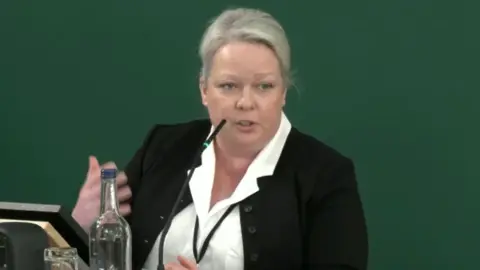
On Wednesday, the trust's executive medical director, Dr Susan Elcock, said a process was in place to reconsider clinicians' evidence to the inquiry.
Calocane was under the care of the NHS trust from May 2020 until September 2022, when he was discharged due to a lack of engagement.
Nine months later, he fatally stabbed students Barnaby Webber and Grace O'Malley-Kumar, and grandfather Ian Coates, before striking Wayne Birkett, Sharon Miller and Marcin Gawronski with a van.
He is currently serving an indefinite hospital order after pleading guilty to manslaughter on the grounds of diminished responsibility, and to attempted murder.
The inquiry has heard there were a number of "missed opportunities" in Calocane's care.
 Nottinghamshire Police
Since the attacks, the inquiry heard, one doctor involved in Calocane's care had self-referred to the independent regulator, the General Medical Council (GMC), but was considered not to have met the criteria for referral. A second doctor had also been referred.
Gary Carter, a former mental health nurse, who was part of the Early Intervention in Psychosis team that cared for Calocane, left the trust before an internal investigation into him had concluded, the inquiry heard.
Angela Patrick, a barrister representing the bereaved families at the inquiry, asked Elcock: "If there is evidence before this inquiry that hasn't been considered in the context of your own investigations, will the trust revisit those questions of disciplinary actions?"
Elcock replied: "Yes, we've already agreed the process, which is what we've done before in terms of professional practice reviews.
"So all evidence that has been heard to date from clinicians, both doctors and nurses, will be reconsidered through that process."
 The Nottingham Inquiry
The inquiry heard how a number of incidents and subsequent investigations or inquests in the years before the Nottingham attacks had raised concerns about a number of issues, including risk assessments and the discharge process.
These were all issues relevant to Calocane's case.
Counsel to the inquiry Rachel Langdale asked Elcock: "Given the issue of risk-assessment and discharge process, which affect all patients, don't they - or at least those who are discharged - was this a time to have some focused intensive training on those two topics?"
Elcock said, at that point in time, in 2021 and 2022, the "operational structure" of the trust was split into the three divisions.
She added: "So the oversight and carrying out of risk-assessment training was being done within the divisions."
Elcock said she was not aware of what communications were sent out to the staff regarding the concerns that were being raised.
'Errors and missed opportunities'
In Carter's evidence, he claimed he had been told by a senior clinician that the trust "could not have predicted nor prevented it [the attacks]".
Langdale asked Elcock: "Now you have seen all the evidence or more of the evidence, do you think the trust could have prevented it?"
She replied: "So I think there are clearly a number of errors and missed opportunities in terms of care and oversight, which might have meant that his care would've been delivered in a different way.
"In terms of then whether it could have been predicted, the levels in terms of risk and risk incidents as such - from my clinical perspective - it would be very difficult to link in terms of predicting the level of future violence and the tragic outcomes.
"In terms of the totality of missed opportunities, in a whole variety, as I've heard throughout the entirety of the inquiry, leads to questions about whether or not there were errors, such that it could have been preventable.
"I think that it's a very difficult, fine, question."
The inquiry continues.
Listen to BBC Radio Nottingham on Sounds and follow BBC Nottingham on Facebook, on X, or on Instagram. Send your story ideas to eastmidsnews@bbc.co.uk or via WhatsApp on 0808 100 2210.
