When whole towns closed and headed for the seaside

 BBC
BBCNot so long ago, many towns and cities in Britain would virtually close down for a couple of weeks each summer, with their people rushing for the amusement arcades and fresh air of the seaside.
It was as much of a beloved fixture in the calendar as Christmas.
As one person told a BBC film crew in 1957: "It was a bit lonely if you weren't going away. The local shops, even the market, used to be shut for two weeks as well."
Lancashire had "Wakes Week", Midlanders loved "Factory Fortnight", and Scots looked forward to "Fair Fortnight" or "Miners' Fortnight".
Back then the idea of everybody going on holiday at the same time made perfect sense.
Following the Industrial Revolution, many towns were dominated by one sector. In Lancashire, for example, it was the cotton mills.
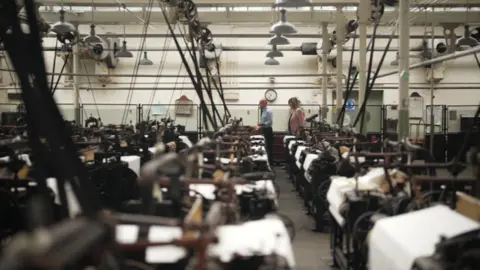
Lancashire Museums curator Philip Butler explained: "With a mill with nearly 1,000 looms for maintenance, for things like filling the boilers or looking after their steam engines, they'd need a shutdown period at some point through the year.
"There were over 600,000 people employed in the cotton industry. The biggest employer in each of the towns had a shutdown and they're on holiday and have left the town.
"It didn't really make sense for much else to stay open."
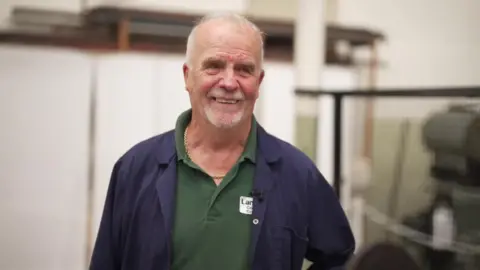
Retired weaver Colin Stevens, who worked at the Queen Street Mill in Blackburn, remembered: "We all stopped and everything stopped, shops shut.
"We used to go to Blackpool. The trains were packed.
"Blackpool has always been same. Absolutely crowded on the beach and if you were lucky the weather would be alright for you."
He remembered that the local women "always tied their hair up" while working at the mill "because [if] you get [it] caught in the loom it'll take your scalp off - it'll scalp you."
At weekends and during Wakes Week, though, "they let their hair down".
Stevens mused: "Happy days - different to now."
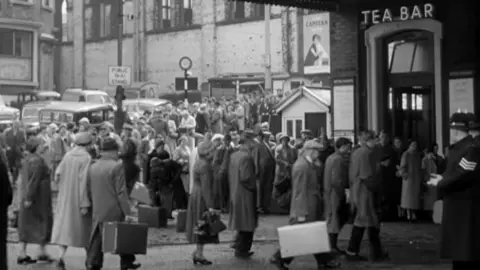
Each town had its own holiday week when its factories fell silent.
The mill town migrations to Blackpool involved scores of trains ferrying holidaymakers to the resort.
At the start of Blackburn's July 1945 Wakes Week - the first since the end of World War Two - holidaymakers queued at the town's railway station from early morning to catch one of 23 trains bound for Blackpool.
The following week 14 trains set off from Accrington and it was estimated that 250,000 people crammed into the resort that Saturday.
According to contemporary reports, it was also estimated that the holidaymakers of Accrington, Church, Clayton-le-Moors, Rawtenstall, Bacup and Haslingden collectively spent nearly £1m on their break from work (equivalent to £39m in 2026).
Wakes Weeks grew out of customs in villages when each would have a celebration on the eve of a Christian festivals.
The term wake is derived from an old English word to keep watch and is still used in relation to vigils kept after someone's death.
During the Industrial Revolution the tradition of the wakes evolved into a regular summer holiday, particularly in industrialised areas of the North West and Midlands.
Each locality nominated a week when factories, collieries and other industries would shut down..
The decline of Wakes Weeks mirrored the demise of the cotton industry in Lancashire. when mills closed at the rate of nearly one a week in the 1960s and 1970s.
By the 1980s the textile industry of the North West had all but vanished.
Even in the early 80s, however, many people from mill towns would still all visit Blackpool for a week.
Listen to the best of BBC Radio Lancashire on Sounds and follow BBC Lancashire on Facebook, X and Instagram. You can also send story ideas via Whatsapp to 0808 100 2230.
