Some rural areas could lose home care visits due to funding

 Getty Images
A major healthcare company has said it is likely it will pull out of domiciliary care in some rural areas of Northern Ireland because it can no longer afford to provide it.
Connected Health has said the failure of government to properly fund the independent care sector means services will be cut with families losing out.
It said warnings had been ignored by healthcare officials.
The Department of Health said the entire health and social care system was facing significant challenges given the lack of an agreed budget.
Meanwhile, a leaked document seen by BBC News NI has revealed plans by the Southern Health Trust to cut the amount of time carers spend on home care visits and the number of visits some people get each day.
A Freedom of Information (FoI) request also revealed massive sickness levels in the Southern Trust with hundreds of missed visits costing more than £2.5m per year.
A spokesperson for the trust said it was currently identifying "new and better ways of working" as it aimed to free up time to care for other service users who need support.
The independent health care sector provides around 80% of home care visits to the elderly and vulnerable with health trusts delivering the rest.
The Department of Health said it was aware that some trusts were assessing their approach to the provision of home care with the aim of providing the appropriate amount of care.
"Trusts will continue to assess and plan care packages based on individual needs and will ensure that care is appropriate, proportionate, and person-centred," a spokesperson added.
Connected Health's chief executive, Ryan Williams, said the move to withdraw services in rural areas was unfortunate and the company was aware it would leave families stranded.
He described the decision as "heart breaking", but said health officials were warned changes to how the independent sector was managed and funded by the trusts would result in major cuts and families being impacted.
Williams said the price of fuel and what they were paid by health trusts meant companies like his could no longer afford to travel distances within rural areas.
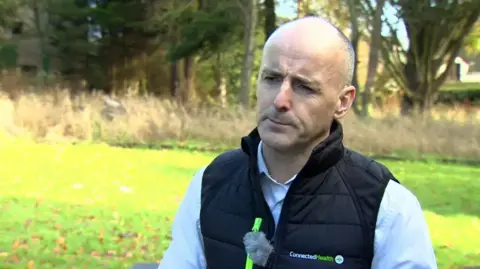
This, along with the decision not to extend the Real Living Wage (RLW) to care workers, had led to a situation which was "completely untenable", he said.
"Reduced home care visit times did not make financial sense, with the client and carer both losing out.
"We are at a tipping point in social care here (in Northern Ireland).
"We have done some things which are positive, but because of the funding environment, because of crisis after crisis after crisis, we are really at the stage now where we are not only looking over the edge of a cliff, but we are falling halfway down the cliff," Williams said.
What cuts are being made?
Demand for home care packages in Northern Ireland is growing, with more than 2,600 men and women on a health trust waiting list.
But the chief executive of the Independent Health and Care Providers (IHCP) said despite that rising demand, health trusts were employing fewer of their services instead of more.
Pauline Shepherd said the Southern Trust plans to reduce time spent with clients meant care workers were being forced to "cram more calls" into an already fragile home care system which would result in "care by stopwatch, not by need".
IHCP represents independent and voluntary organisations which provide care for older adults and those with disabilities.
The new home care changes in the Southern Trust include morning and night visits reduced from 30 minutes to 20 minutes, and lunch and tea from 20 to 15 minutes.
The document – 'Modernising Home Care: A new way of working' - advises care staff to explain to clients that change is not about saving money but about providing care fairly.
A change to the number of visits paid to men and women will also change with a one carer package moving from four visits to three visits per day and a two-carer package may go from five to four visits per day.
One carer who works for the Southern Trust, but who asked to remain anonymous, described the changes as "madness" and said they would reduce standards and increase pressure on staff.
Shepherd said there had been no consultation about the changes within the Southern Trust and it was her understanding that other health trusts were considering adapting the changes to save money.
She described the system as a "mess" and said it jarred with the Department of Health's new neighbourhood model for healthcare, which she said was heavily reliant on home care services.
What else did the FoI reveal?
Separately, the FoI to the Southern Health Trust revealed sickness levels of more than 41,000 days lost in one year - the equivalent of 113 staff off every day, and at a cost last year of £2,570,966.
Sickness absence meant that around 550 home care visits were missed last year.
The FoI also revealed the cost of home care services provided by the Southern Trust are double that of the independent sector.
The trust's own internal home care unit cost is £39.74 per hour, compared to the independent sector rate of £21.25 per hour.
Shepherd described the rate and cost of sickness among staff in the Southern Trust as "shocking".
She said the independent sector had proven to be more efficient and could do the job at half the cost compared to health trusts.
"At present the independent sector provides around 70% of social care with the health trusts delivering the rest," said Shepherd.
"However, we know that a majority of social care staff within the Southern Trust are on zero hour contracts – if the independent sector was paid the same as their counterparts in health trusts we could deliver better across more areas," she said.
