Smart pillow alerts the deaf to emergency alarms

 IAN REYNOLDS/NOTTINGHAM TRENT UNIVERSITY
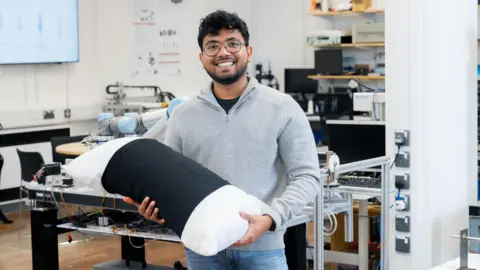
A smart pillow sleeve which vibrates to alert people who are deaf to fire and burglar alarms has been created by scientists at Nottingham Trent University.
Developed with members of the deaf community, the smart textiles technology replaces bulky gadgets that are kept under pillows.
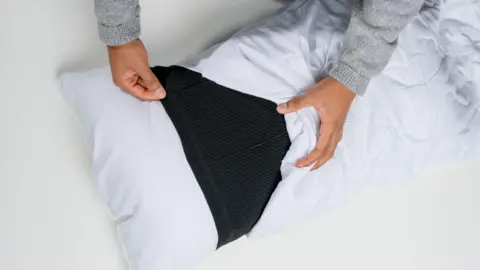
The design is centred on a thin, flexible, electronic textile sleeve which features four tiny haptic actuators that create tactile feedback through vibrations, forces, or motions.
PhD researcher Malindu Ehelagasthenna developed the sleeve as part of his doctoral studies at the university's school of art and design.
 IAN REYNOLDS - NOTTINGHAM TRENT UNIVERSITY
The actuators measure 3.4 mm by 12.7 mm and are encapsulated and embedded within a yarn-like structure.
Ehelagasthenna said the idea came directly from feedback from deaf users who wanted a less intrusive solution.
"The electronics we have embedded in the yarns of the sleeve are so tiny that they cannot be felt by the users," he said.
"But when an alarm sounds they can be made to vibrate intensely in order to wake even the most heavy sleepers."
 NOTTINGHAM TRENT UNIVERSITY
The sleeve slips over a standard size pillow and placed inside a normal pillow case.
The electronics connect to a smartphone, via a microcontroller. It's then wirelessly linked to household alarms.
Once slept on, the smart pillow use different vibration pulses to indicate between fire alarms, burglar alarms and phone calls.
Dr Theo Hughes-Riley, who supervised the research, said: "This smart design represents a significant step toward inclusive emergency alert systems, allowing deaf and deafblind individuals to sleep more safely - and with greater peace of mind and comfort.
"It has been an entirely user-led development, stemming from feedback from the Deaf community, who told us exactly what kind of real world challenges they face which might be solved with electronic textiles."
The research team are now working to develop the prototype further and find an industrial partner, who would be interested in taking the product to market.
Listen to BBC Radio Nottingham on Sounds and follow BBC Nottingham on Facebook, on X, or on Instagram. Send your story ideas to eastmidsnews@bbc.co.uk or via WhatsApp on 0808 100 2210.
