Antisemitism 'a national security emergency', government terror adviser says
Attacks on Jewish people in the UK are "the biggest national security emergency" in almost a decade, the government's adviser on terrorism has told the BBC.
Jonathan Hall KC said British Jews were "now thinking they cannot live a normal life" due to a series of incidents in recent months in which Jewish communities have been targeted.
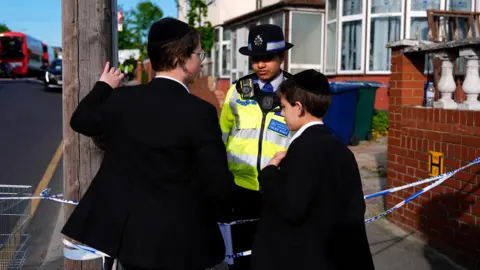
The most recent of these came on Wednesday, when two Jewish men were stabbed in Golders Green, north London, in what police have declared a terrorist incident.
Home Secretary Shabana Mahmood said she did not agree that attacks against Jewish people amounted to a national emergency, but insisted the government was treating the issue as an "absolute priority".
She also said that she viewed the rise in antisemitic attacks as an emergency for her in her role as home secretary.
She told BBC Breakfast that the phrase "national emergency" had particular connotations, including suspending elements of democracy.
"I don't believe this is where we are today," she said.
The UK's terrorism threat level was raised from "substantial" to "severe" on Thursday evening, partly in light of Wednesday's attack. It was last at this level in February 2022.
The two victims of Wednesday's attack have been named locally as Shloime Rand, 34, and Moshe Shine, 76. A 45-year-old British national, who came to the UK from Somalia as a child, has been arrested on suspicion of attempted murder.
At a meeting of criminal justice agencies on Thursday, Prime Minister Sir Keir Starmer said there was "no getting away from the fact that this was not a one-off".
"This has been a series of attacks on our Jewish community," he said, adding the response from agencies must be "swift and visible".
Sir Keir said the fight against antisemitism was one for all Britons, not just the Jewish community, as it was "about what sort of a country do we want to live in".
The government has announced an extra £25m in funding for increased police patrols and security in Jewish communities.
The funding will also be used to put further protections in place around synagogues, schools and community centres.
Chief Rabbi Sir Ephraim Mirvis, who represents the UK's largest Jewish community, said Wednesday's attack "proves that if you are visibly Jewish, you're not safe and far more needs to be done".
He called for "meaningful action" to tackle the "root causes" of antisemitism.
Meanwhile, the Board of Deputies of British Jews and the Jewish Leadership Council said they were "sickened" by the attack, adding that security measures were essential but "not the answer".
"British Jews will not be intimidated. But we should not face this threat alone," their joint statement read.
Mahmood said she understood that there was fear within the community, and stressed the enhanced security measures announced by the government would mean "people can go about their business".
She said she accepted that security could only tackle the "end of the problem" and that more must be done to address antisemitism "at its root".
Shadow home secretary Chris Philp said it was "shameful" that attacks on Jewish communities were happening "on such a frequent basis" and agreed with Hall that this amounted to a national emergency.
"I think from the government, words are no longer enough," he told BBC Breakfast.
Reform UK leader Nigel Farage also described the situation as an emergency and urged the government to show "real action".

 PA Media
Labour MP Sarah Sackman, who represents Finchley and Golders Green, said Wednesday's attack demonstrated that "threats to Jewish people in this country are very real".
Sackman, who is Jewish herself, told BBC Newsnight: "When I take my children to synagogue in my local area, I find myself holding and gripping their hand a little bit tighter. I know I'm not alone in that."
Meanwhile, the office of Israeli Prime Minister Benjamin Netanyahu called on the UK government to do more to protect the Jewish community, with a statement referencing "weakness" in the face of "one antisemitic attack after another".
Sir Keir joined Sackman in visiting Golders Green on Thursday afternoon, where he was heckled by protesters.
 PA Media
Wednesday's attack follows a spate of incidents in recent months targeting Jewish sites in the UK:
- 2 October 2025: Two Jewish people were killed and three left in a serious condition after a car ramming and stabbing attack outside a synagogue in Manchester. One of the men was killed by a bullet fired by police.
- 23 March 2026: Four Jewish charity-owned ambulances were set on fire in the car park of a synagogue in Golders Green
- 15 April: A brick and two bottles thought to contain petrol were thrown at the Finchley Reform Synagogue in north London
- 17 April: Suspicious items, later found to be non-hazardous, were found near the Israeli embassy in London. A video posted to social media claimed the embassy was going to be attacked by drones
- 18 April: A bottle containing a type of accelerant was thrown through the window of Kenton United Synagogue in north-west London
- 27 April: A suspected arson attack was carried out at a memorial wall in Golders Green. The wall contained tributes to people killed by the Iranian regime during anti-government protests earlier this year, as well as a section to those killed in the 2023 Hamas attack on Israel
Some of these attacks have been linked to groups with ties to foreign regimes, such as Iran. Police have not made any such links with Wednesday's attack.
Liberal Democrats leader Sir Ed Davey called on the government to "ban organisations like the IRGC", Iran's Islamic Revolutionary Guard Corps.
Sir Keir said on Thursday afternoon: "We need stronger powers to tackle the malign threat posted by states like Iran. We know for a fact they will harm British Jews, which is why we will fast-track the necessary legislation."
He also pledged to introduce stronger powers to "shut down charities that promote antisemitism" and "prevent hate preachers from entering our country", as well as speed up sentencing on antisemitic attacks "so there is stronger de facto deterrence".
But he added that while "we can and will bring the full power of the state to bear" on tackling antisemitism, "far too many people in this country diminish it".
