Banksy confirms he's behind statue in central London

 Getty Images
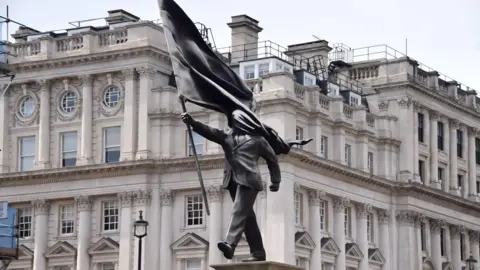
Street artist Banksy has confirmed a large statue that appeared in central London is his work.
The sculpture - which bears his signature - depicts a suited man walking forward off a plinth while carrying a flag that covers his face.
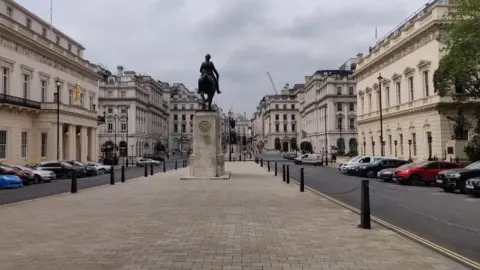
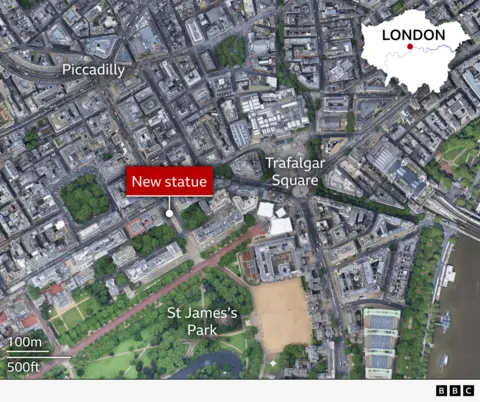
Its location - Waterloo Place, St James's - is an area designed to celebrate imperialism and military dominance in the 1800s. The sculpture sits near statues of Edward VII, Florence Nightingale and the Crimean War Memorial.
Banksy's representatives told the BBC the statue was installed in the early hours of Wednesday, before the artist posted a video of it on his Instagram account on Thursday afternoon.
 PA Media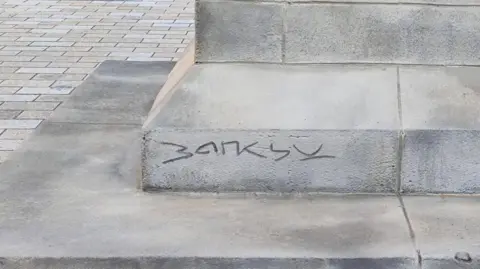
On the statue's position on the ceremonial island in Waterloo Place, Banksy said: "There was a bit of a gap."
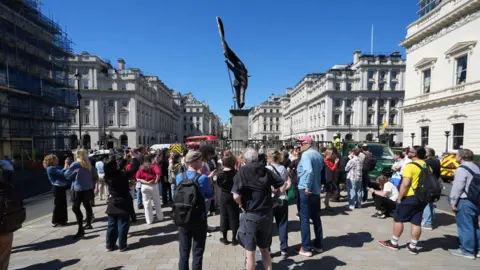
Since it appeared on Wednesday, crowds have gradually increased in size.
"With Banksy, it's a limited time event because it's public art - you don't know how long it's going to be up," said 23-year-old student Ollie Isaac as he joined dozens taking a look.
"I think it's brilliant," he added, saying he thought the statue was a response to "the resurgence of nationalism in the world and this country".
"That suit screams politician," he added.
Teacher Lynette Cloraleigh, 55, came down after a friend posted about the statue on Instagram.
"I like it," she said. "I like where it is. (It's) intriguing how it got here."
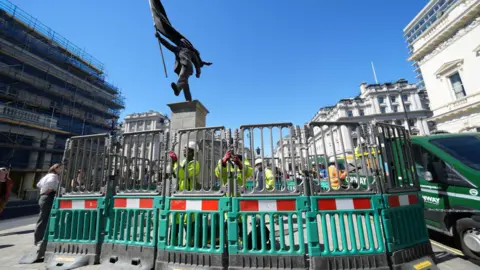
Contractors were seen erecting safety barriers around the work on Thursday afternoon.
 PA Media
Westminster City Council, which is responsible for the area, said: "We're excited to see Banksy's latest sculpture in Westminster, making a striking addition to the city's vibrant public art scene.
"While we have taken initial steps to protect the statue, at this time it will remain accessible for the public to view and enjoy."
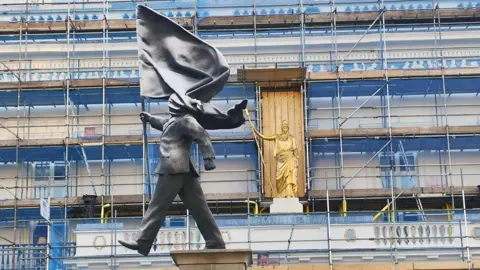
James Peak, creator of the BBC podcast series The Banksy Story, said: "Here, you've got a brilliant comment on a bumptious, chest puffed out man in power with the flag completely obscuring his vision, which is why he is about to fall off the plinth.
"It is a wonderfully framed moment in time that you never really get with a statue."
He added Banksy had "pulled off another fantastic coup... the positioning is absolutely knockout".
"I don't know how he's managed to do it.
"How has he got a low-loader to there with all the security and put up a massive resin statue?"
On the statue's location, he added: "We've got to face up to the fact that Britain has an imperialistic history full of takeovers and part of that is the sort of extreme nationalism that Banksy absolutely abhors.
"Every (Banksy) piece is a campaign."
On Banksy's Instagram post, one commentator wrote: "I love that he appears when enough time has passed to forget, and arrives with full force unnoticed" while another wrote: "As a long-time Banksy collector, this one really hits. Big monument energy, but the idea is brutally simple: a suited figure blinded by its own flag. Classic Banksy. Quiet at first, then impossible to unsee".
On its meaning, many interpreted the statue as a commentary on "blind patriotism".
This is not the first time Banksy, whose real identity is not officially known, has previously left a statue in London. In 2004, The Drinker, a subversive take on Rodin's The Thinker, was installed on Shaftesbury Avenue before being stolen soon afterwards.
This piece is the latest in a recent series of London‑based works by the artist who is known for high‑profile and often controversial pieces worldwide.
In December, a mural appeared in Bayswater of two children lying on the ground, while in September, he claimed to have painted a scene on the Royal Courts of Justice complex of a protester lying on the ground holding a blood-spattered placard while a judge looms over him, wielding a gavel.
In 2024, the street artist created an animal trail around the capital with pieces including a goat, elephants, a gorilla, monkeys, piranhas, a rhino and pelicans.
Each time, the pieces have appeared to have been installed covertly and later confirmed as his work on his Instagram account.
His works, installed on both private and public property, are widely interpreted as political statements and are often removed soon after they appear.
Listen to the best of BBC Radio London on Sounds and follow BBC London on Facebook, X and Instagram. Send your story ideas to hello.bbclondon@bbc.co.uk
