Spikes in air pollution recorded near landfill fire site

 PA Media
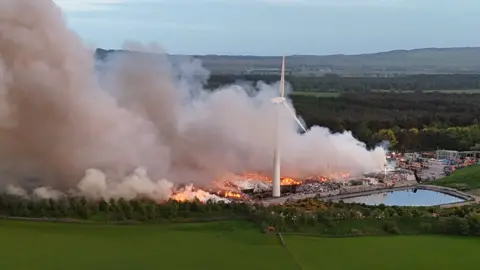
Residents living near a landfill site which has been on fire for more than a week have been advised to take precautions after official data showed a change in air quality.
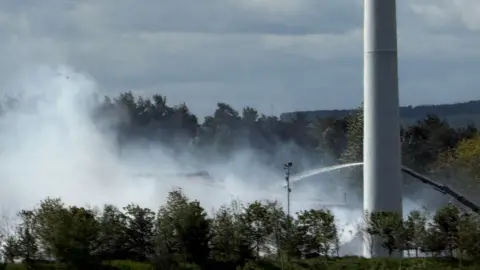
Fire crews have been tackling the "deep-seated" fire at Ladybank Waste Facility in Fife since Tuesday last week.
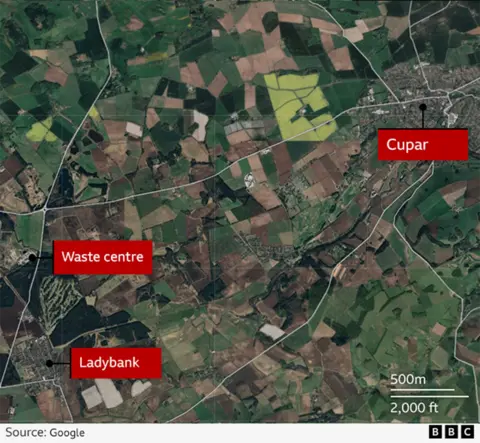
Air monitoring data published by the UK government shows raised levels of nitrogen oxide, nitrogen dioxide and particulate matter recorded at nearby Cupar on several occasions since the fire began.
An air quality expert told BBC Scotland News people should not be "extremely worried", but those with lung conditions or asthma should take precautions like keeping windows closed.
Earlier this week the Scottish Fire and Rescue Service warned that firefighting at the site could continue for some time.
Meanwhile wind conditions have made the operation more difficult, according to Fife Council.
"As operators move waste impacted by fire, more pockets of fire open up," a spokesperson said.
Mark Miller, a professor of environment and health at the University of Edinburgh, said the latest data showed a peak in nitrogen dioxide, which can irritate the lungs, on Thursday last week.
Levels of tiny particles in the air - known as particulate matter - spiked on two occasions over the weekend.
"In both cases these are above the hourly UK guideline levels, although only for a short period, most of the time the levels are relatively normal" said Miller.
The "peaks" were likely explained by the changing wind direction, blowing smoke towards the air pollution monitor in Cupar, he added.
 Mark Miller
In a statement published last week, Fife Council said it was monitoring the smoke plume and wind direction.
A spokesperson added: "The council's static air quality monitors across Fife are also being monitored and show normal readings."
It said there had been no change since then.
"I don't disagree with it but I think it's not quite as simple as that," Miller said.
"There is no persistently high air pollution and I think that is good news.
"But there's certainly these spikes and certainly some of these spikes are now above the UK guideline level."
He said it was a "more complex picture" but people did not need to be "extremely worried".
The limits for air pollution are set by the UK government/Defra and the Scottish government.
The hourly limit for nitrogen dioxide is an average of 200 microgrammes per cubic metre (µg/m3) this cannot be exceeded more than 18 times a year.
The daily limit for larger particulate matter (PM10) is an average of 50µg/m3 which cannot be exceeded more than seven times a year.
There is no hourly or daily limit for smaller particulate matter (PM2.5) but the yearly limit is an annual average of 10µg/m3
Asthma attack
Miller said a few peaks recorded in the data went above the hourly guideline levels for air pollution.
"These air pollutants won't be good for health," he said.
"This is especially the case when you consider the different materials that could be burning in that landfill meaning there are more chemicals in the air."
Miller said most people would not experience symptoms or serious harm but advised people with underlying conditions to take precautions.
"These air pollutants can exacerbate asthma, make it more likely you'll have an asthma attack," he said.
"If you have a chronic lung condition, that may be triggered."
Miller urged people with these conditions not to panic and to just be aware of their symptoms.
 Fife Council
Fife Council leader David Ross welcomed the progress being made in bringing the fire under control.
"It's been reassuring to see confirmation from NHS Fife and Sepa that the risk to public health is low," he said.
"However, I understand the impact that smoke and smells have had on local communities since last week as the wind has blown the plume in various directions.
"I have every sympathy with residents affected by this and by the traffic disruption."
He said there would be a full investigation into the cause of the fire and they would see if more could be done to reduce the risk of such incidents.
