'Dad faked his age in WW2 to sign up for the Army'

 Mandy Hardman
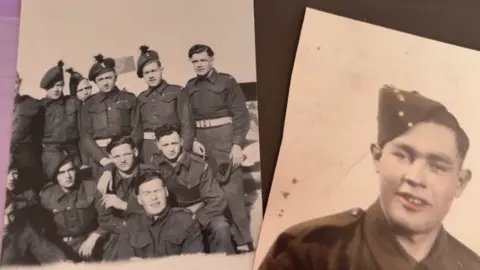
The daughter of a World War Two soldier has described how he was "laughed out" when he tried to join the Royal Air Force because he was too young.
After he was turned away, Norman Butt, from Guernsey, was so determined to fight in the war he faked his age and signed up for the Army instead.
He told the forces he was born in 1921, three years before his actual birth year of 1924.
Mandy Hardman has shared memories of her father ahead of Liberation Day on 9 May.
She said: "He was determined at that time he was going to join up - he was fifteen and a half.
"They [the RAF] just said to him 'go home sonny' and laughed him out the door really."
Butt was apart of the first Arakan offensive in Burma where the British troops faced the Japanese forces in 1942 and 1943.
During this time, Butt once saved a man's life by pushing him in a barrel across a stream and carried him back to their camp for medical treatment.
However, Hardman said the man was taken off her father by a corporal, who wasn't involved in the fight, but claimed a bravery medal for the act performed by Butt.
Butt was 17 at the time.
Hardman said: "He was a very proud man - a very very hardworking man."
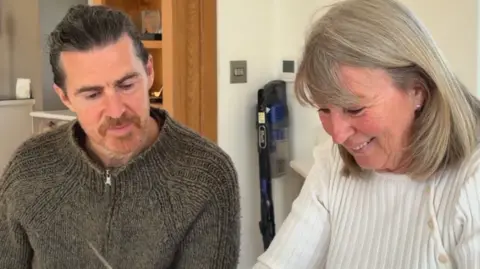
During his life, before he died in 2010, Butt also shared his memories with his grandson, Darren Sylvester, 50.
Sylvester said: "When I was sat with him in the pub as a 19-year-old youngster, it was one of the things that made me want to travel.
"If I look back now, I see more of the folly of war."
He added: "I have all these stories which brings liberation home to me."
In the years that followed the war, Hardman said her father was "traumatized" by the war.
Hardman said her father suffered with depression and had a temper, although he was never violent.
She said: "I was afraid of him, but I loved him and respected him.
"I could only ever see him and admire him - for his flaws, I could see what he was carrying and I knew why he was behaving at times like he behaved."
Hardman added: "It took a very long time for my father to be prepared to talk about his experience - they were told when the war ended they should go home and forget it.
"I do not want what he went through to be forgotten and I do not want what all the other men went through to be forgotten."
Follow BBC Guernsey on X and Facebook and Instagram. Send your story ideas to channel.islands@bbc.co.uk.
