Tartan Army's World Cup traffic cone high jinks are taking over Scotland

 Getty Images
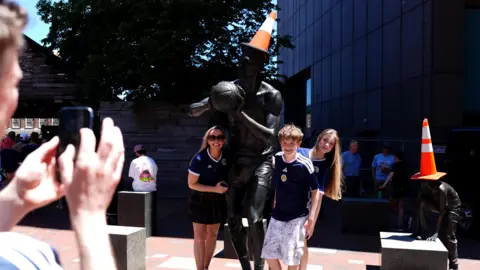
They came. They saw. They coned.
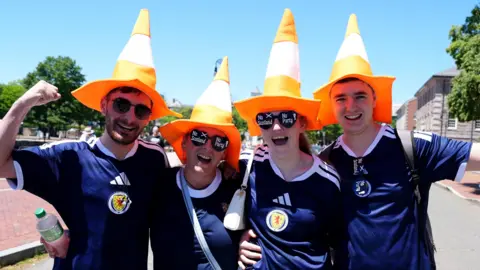
The Tartan Army's coronation of statues in Boston baffled locals and global audiences alike, however the practice has divided opinion at home.
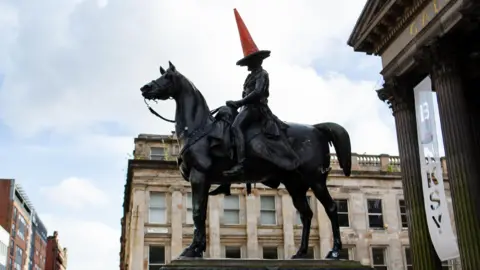
Monuments across the country have now received the treatment usually reserved for the Duke of Wellington in Glasgow.
But is this the last throes of World Cup fever? Or is the Scotland faithful's new calling card here to stay?
The coning of the Duke, Arthur Wellesley, outside the Glasgow Gallery of Modern Art (GoMA), is thought to have been started by students returning home from nights out in the 1980s.
The monument, showing the Duke on his faithful horse Copenhagen, was designed by the Italian artist Carlo Marochetti and erected in 1844 to commemorate his victory over Napoleon at the Battle of Waterloo nearly 30 years earlier.
Over the next 30 years, Glasgow city council and some residents engaged in their own conflict around the cone.
Every time the local authority removed it, at a cost, the cone would reappear and appeals for it to stop only heightened resolve.
The council eventually gave up after an attempt to raise the height of the statue's plinth was defeated.
It has since become something of an iconic symbol of the city and was even named by artist Banksy as his "favourite" artwork.
So, when the Tartan Army descended on Boston, and saw the city's statues coneless, nature took its course.
The people of Boston seemed to love it, so much so that a proposed twinning of the two cities has been marked by the gifting of a signed cone from Glasgow to the city where that birthed the American revolution.
Back home, however, the reaction from some has been less than positive.
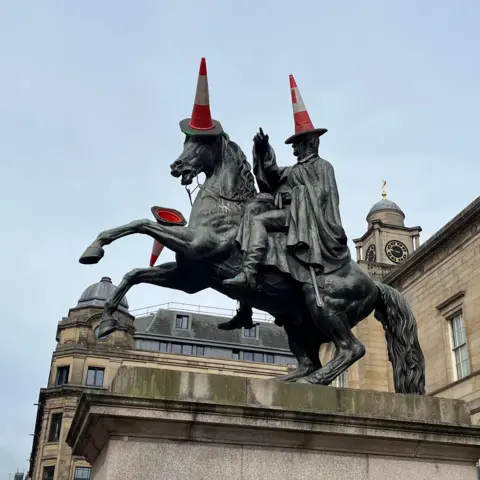
Edinburgh's own Duke of Wellington statue, outside Register House in the city centre, was spotted sporting fetching, orange headwear earlier this week.
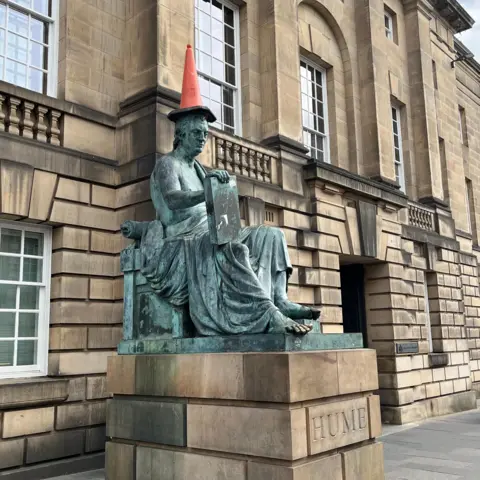
Monuments to Adam Smith and David Hume on the Royal Mile have also been anointed with plastic crowns.
While the image is more closely associated with Glasgow, some capital locals say this is nothing new.
Edinburgh city centre councillor Jo Mowatt told BBC Radio Scotland's Mornings programme that the practice made statues look "undignified".
"I think I would much rather it stayed the other side of the M8," she said.
"I wouldn't tell Glasgow what they should and shouldn't do, that's up to them, but in the middle of where it's happening, in Edinburgh, it's just totally inappropriate."
 PA Media
But the tradition appears to have spread further than the Central Belt.
In Dumfries, the Robert Burns statue was given a new hat to protect the poet from last week's sweltering heat.
Readers have sent in pictures of coned statues on Aberdeen and Inverness.
Even Nessie is now sporting cones on its head in the middle of a roundabout in Inverness.
And, of course, with such an iconic image, there is money to be made.
Several members of the crowd at the TRNSMT festival on Glasgow Green were spotted wearing felt cone hats.
Visitors to the GoMA can also part with £15 to get their hands on a coned Duke of Wellington tote bag or £20 for a T-shirt. Bad news if you fancy a £9.50 pair of socks with the Duke on them though, those are sold out.
When athletes arrive at this summer's Commonwealth Games in the city, they will be greeted by mascot Finnie, a unicorn with a cone on its head.
 PA Media
Historian and tour guide Alistair Heather said the commercialisation of the image in some parts of Glasgow had taken away its original meaning.
"It started off in a proper 'us v them', tit for tat thing between the people and the council," he said.
"Where I think it got really brutally unfunny was, once the Commonwealth Games in 2014. It got gentrified.
"All the corporate hotels in Glasgow would all have stencils of traffic cones on the wall.
"Once that happens, I think the thing is flat dead."
But he said the Tartan Army had helped rehabilitate the image.
"I've fallen right back in love with it as a folk image," he said.
"It's the signature of the Tartan Army. It's World Cup fever and I think that will die down.
"But I would love to go and cone London next time we play at Wembley."
