Why are Scotland fans putting traffic cones on statues in Boston?

 Alamy
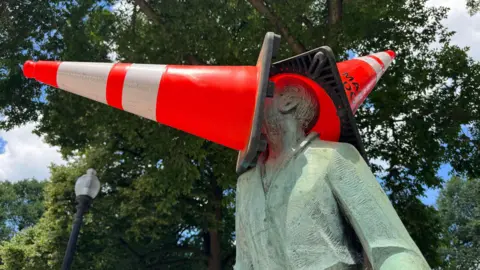
AlamyDescribed as the "birthplace of the American Revolution", Boston's streets are teeming with monuments and landmarks that tell the story of the nation's history.
And they're now experiencing something of a makeover.
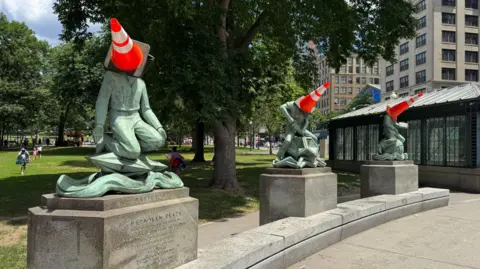
Scotland fans visiting the city for the World Cup have been decorating its statues with bright orange traffic cones, much to the bemusement of locals.
The practice is familiar to anyone from Glasgow, where the Duke of Wellington statue at the Gallery of Modern Art has been wearing a cone at a jaunty angle since the 1980s.
It's a mischievous visual ingrained in Glasgow's identity - and was even a source of inspiration for the graffiti artist Banksy.
 PA Media
An estimated 20,000 to 30,000 Scotland fans travelled to Boston for Scotland's opening match against Haiti last week - which ended in a 1-0 victory.
Anticipation for their second match against Morocco on Friday is building and the conical pranks are perhaps an indication of high spirits.
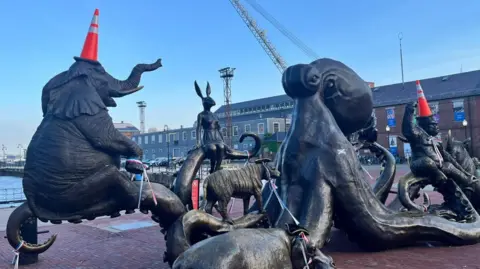
The Arms of Friendship statue at Charlestown Navy Yard received the traffic cone treatment earlier this week.
Designed by Gillie and Marc Schattner, the artwork features a 36ft (11m) long bronze octopus holding up a number of the world's endangered animals including an elephant and a gorilla.
 Alamy
Alamy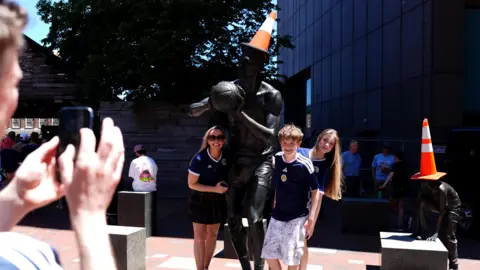 PA Media
A couple of miles to the east on Faneuil Hall Square is a statue of the beloved former mayor of Boston, Kevin White.
The Democrat served four terms, from 1968 to 1984, at a tumultuous time of racial conflict in the city.
According to the Boston Globe, White governed in a "grand manner" and there was debate about whether the 10ft statue was tall enough when it was installed in the mid 2000s.
Perhaps the Tartan Army thought he deserved an extra foot or two.
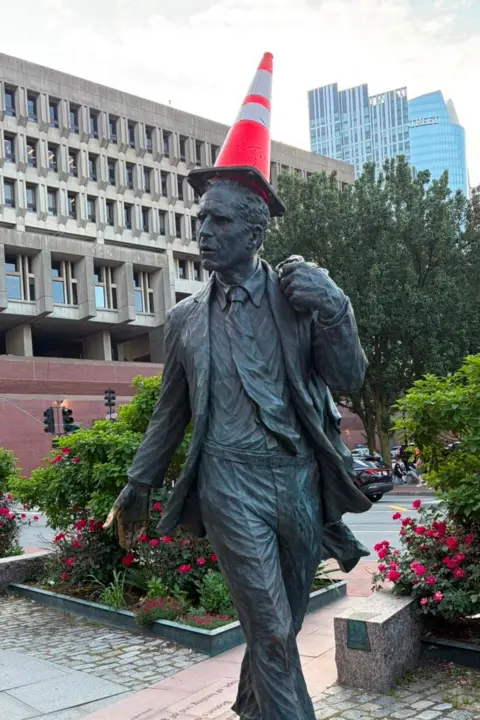
A similar treatment was given to the statue of Boston Celtics basketball legend Bill Russell at City Hall Plaza.
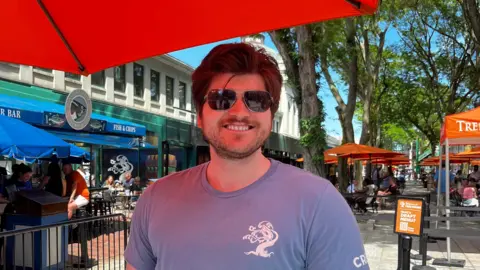
Brendan McGillicuddy, 26, from Boston, told the BBC he admired the statue's new addition on his way to work.
"I welcome it," he said. "I have no idea what it means but it's a nice little symbol of Scotland.
"It's a mark to say Scotland was here. I never realised it was a thing before the World Cup. I'd heard of the Tartan Army but not the cone thing. I'm here for it though."
By Wednesday afternoon, Boston authorities had started to remove the traffic cones from statues - but fans are still keeping the momentum going in their own way.
Alistair Blake, from Glasgow, and his two sons spoke to the BBC while wearing their own traffic cone hats.
He started wearing them at the Euros because it was a bit of fun - and handy for the boys to spot him in the crowd.
He said: "It's a friendly Glaswegian gesture. I think you see it more here because there's so many statues.
"We don't get very far without someone stopping us and asking for a picture.
"They think it's fun and want to know the symbolism behind it."

Where does the tradition come from?
Arthur Wellesley, the Duke of Wellington, is famous for defeating Napoleon at the Battle of Waterloo in 1815 and later becoming prime minister.
The Category-A listed statue of the duke on his favourite horse, Copenhagen, was sculpted by Italian artist Carlo Marochetti and erected in 1844 in Glasgow.
However the tradition of his traffic cone is thought to have started by late night revellers in the 1980s.
For years locals battled the council over the placement of the cone.
It said the statue had once been minorly damaged and raised concerns around the potential for injury when attempting to place a cone.
The council also reminded locals that the act was "vandalism" and police warned of criminal charges.
But the prank continued and any attempts to free the duke of his plastic hat have always been quickly thwarted with the cone replaced within days.
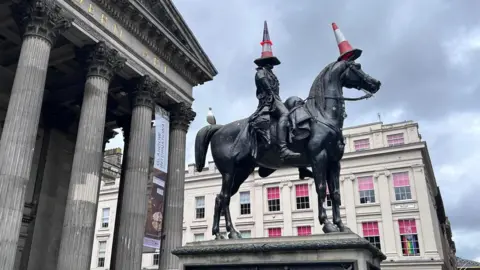
Now images of the cone-topped statue are used to promote Glasgow and feature on posters, coasters and key rings.
In 2023 Banksy called it his "favourite work of art in the UK", and it is was the reason he chose to hold his first exhibition in 14 years at the gallery.
News of the traffic cones in Boston had made its way to the streets of Glasgow on Wednesday.
Susan Law, who is originally from Paisley but now lives in Stamford, Lincolnshire, said the Boston statues were "brilliant".
"It's fun and shows people are friendly," she said.
"I think the Americans are loving it and it seems to have been well perceived."
Nicole, who is visiting Glasgow from Los Angeles with her daughter, said she had seen the photos of the Boston statues on social media but had not heard about the so-called tradition until she started planning her trip to Scotland.
"I messaged one of my friends in Boston who had no idea what was going on until I sent her one of the videos," she said.
"It's spread so quickly on social media that it is now recognisably Scottish and I knew the Duke of Wellington was the one statue I wanted my daughter to see over here.
"I've bought a bag with the Duke embroidered on it - it's really fun."
She added that it was impressive the Scotland fans had managed to find so many traffic cones.
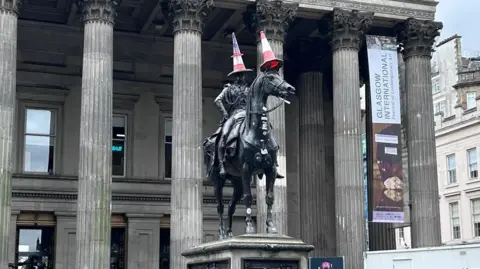
Marcos moved to Glasgow 10 years ago but was keen to show his friends, who are visiting from his home country of Spain, the iconic Duke of Wellington statue.
"It's really cool and I'm happy the council gave up removing the cone," he said.
"I hadn't seen it before I came here but I knew about it and it is absolutely something that everyone can recognise as Scottish now.
"It reflects how funny and friendly people are in Glasgow."
Many locals and tourists in the city centre agreed the cone demonstrates the best of Glasgow's sense of humour and brings the country together.

