The big blue blimp gracing London's skies

 BBC
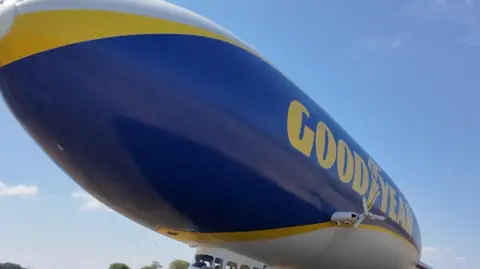
BBCMany Londoners last week may have felt like the big blue blimp in the sky was following them wherever they went.
A viral social media hit, the dirigible's journey also became the most tracked flight in the world on some online flight tracking platforms.
Critics have said the return of the blimp - operated by tyre and rubber company Goodyear - has highlighted a gap in the rules, as adverts in the sky have been banned in Britain since 1960.
Under the Civil Aviation Act, no aircraft may be used to display an advertisement visible from the ground, except in circumstances set out by the government.
Airships are one of the few exceptions - while the flight itself needed clearance, the giant advert did not need approval from anyone.

Goodyear's first branded airship, Pilgrim, made its maiden flight over Akron, Ohio on 3 June, 1925, marking its 100th anniversary of flying last year.
So far no rules have been broken, with its pilots have working closely with air traffic controllers to fly over the capital.
The 75-metre airship flew over London this month for the first time in four years, as part of a European tour.
Its return may have been a novel experience for many Londoners, but Prof Jonathan Hardy, professor of communications and media at University of the Arts London said he suspected most people would not want "the kind of corporate sky advertising we see depicted in the Blade Runner films".
He said there should be clear rules, a clear path for consumers to complain, and effective regulation - none of which is in place.
While the flight required clearance to operate in some of the busiest airspace in Europe, no council or advertising watchdog had any say.
Board said getting into the London airspace was hard enough,
"We had to jump through a lot of hoops to get in. It took a bit of time the first time we got permission for the Zeppelin, because they hadn't seen it before. But now they know who we are."
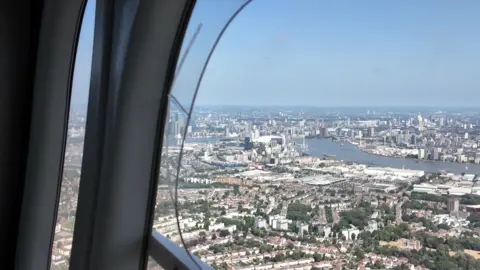
Katharine Board, one of the airship's pilots, said she had flown over many cities in the world, "but London is definitely the most spectacular."
The blimp flies fairly low - passengers aboard can even see the reflection in some of the city's skyscrapers. Below, many people in the streets have been pointing their phones at it.
"You can see people on the ground waving, and I always try and wave back. I don't know if they can see me, but I can definitely see them.
"Everyone's taking pictures, so I wave, and sometimes they don't wave back because they're busy filming us," Board said.

The Advertising Standards Authority told BBC London the blimp was likely to fall outside its remit and would be a matter for Trading Standards. No complaints have been received.
Because the branding appears on Goodyear's own aircraft, the regulator would treat it as "point of sale" advertising, beyond the scope of the advertising codes, in the same category as a sign in a shop window.
Hardy called it "ironic".
"It's about as far from point of sale as it's possible to get. It's a floating ad."

Goodyear describes the airship as an analogue piece of marketing that feeds today's social platforms - the kind of publicity no ordinary ad campaign could buy.
Nicola Green, the company's lead for communications in northern Europe, said that in a week of unprecedented temperatures, "we managed to get the Brits in London to stop talking about the weather and to talk about the Goodyear Blimp".
And when British people stop looking to the sky to discuss the sun and start looking up to discuss a rubber airship, Goodyear knows its job is done.
Listen to the best of BBC Radio London on Sounds and follow BBC London on Facebook, X and Instagram. Send your story ideas to hello.bbclondon@bbc.co.uk
