Campaigners spend thousands on chemical pollution tests

 BBC
BBCCampaigners calling for action on chemical contamination at a former RAF base said they have spent more than £10,000 on independent testing.
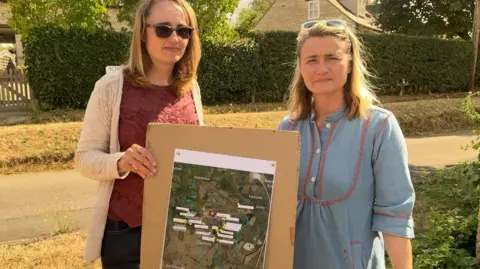
Gallos Brook Community Group said it has carried out more than 14 tests near RAF Upper Heyford, which show unsafe levels of polyfluoroalkyl substances (PFAS), referred to as forever chemicals.
Group member Helen Christie said the testing was done by "a group of mums", adding: "The authorities should be taking responsibility for it."
The Environment Agency (EA) has previously stated there was a risk of contamination at the site from historic fire fighting activities and has conducted its own testing as part of an England-wide PFAS monitoring programme.
It has said military sites and airports are hotspots for PFAS, which were used extensively in firefighting foams for decades.
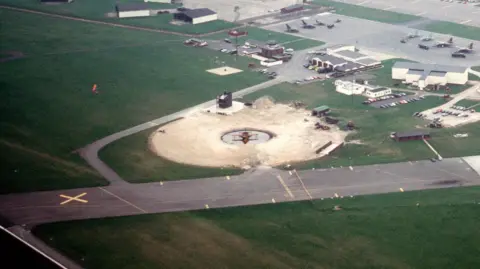
At RAF Upper Heyford, firefighters would practice putting out an aeroplane set on fire above a "pond" of fuel.
According to Ministry of Defence documents dating back to 1997, the list of potential contaminants from the "fire practice pond" include petrol, oil, lubricants, solvents and firefighting chemicals, which were "drained into storm water drainage".
The EA's testing of Gallos Brook - one of the streams near the base - concluded that while its overall ecological status is classed as "moderate", the waterway fails specific chemical targets in relation to PFOS and other persistent PFAS compounds.
The agency has set a target to improve it to "good" by 2039, adding that it is "technically infeasible: no known technical solution is available".
Christie said: "My concerns are that serious, significant pollution is happening to all the streams in the area and potentially the groundwater and no-one is taking it seriously.
 National Archives
Gallos Brook Community Group, a collective of residents and activists in Oxfordshire, has been testing nearby waterways, which flow from streams beneath the old base.
"I'm so concerned about the whole issue that I've been devoting all my spare time to it for the last couple of months," said Christie.
A number of people in communities around the base have told the BBC that although the EA, local authority and current site owner acknowledge there was a risk of PFAS contamination at the site, not enough was being done to tackle it.
Bicester and Woodstock MP Calum Miller, who has called on ministers to address the issue, has said the government was also "not taking the discovery of PFAS seriously enough".
He said: "We know that PFAS has been found at several sites around the country and that it is at particularly high levels on the Upper Heyford site.
"The threat to public health has not yet been determined and has left people living there very concerned."
PFOS - a PFAS compound commonly used to create foams - is banned in the UK due to potential carcinogenic risks and was found in the EA's testing to be hundreds of times higher than standard environmental safety limits, though they say they are not investigating the source of the pollution.
Gallos Brook Community Group has said almost all of the levels recorded in their 14 independent tests exceed environmental quality standards (EQS) , with one 43k times higher.
The BBC has spoken to a number of residents who said they have drunk water from streams or wells, which have subsequently been found by the action group's testing to contain unsafe levels of the chemicals.
Thames Water has reassured residents that drinking water in the area is safe.
The current site owner Dorchester Living, which has applied to build 9,000 homes on the former base, has said that no previous testing for PFAS had been done.
The leader of Cherwell District Council previously called on the government to take action and requested a meeting with water and flooding minister Emma Hardy.
In an update in July, the council said: "Representatives from Cherwell District Council, the Environment Agency and Dorchester Living recently met to discuss the PFAS findings in the Heyford Park area."
It said the purpose of the meeting was to share information, improve understanding of the available evidence and to coordinate and agree how investigations should go forward.
But Christie said the problem went beyond the current planning application.
"It's spread all into the surrounding area and villages, half of the site's already been developed, how is that going to be remediated?"
