PM promises action on chemicals 43k times standard

 BBC
BBCSir Keir Starmer has said he will "make sure" that the "appropriate steps are taken" to tackle 'forever chemical' contamination at a former RAF base.
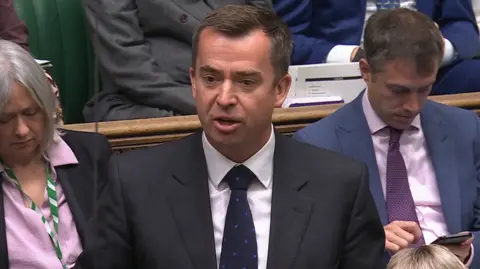
The prime minister had been responding to Bicester and Woodstock MP Calum Miller, who raised concerns over the contamination at the former RAF Upper Heyford in parliament on Wednesday.
It comes after local residents paid for independent testing in a stream near the historic airbase, which found levels of 'forever chemicals' 43,000 times higher than environmental standards.
Speaking at Prime Minister's Questions, Miller called on the environment and health secretaries to meet with him and residents to "explore what more can be done".
Highlighting the BBC's coverage of the contamination, Miller said the the Environment Agency currently has "no plans for regular monitoring"at the site.
"The Gallos Brook in my constituency has the highest concentration of forever chemicals in the country," he added.
In response to the question, Sir Keir thanked Miller for raising the issue and said he would make sure a meeting took place between the Bicester MP and the relevant secretaries of state.
"I'll make sure that the detail is looked at and that appropriate steps are taken," the prime minister added.
 ParliamentTV
Concerns were first raised in April after previous water data came to light and showed high levels of the chemicals 4km (2.5 miles) downstream.
This week, residents said independent testing had been carried out in a stream 0.5km (0.3 miles) south of the former RAF base.
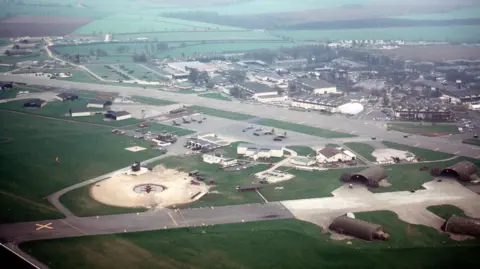
The Environment Agency (EA) previously said there was a risk of contamination from historic fire fighting activities.
The fear is that the land may be contaminated with polyfluoroalkyl substances (PFAS), a group of more than 10,000 substances often referred to as "forever chemicals" because they can take thousands of years to break down.
Dr David Megson from Manchester Metropolitan University specialises in environmental forensics and said PFAS are "much more mobile" than traditional forever chemicals and can "easily get into shallow groundwater and into local rivers and ditches."
One of the chemicals found by both the EA and the independent testing is PFOS, a substance banned in the UK due to potential carcinogenic risks, often used in firefighting foams.
The levels recorded in the independent test were 27,000 ng/l, which is forty times higher than levels recorded by the Environment Agency further downstream and 43k times higher than environmental quality standards (EQS) of 0.65 ng/l.
The stream is one of a number that flow from an aquifer underneath the air base, however, the source of the contamination is not known. Thames Water has reassured residents that drinking water in the area is safe.
 Parliament TV
Dorchester Living, which owns the site has said "extensive environmental investigations and remediation had already been carried out in consultation with the EA."
Its CEO Paul Silver added, "further targeted investigation is appropriate in specific areas".
But Leigh Radwell who has lived on the periphery of the base in Heyford Park for more than a decade, wants to know whether it has polluted the surrounding environment where she lives.
"If you're getting readings in the thousands further on down this stream that's off the richter scale... I am very concerned for the people that are close and the people that have got it running, like me, 16-17ft from their front door."
She has a large garden adjacent to the stream where she grows a variety of fruit and vegetables that she also gives to friends and family.
"If the produce that I've been growing is contaminated in some way, hows it going to affect somebodies health. How is it going to affect my health?," she said.
 National Archives
Mr Miller said a couple of "sporadic tests on one water stream give us a bit of information and give us a reason to act rapidly. They don't give us a full picture."
"What we need is for the environment agency, local authorities to come together and put in place some regular testing that will allow us to establish the scale of the problem and then to think about what can be done."
An EA spokesperson said it tested surface water at Upper Heyford as part of its routine surveillance monitoring, to improve understanding of PFAS concentrations in water across England.
"Given Upper Heyford's former use as a military airfield, there is a risk that the site could be contaminated with PFAS in firefighting foams."
They added it "will work alongside developers and local planning authorities as part of any redevelopment proposals to ensure that investigations are carried out along with any necessary remediation."
