'My son gets just one hour of school a day'

 Jaimielee Rendall/BBC
Many parents and carers across the country are looking ahead to the new school term in September, thinking about buying school uniforms and new stationery for their children.
But for some whose children have special educational needs and disabilities (SEND), there is still a nervous wait to see whether they will even have a place to go to school in just a few weeks' time.
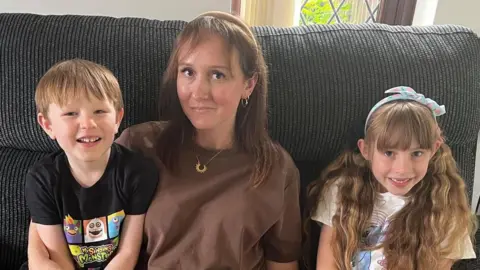
That is the case for Suffolk mum, Roxanne, who still does not know where her five-year-old son, Franklin, will be going.
"It just seems endless," she said.
"You get the diagnosis that you have to fight for, get the EHCP (Education, Health and Care Plan) that you have to fight for and then fight to get the school that you need for your child to access education.
"It's long-winded and it's very disheartening."
Franklin was diagnosed with autism in November 2025, four years after Roxanne, 37, from Martlesham, started the process of getting him assessed in 2021.
She said it was clear early on that a mainstream place was not suitable for Franklin when he first started school in 2025, and he needed a quiet area where he could also have a time out when needed.
But for the last few months of his first school year, he was there for just one hour a day after it was determined by his teachers that he could not settle.
Roxanne said returning to the school this coming term was just not viable and the issue had taken a "mental toll" on her.
"I expected to send my son to school last September and not see him for five days a week," she said.
"I now only have an hour a day when I'm not with my son - I'm with him consistently all day, every day.
"There's no alternative provision. He doesn't go anywhere else. There's nowhere for him."
 Contributed
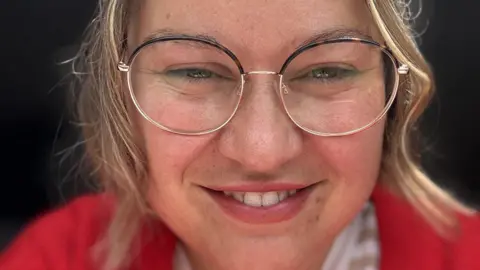
Another Suffolk mum, Xylina, faces a similar situation.
Her seven-year-old daughter, Lyla, has autism and complex sensory needs and has been receiving specialist education in Felixstowe.
But now she is moving into Year 3 they are having to re-apply for a school place and are struggling to find somewhere suitable.
"She needs constant supervision all the time, and that is just to keep her safe, and it's a lot to do with the way that her brain has developed."
Xylina says Lyla, who's also non-verbal, was given a mainstream place when she started school, but the mother was called daily by the teachers.
"It contributed to the loss of my career. I was a mental health nurse and it interfered with my ability to do my job safely and correctly," she explained.
"I tried to apply for another job and I was asking for certain hours to fit around school and with the possibility of me being called at any moment to come and collect her because she was so upset."
Lyla also struggles with eating things that are not food and there were cases where she had eaten something within the classroom leading to calls to 111, Xylina added.
Xylina and Roxanne have both requested a tribunal with Suffolk County Council, but there is still uncertainty about whether their children will be placed in suitable education by September.
According to data from a Freedom of Information request, there had been 366 SEND tribunal appeals between April 2025 and the end of that year.
The percentage of children with EHCPs placed in specialist provision as opposed to mainstream schools was 24.6% between 2024 and 2025.
 Contributed
Sophie Underwood, from Suffolk Child Counselling in Occold, works with SEND children and said the impact on youngsters not being in school was long-lasting.
She said about 80% of her clients were parents of SEND children, but schools cannot afford to have experts like her to help.
"Schools are struggling with their budgets at the moment, and they have such a wide range of children within their class because there isn't enough SEND funding or SEND places," she added.
A county council spokesperson said it understood concerns from families and that school transitions could be an "anxious time".
They said they were committed to working with families of SEND children to help them "access the education and support that best meets their needs".
They encouraged families to contact their SEND caseworkers for help.
Inspections by Ofsted and the Care Quality Commission (CQC) earlier this year found Suffolk's SEND partnership had taken "effective action" to address serious weaknesses identified in a damning 2023 inspection, while also identifying parts of the service where further improvement is still required.
Among the changes were a £9.1m investment into SEND services, the creation of a SEND Improvement Board with an independent chair, large-scale recruitment into statutory SEND teams, and new quality assurance and data systems.
Do you have a story suggestion for Suffolk? Contact us below.
Follow Suffolk news on BBC Sounds, Facebook, Instagram and X.
