'Rare' ring sheds light on how Romans navigated unrest

 BBC
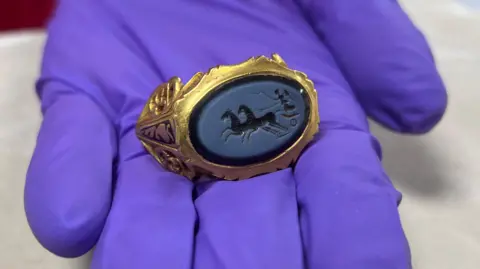
BBCAn "extraordinary" Roman gold finger ring has been acquired by a heritage trust and will go on display at a museum.
The ring, along with a hoard of coins, were discovered as part of an archaeological dig at land near Ilminster, Somerset, in 2018 by metal detectorist Kevin Minto.
Amal Khreisheh, senior curator for the South West Heritage Trust, which purchased the ring, said the extraordinary discovery sheds light on how south Somerset's Roman inhabitants navigated a period of unrest from 286 to 296 AD.
"Roman gold is really rare, most jewellery is made out of silver or bronze in this period, so it's really striking to see in such good condition," Khreisheh added.
Khreisheh said the ring, which has a finely engraved gemstone, is a "nationally significant find".
Most jewellery discovered in the UK from the period of unrest between AD 286 and 296 was made of silver or bronze. However, this unusually large gold ring suggests that wealthy Romans were living in the area and navigating the conflict.
She continued: "The Ilminster Ring is both large and heavy, with elaborate goldwork and a beautifully executed intaglio.
"It is likely the ring was buried shortly after 297 as part of a hoard including coins, lead and pottery objects."
Kevin Minto, who's from Amesbury, found the ring in 2018.
He said: "At the time, you're tired from digging all day.
"When you see it, it's all a bit overwhelming and it didn't really sink in until I got home that night.
"I put the coins on the table and was like, 'wow'."
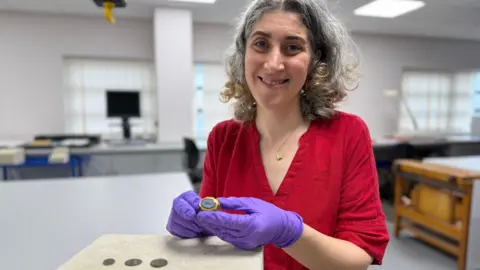
South West Heritage Trust raised £78,010 to acquire the so-called Ilminster Ring with support from the Arts Council England and charities.
Following conservation work, the Ilminster Ring will join the Roman collections on display at The Museum of Somerset in Taunton.
Follow BBC Somerset on Facebook and X. Send your story ideas to us on email or via WhatsApp on 0800 313 4630.
