'It's not a nice world to bring children into': Births fall to the lowest level in 50 years

 Family handout
"It's just not a very nice world to bring people into, and why would I consciously do that when I can choose not to?"
Stacey Waring, 40, a nurse from Nottingham, says global uncertainty has made her think twice about starting a family.
She is one of an increasing number of people having either no or fewer children, contributing to a national and global picture of falling birth rates.
In 2025, births in England and Wales fell for the fourth year in a row to their lowest level in nearly half a century, according to the Office for National Statistics (ONS).
Waring suggests that bringing children up in the UK today is less appealing than it was for her parents' or grandparents' generations.
"If I think of the childhood that I had, I was one of the last generations to grow up playing outside without a mobile phone, and it's very different now," she adds.
But she says she feels lucky to live at a time when people have more choice about whether to start a family.
"If I'd had children, I'd have had to reduce my hours at work," she says.
"I'm a huge traveller and go away whenever I can in my camper van, which I wouldn't be able to do if I had children."
Birth rates in the UK have been falling steadily since 2010. There were 585,000 live births in 2025, a fall of 10,000 on the year before and the lowest overall figure since 1977.
The estimated number of children born per woman fell to just under 1.4 for England and Wales in 2025, down from 1.9 in 2010.
Women are also having their first child later than ever before, at an average age of 29.6 years old.
That is about two years older than in 2010 when the most recent decline in fertility rates started.
Births where at least one of the parents was born outside of the UK increased to 40%, up from 30% over the same timeframe.
'It's heartbreaking'
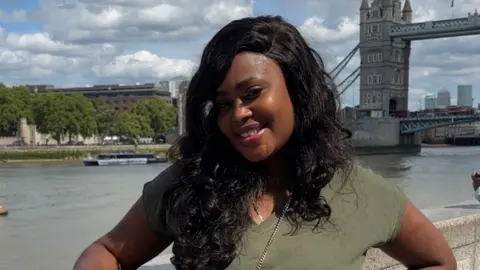 Georgina Tuffour
Georgina Tuffour, 35, would love to have a larger family but says that the rising cost of living makes that difficult.
The trainee nurse and her Uber driver husband already have three children, aged 10, eight and six, and she worries about having more.
"My daughter wants to register for everything at school, my son loves to play the drums and that costs £50 a month," she says.
"I've had to say to them that I cannot afford to sign all of them up and that breaks my heart, so imagine having another?"
Tuffour, who contacted BBC Your Voice, says she feels the government has been doing more to support young families, but would like to see more policies to help pay for the cost of childcare.
Dr Paula Sheppard, an anthropologist at the University of Oxford, says the rising cost of living partly explains why people are waiting until they have "a lot more proverbial ducks in a row" before having more children.
"They're waiting for a better job, better salary, better house, better neighbourhood, and it takes longer to get those things in the current climate," she adds.
"People have always wanted the best for their kids, but the cost of having children is increasing - food costs more, clothes cost more – so absolutely the economy makes a difference."
Dr Sheppard argues that falling birth rates are not exclusively a UK or European phenomenon but part of a wider global trend.
"Even in the Nordics, with [their] family-friendly social policies, they don't see an increase in birth rates," she says.
Instead she says the trend is tied to a "cultural shift" with families deciding to "invest in fewer children rather than having lots of children with fewer things."
Falling birth rates can have a self-perpetuating psychological effect, she argues, because "if you grow up in a society not seeing lots of babies, then it becomes harder for you to have babies [yourself]."
Additional reporting by Joe McFadden. Consultant statistician Amy Whittlestone.
19 October 2026: This article has been updated to make clear that one of the contributors was a consultant statistician.

