US kills leader of Venezuela's Tren de Aragua gang in air strike, Trump says

 Truth Social
The US military has killed the leader of the Venezuelan gang Tren de Aragua in an air strike in the country, President Donald Trump has announced.
"At my direction, the United States Southern Command delivered a swift and lethal kinetic strike to successfully execute Niño Guerrero," Trump wrote on social media.
Niño Guerrero, whose full name is Héctor Rusthenford Guerrero Flores, was the longtime leader of Tren de Aragua. The gang is one of the most notorious criminal groups in Latin America and has been a target of the Trump administration.
The president has accused the group of engaging in "irregular warfare" against the US and declared it a foreign terrorist organisation.
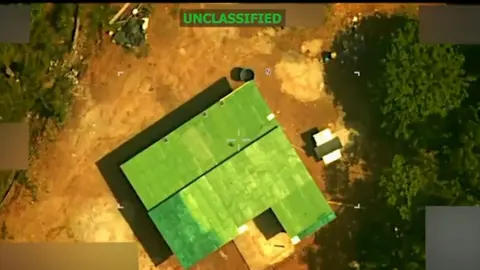
Trump posted footage of what appears to be the airstrike, showing a green building with a nearby shed being blown up, debris flying into the air. He said the military action was "coordinated closely with our friends in Venezuela, with whom we are working very well".
Venezuelan authorities confirmed their involvement in what they described as a "joint operation".
US Defence Secretary Pete Hegseth said on X the strike took place earlier this week on a Tren de Aragua compound in Venezuela.
Later, Venezuela's communication ministry said Guerrero was killed in a "combined operation" with the US that targeted organised crime in the country's Bolívar state.
In January, American forces seized then-Venezuelan President Nicolás Maduro from his compound in a dramatic overnight raid to face criminal charges in New York. The US accused him of collaborating with the gang. The indictment named Guerrero Flores as a co-conspirator.
Since then, the US has sought to tighten ties with Maduro's successor, Delcy Rodríguez, lifting sanctions on her and pushing to collaborate on the extraction of Venezuela's oil reserves - the most plentiful on earth.
Under Guerrero's leadership, Tren de Aragua expanded into Colombia, Ecuador, Peru and Chile and diversified from extorting migrants into sex-trafficking, contract killing and kidnapping.
It was originally a prison gang that Niño Guerrero turned into a "transnational criminal organisation", according to the US state department, which had offered millions for information leading to his arrest.
Guerrero spent years in and out of prison. In 2012, he escaped by bribing a guard and was then rearrested in 2013.
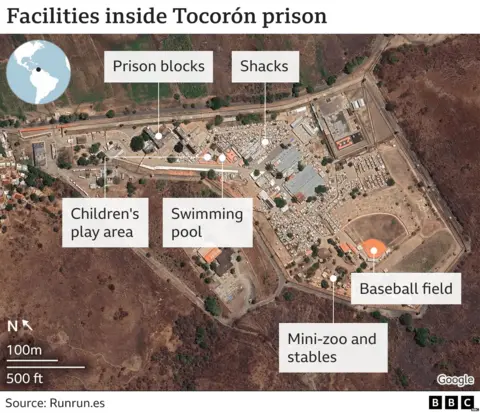
Upon his return, he transformed the Tocorón Prison in the northern Venezuelan state of Aragua into a leisure complex, complete with zoo, restaurants, nightclub, betting shop and swimming pool.
In September 2023, Maduro - then still president - sent 11,000 soldiers to storm and wrestle back control of the jail. Guerrero escaped - again.
In and out of prison, he was still able to expand the gang's influence, seizing control of gold mines in Bolivar state, drug corridors on the Caribbean coast, and clandestine border crossings between Venezuela and Colombia, according to the US state department.
By most accounts, Tren de Aragua spread out of Venezuela when the country entered a humanitarian and economic emergency in 2014 that made crime less profitable, and now is believed to have nodes in eight other countries, including the US.
The group, in part, operates by forming alliances and partnerships with local criminal organisations.
In Ecuador, for example, the gang is believed to work with groups loosely affiliated with Mexico's Sinaloa cartel, while in Colombia some have alleged that they have worked with members of the left-wing National Liberation Army guerrilla group, or ELN.
Under the Trump administration, US forces have launched dozens of strikes on boats they say are part of a large-scale operation to ferry drugs into the US, including those it claims are linked to Tren de Aragua.
More than 200 people have been killed in strikes since September, according to US media.
But the military has not provided evidence that the attacked boats were carrying drugs or drug smugglers, sparking criticism of the operation and questions around its legality.
Some legal experts have argued that the strikes could violate international law by targeting civilians without offering them due process.
The Trump administration has said the killings are lawful. In a statement to Congress last year, the White House said US President Donald Trump had "determined" that the US was in a formal armed conflict with drug cartels and that crews of drug-running boats were "combatants".
