'Some say faith and politics should never mix'

 BBC/Richard Moss
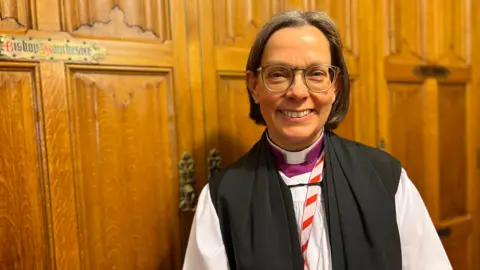
She might not be elected by a single voter but the Bishop of Newcastle says she can and does use her role in the House of Lords to tackle the disconnection between the North East and Westminster.
From tackling poverty and drug problems to dealing with proposals to allow assisted dying, the Right Reverend Dr Helen-Ann Hartley, the Bishop of Newcastle, is clear that clergy do have a role in 21st Century politics.
"There are some people that say faith and politics should never mix, but I think having a world view, framed in my case through a Christian faith, absolutely touches on political issues," she said.
"I am not in the House of Lords to evangelise or preach the gospel, but I hope in the speeches and contributions I make that I am shining a light on what it is for people to live in fullness and what prevents that happening, and I think that is where my voice can be most effective."
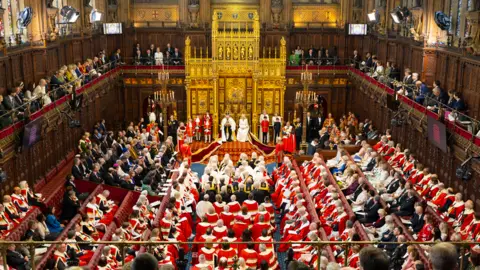
Hartley, who has been in post since 2023, is one of 26 Church of England bishops to have a guaranteed place in the House of Lords where she can vote, speak in debates and ask the government questions.
Their presence in parliament dates back 700 years, but she insists there is still a role she can play advocating for the people and places in a diocese that stretches from the Scottish border to the North Pennines and from the North Sea to Alston Moor in Cumbria.
At the start of the year, she used a speech in the Lords to back a campaign by teenager Holly Newton's family's campaign for a change in the law. The 15-year-old from Hexham, Northumberland, who was stalked and murdered by her ex-partner, was not classed as a victim of domestic violence because of her age.
Hartley said: "We kind of have constituencies in as much as we are rooted in particular areas and regions. We are able to tell the stories that we come across either ourselves or through our church communities.
"Just last week I was in Wallsend and a couple of clergy there spoke to me about their real concerns around drugs and the way it was impacting on children's lives. They wanted to ask me if I could find a way to articulate that in my role at Westminster. I can hopefully shed a light on that."
 BBC/Richard Moss
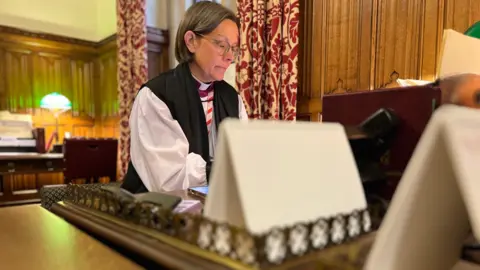
Hartley acts as the lead for the bishops on economy and business, but often uses that to talk about the qualities and the problems in the North East.
"I can raise subjects from the systematic issues of poverty to the real sense of disconnect that people have which we have seen in the recent local elections, and so I ask questions about what is informing that," she said.
"The North East is a region that is doing fantastic things and has a lot of confidence, but which is still underpinned and affected by industrial decline and underinvestment over quite a long period of time."
'Crackers' to have clerics
There are controversies though. Hartley sat on the Lords committee that had to study the legislation on assisted dying. It was a bill that got through the House of Commons but ran out of time because of opposition in the Lords.
She was among the bishops who opposed the change in the law. MPs who backed it have criticised the role the clergy played.
Liberal Democrat Harrogate and Knaresborough MP Tom Gordon was among supporters of the bill.
He said: "Having reserved spots for a particular religious group in our parliament is absolutely crackers in the 21st Century. You look around the world and Iran is the only other country that has spots reserved for clerics.
"That is not to say that we cannot have valuable contributions but no-one should have a faith-based space in our House of Lords."
But the Bishop of Newcastle insists she was focused more on the practicalities than morality.
"I am opposed to assisted dying but I was very careful, as were many of my colleagues in the chamber, to ensure my role was to scrutinise and improve the legislation," she said.
"It became very clear that the more the scrutiny, the more the issues. So it's not surprising that the bill ran out of time.
"I am very careful though not to evangelise or use my speaking role as a pulpit."
 House of Lords/Roger Harris
She has offered support to some of the MPs from her diocese during the current turmoil in Westminster.
"There are one or two I have reached out to. I think sometimes having me in my role as a bishop, as their bishop, can be appreciated in terms of somebody who is there to support them as human beings."
The bishops have so far survived reforms that have seen some hereditary peers leave the House of Lords. Hartley says she is more than happy to discuss their continued presence.
While they still have a place though she is determined to advocate for the people and parishes of the region.
"Personally, I think it would be sad if the bishops were removed, but if that comes at the end of a careful consultative process, so be it," she said.
"At the moment I live in the present and hope I am a good example of how a bishop can work effectively and positively and be a good presence in public life."
