Holyrood restricts media access to politicians after FMQs

 PA Media
A row has broken out at Holyrood after it was announced journalists will have restricted access to politicians after First Minister's Questions.
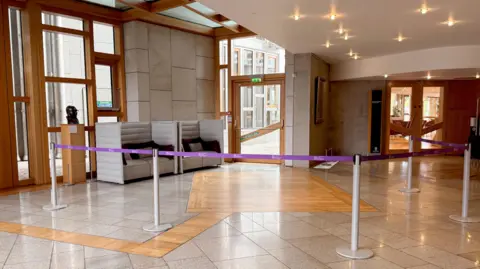
Scottish parliament officials set out a designated area for journalists on Thursday ahead of the opposition party leaders' questions to John Swinney.
The parliamentary bureau said it had decided to impose the designated spot for the media "following feedback from a range of building users and discussions with all parties".
But the decision has sparked a transparency row and has been condemned by some opposition parties.
"It is a matter for the Scottish Parliament Corporate Body, not for me," John Swinney responded when asked about whether he agreed with the restrictions.
Reporters often question, or "doorstep" MSPs, including the party leaders, just outside the chamber after FMQs.
Journalists attempted to question Presiding Officer Kenneth Gibson about the decision to restrict the media to the pen, but he refused to stop and answer questions.
Approaching the media after FMQs, Scottish Conservatives leader Russell Findlay - who is a former journalist - removed one of the cords to break the barrier.
Conservative MSP Craig Hoy described the move to restrict the media as "shocking" and said it was a "clear attempt to curb the press".
Scottish Labour leader Anas Sarwar said: "The freedom of the press, for you guys to come and ask us difficult questions, it makes it uncomfortable for us sometimes, but that is a fundamental part of our democracy."
Alex Cole-Hamilton echoed Sarwar and Findlay, calling the pen "absolutely disgraceful" and "ridiculous".
"We're not in an ivory tower here. You should be able to go wherever you want," he said.
Asked from the pen if he supports the restrictions, Scottish Greens co-leader Ross Greer said: "Have a word with some of your colleagues about their behaviour."
Reform UK was contacted for comment.
'Physical and symbolic barrier'
The Scottish Parliamentary Journalists' Association (SPJA), the group that represents reporters at Holyrood, said it was not consulted.
In a letter to the presiding officer and the chief executive of the parliament, the SPJA called for the decision to be "reviewed as a matter of urgency".
It said: "This change represents a significant departure from established parliamentary practice and risks undermining the ability of accredited journalists to scrutinise elected representatives on behalf of the public.
"Since devolution, Holyrood has rightly taken pride in being a more open, accessible and transparent institution than Westminster.
"The ability of journalists to approach ministers, opposition leaders and backbench MSPs in the public areas of Parliament following debates and major announcements has been a central feature of that culture."
The letter added: "The imposition of a designated area from which journalists must operate fundamentally alters that relationship.
"It creates a physical and symbolic barrier between elected representatives and those tasked with holding them to account."

Journalists at Holyrood have always had far more freedom than our Westminster counterparts in terms of parliamentary access to politicians.
But it's been curtailed, without consultation, and the media isn't happy.
"Doorstep" interviews are an opportunity for reporters to call out questions to passing MSPs, who can choose to engage, or not.
Most weeks after First Minister's Questions, the media gather in what's called the Members' Lobby, a space between the debating chamber and the lift to the Ministerial tower. The first minister has to pass by in order to return to his office.
It's a chance to hear directly from John Swinney on breaking or developing stories.
There's not usually an issue. But last week different groups of journalists tried to speak to different MSPs about different stories at the same time, leading to some congestion in the corridors of power.
It seems that this may be what has prompted complaints, leading to the parliament's press pack being put in a pen like a recalcitrant toddler.
Watch out for tantrums.
