Ex-BBC presenter John Humphrys on being drunk during live Nixon resignation report

 EPA
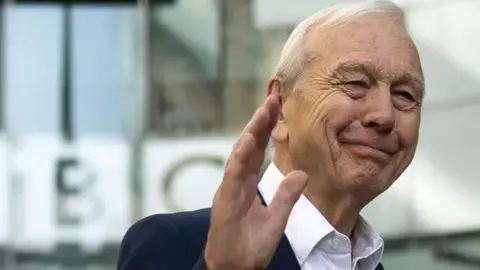
EPAFormer BBC presenter John Humphrys has recalled being drunk live on air in the early years of his career.
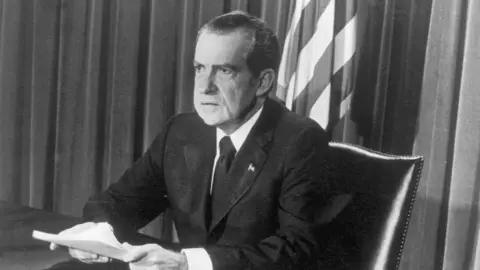
Humphrys told The Times he "staggered" back to the office after a "lavish" lunch in August 1974 - and then was told to break the news that US president Richard Nixon was resigning.
"I didn't fall off the chair, but it was painfully obvious," said Humphrys, adding: "That was the last time ever."
Humphrys went on to present Radio 4's flagship Today programme for 32 years before retiring in 2019.
Now aged 82, he has released a new podcast called The Odd Couple in which he talks about being the first journalist at the scene of the Aberfan disaster, and growing up in Cardiff.
 Getty Images
Humphrys, who joined the BBC in 1966, said he was working for the corporation in Washington DC when he was among the first journalists to break the news of Nixon's resignation.
He told The Times he had gone for a "very, very, very lavish lunch, a couple of glasses of red in the office beforehand".
"We used to have this gallon thing of burgundy, so had a couple of glasses of red wine, then go to the restaurant, have a martini or two, then a glass of wine with lunch and brandy afterwards.
"Anyway, I staggered back to the office and my PA, or BA [broadcast assistant], whatever they called them in those days, said: 'Are you sober?' and I said, 'What do you think darling?' or something stupid.
"And she said, 'You've got to get on. They've booked a satellite."
Humphrys said he "got through it" but "only just".
"She said to me the next day, my BA, 'London probably won't say anything to you, but they've just said it to me. You can't do it again'."
Humphrys said it never happened again, adding that he now "virtually [does not] drink at all".
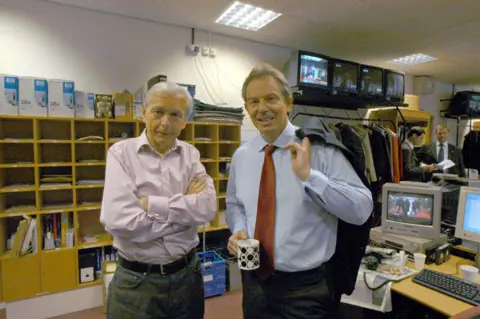
Humphrys was born in 1943 and grew up in Splott, Cardiff.
In the first episode of his new podcast, which he co-hosts with journalist Matthew Norman, Humphrys said he achieved good grades and earned a place at Cardiff High Grammar School but was "the poorest kid in my class".
He was picked on by his classmates for only having one pair of trousers and being told "your trousers smell bad".
"It was not a nice time, not a good time and I hated it," Humphrys told his podcast.
'I've seen horrible things, but nothing matches Aberfan'
 Mirrorpix via Getty Images
Humphrys described working three part-time jobs while at school, including a morning paper round, being a messenger for a chemist and growing food in an allotment.
Aged 15, he left school and got a job as a reporter for the Penarth Times.
"I needed the money, we needed the money," said Humphrys.
"It didn't occur to me for a moment that I shouldn't leave school at 15 and start working."
At 21, he started working in television news for Television Wales and The West (TWW).
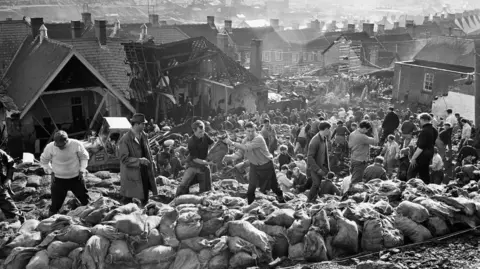
It was from here that he was deployed to the scene of the Aberfan disaster on 21 October, 1966, when a coal tip slide left 116 children and 28 adults dead.
"I was the first person to get there," he said.
"There were mothers, hundreds of mothers with their babies standing watching their husbands, the miners on the top of this great heap with shovels and spades.
"They couldn't use heavy machinery because of crushing and the children were underneath this mountain of waste, so they were digging with their hands and their picks and shovels, looking for the bodies."
He recalled how the miners' faces were still black "except the lines of white at the side of their cheeks, where the tears rolled".
The journalist said a barman at a pub in the village let him use the phone there to report on what was happening.
"I did a broadcast to TWW and that was broadcast to the world," he said.
"I didn't have time to write anything or prepare anything, I just described what I was seeing.
"I've seen quite a few horrible things in my time, but nothing matches that."
