Forty-three arrests after enormous £4.5m police operation keeps rival protests apart

 Getty Images
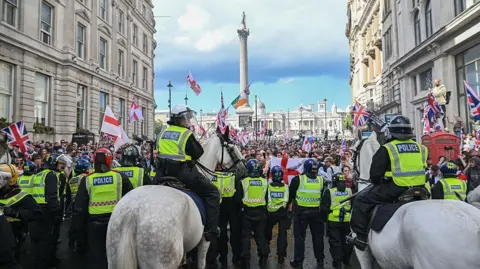
The Metropolitan Police has said 43 arrests were made on Saturday during an enormous £4.5m police operation to keep demonstrators at two rival London protests apart.
More than 4,000 police officers were deployed to the capital to manage a so-called "sterile zone" between a rally organised by far-right figure Tommy Robinson, and a pro-Palestinian demonstration.
Tourists trying to navigate major central London landmarks were left bemused by the operation.
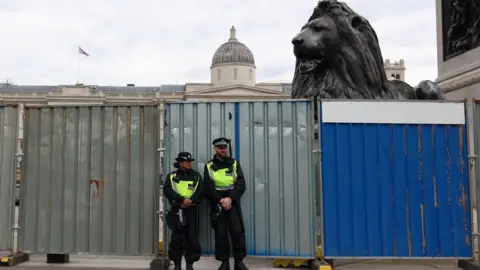
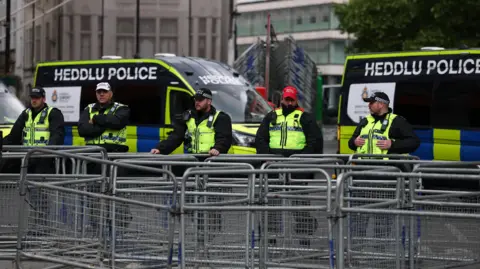
Nelson's Column was surrounded by metal barriers. Police officers from Wales in riot uniforms prevented anyone getting from the National Gallery to Pall Mall and Regent Street. Police vehicles lined The Mall from Trafalgar Square to Buckingham Palace.
On the steps above Churchill War Rooms, a two-metre-high metal barrier blocked the road past the Foreign Office towards Whitehall.
But there were no serious clashes between protesters on the different marches.
Every year, pro-Palestinian protesters hold a march on the weekend closest to 15 May to mark the Nakba, the displacement of Palestinians who fled or were driven from their homes during the war surrounding Israel's creation in 1948-49.
But when organisers started talking to the Metropolitan Police about this year's march, they discovered 16 May had already been booked by anti-Islam campaigner Robinson, whose real name is Stephen Yaxley-Lennon, for one of his Unite the Kingdom marches.
After negotiations, it was agreed that both marches could go ahead, but it meant a huge security headache for the police force. Not only were there two rival marches, but the FA Cup Final at Wembley also fell on Saturday.
It meant the Met had to stage one of its most significant public order policing operations since the May Day riots of the early 2000s.
The operation's aim was to maintain the principle of freedom of speech - that people should be allowed to express their political views, so long as hate speech laws were not broken.
But officers'concerns were high because the last time Robinson staged a march, an estimated 150,000 turned up. A few of his supporters had running battles with the police as they tried to get close to anti-racism campaigners at the other end of Whitehall.
Of the thousands of officers drafted in on Saturday, 660 of them were from other forces in England and Wales under what is known as mutual aid.
Senior officers devised a sterile buffer zone between Trafalgar Square, Buckingham Palace and Parliament Square.
The Unite the Kingdom protesters were able to walk from Holborn, along the Strand, down Whitehall and into Parliament Square for their rally.
Those on the pro-Palestinian march were allowed to make their way from Knightsbridge, along Piccadilly and into Pall Mall for their speeches.
The plan to keep the two sides apart seems to have largely worked.
 Reuters
For the first time while policing a protest, officers set up a live facial recognition camera at Euston and King's Cross St Pancras railway stations, where people attending the Unite the Kingdom march were likely to arrive.
One early arrest was of a man being sought in connection with an incident in Birmingham on Thursday, in which someone was run over by a car after an altercation linked to the Raise The Colours group that has been putting flags on lampposts across the UK.
By 19:30 BST, there had been 43 arrests at the two protests, with 22 people also arrested at the FA Cup Final.
In an update on Sunday morning, the Met said: "Twenty of those arrested were affiliated with the Unite the Kingdom protest, while 12 were affiliated with the Nakba protest.
"Eleven were either not affiliated with either group, or it hasn't been possible to confirm their affiliation."
It added that 11 arrests were related to alleged hate crime offences - two affiliated to the Nakba Day protest and nine to Unite the Kingdom.
A further seven alleged hate crime offences at the Nakba march remain under investigation, the force said.
 Reuters
Police helicopters were in use throughout the afternoon, monitoring the protests from above. Police dogs were waiting in vans on Horse Guards Parade.
Somewhere out of sight were the Met's new SandCat armoured vehicles, which officers said were only there for circumstances where officers were confronted by "extreme violence".
An early police estimate was that the numbers on the Unite the Kingdom march were around 60,000, less than half the numbers estimated for September's march.
In truth, there was less edge to Saturday's protest.
Some of the most high-profile speakers from overseas had been prevented from coming by having their right to enter the UK revoked.
These included the Colombian-American anti-Islam influencer Valentina Gomez, while Polish MEP Dominik Tarczynski and Ezra Levant, a longtime Canadian supporter of Robinson, also said they had been blocked.
US tech billionaire Elon Musk had addressed September's rally by video call saying "Fight back or die!". Although Tommy Robinson thanked him for his support on Saturday's march, he was notable for his absence.
