What you need to know about Saturday's protests

 Getty Images
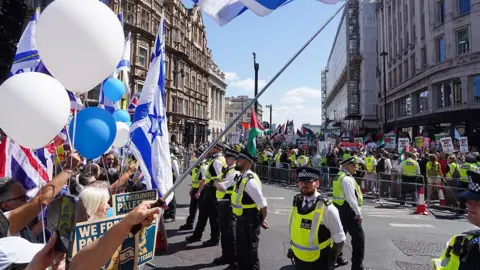
Two major protests are taking place on Saturday in central London, in what the Metropolitan Police say may be one of its busiest days in recent years.
The annual pro-Palestine "Nakba Day" march will travel to a rally at Waterloo Place, while a separate Unite the Kingdom march, organised by Stephen Yaxley-Lennon, better known as Tommy Robinson, will gather at Parliament Square.
Public Order Act conditions are being imposed on both marches and live facial recognition will be used as part of a protest policing operation for the first time.
The operation is expected to cost around £4.5m and coincides with the FA Cup Final at Wembley, against a terrorism threat level that remains at severe.
How is the Met policing the events?
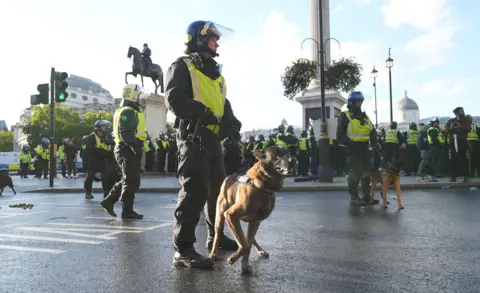
Approximately 4,000 officers will be deployed, including 660 from other forces across England and Wales, with specialist traffic units, mounted officers, dogs, helicopters, drones, detectives, and specialist armed vehicles available as a high-level contingency.
It is the first time live facial recognition will be used as part of a protest policing operation, deployed in Camden in an area likely to be used by those attending Unite the Kingdom.
Dispersal orders are in place, plus Section 60 and Section 60AA powers covering search and removal of face coverings.
For the first time conditions have been imposed on speakers themselves, making organisers responsible if invited speakers cross into unlawful extremism or hate speech.
Deputy Assistant Commissioner James Harman put the cost at around £4.5m including opportunity costs, with £1.7m of that spent bringing in officers from other forces.
The pro-Palestine march
The Nakba march, which is Arabic for "catastrophe," refers to the mass displacement of Palestinians in 1948 around the founding of Israel and this year marks its 78th anniversary.
It will form up at Exhibition Road in Kensington, then go via Cromwell Gardens, Brompton Road, Knightsbridge, Piccadilly, ending at Pall Mall.
The rally will then take place at Waterloo Place; speeches and music must conclude by 17:00 BST, and the assembly must end by 17:30.
 Lucy North / PA Media
The Unite the Kingdom protest
The Unite the Kingdom march is the second rally of its kind organised by the anti-Islam activist Tommy Robinson, who says it is a demonstration for "national unity, free speech and Christian values".
It will start on Kingsway and proceed to Aldwych, Strand, Trafalgar Square, Whitehall, ending in Parliament Square.
The speeches and music are to conclude by 17:30, and the assembly must end by 18:00.
There will be two parallel corridors running east-west through central London for most of the afternoon, with Trafalgar Square, Whitehall and Parliament Square sitting between them and the two end-points where speeches are planned.
The Met Police has been explicit about keeping the two crowds apart, so hard cordons and rolling closures around Pall Mall, Haymarket, lower Regent Street, Trafalgar Square approaches and the bridges feeding Whitehall are to be expected.
Football fans in Wembley for FA Cup final
The FA Cup Final is at Wembley the same day, bringing tens of thousands of fans across London.
The Met has flagged the history of football hooligan groups supporting Yaxley-Lennon's causes, and has noted there are no other professional men's games in England that day.
In a briefing on Wednesday, Harman said this may increase the likelihood of those groups travelling into London to join the rally.
Listen to the best of BBC Radio London on Sounds and follow BBC London on Facebook, X and Instagram. Send your story ideas to hello.bbclondon@bbc.co.uk
