Anti-immigration AI videos traced to overseas fakers, BBC finds

 BBC
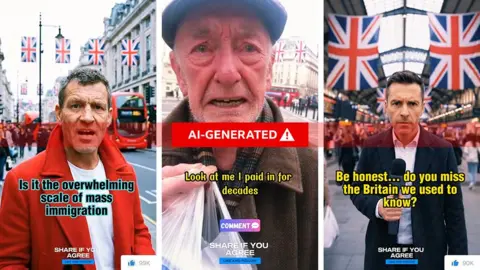
BBCThe "Great British People" Facebook page, which purports to be from Yorkshire, has had 1.3 million views for its latest video of an elderly white British man crying about his pension. Other videos show reporters discussing "the overwhelming scale of mass immigration" and asking viewers if they miss "the Britain we used to know".
But it is not clear whether the creator of the videos knows the UK at all: the account is really run by someone based in Sri Lanka.
It is one of dozens of interconnected Facebook and Instagram accounts identified by BBC Panorama and the Top Comment podcast, which create and share anti-immigration AI-generated posts about the UK to large audiences - but the creators are often located hundreds or thousands of miles away.
Several are from Sri Lanka, the US and elsewhere in Europe, while others are in Vietnam and the Maldives, or linked to Iran and the UAE, according to information from Facebook's transparency tools, interviews with the content creators and other tell-tale signs on social media such as spelling and accounts they follow.
One expert told the BBC that research shows people are worse at detecting AI fakes than they think, and the more AI content they see, the more likely they are to distrust authentic material.
London Mayor Sir Sadiq Khan - who has commissioned research into AI-generated images showing the capital in decline, which he says harm the city's reputation abroad - said while some of the people behind the accounts are motivated merely by money, others are backed by hostile states such as Russia and Iran.
It is difficult to verify claims of direct state involvement, but a handful of the accounts do share posts sympathetic towards the Russian and Iranian governments. The owners of the accounts did not respond to the BBC's attempts to contact them.
Several accounts have repurposed their pages, seemingly to increase engagement, switching from topics such as "Make America Great Again" and "Life in the USA" to using AI to push anti-immigration narratives. Some of them have also occasionally experimented with content more sympathetic to migrants.
States and other groups are attempting to manipulate public opinion with Fake AI accounts such as these, according to Prof Sander van der Linden, a social psychologist at the University of Cambridge, who described them as "new evolution of influence operations".
It is easy for AI fakers living overseas to pose as British nationals online, he said, because it is relatively cheap to buy social media accounts originally set up in the UK.
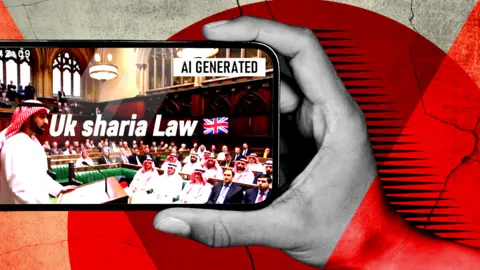
The accounts have been racking up hundreds of thousands of views with AI-generated videos of fake scenes - such as the House of Commons filled with men in traditional Arab clothing imposing Sharia law. Others feature fake interviews with women in hijabs discussing how the UK needs to be more Islamic.
The image of the UK these videos create can be contradictory. In some widely shared content, this decline is associated with Muslim immigration, but at the same time several videos from the same creators present Islamic countries as being idyllic in comparison.
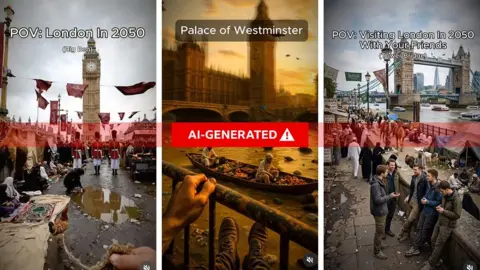
We spoke to two people who said they were behind an account with more than 20 million views showing content like this. The account shows AI-generated videos from the point of view of people walking through a series of British cities in 2050.
Liverpool, London, Birmingham and unnamed places in England are depicted as dirty and full of rubbish with people dressed in traditional Islamic clothing and hijabs lining the streets. Stalls have "Halal" written on them and there's bunting featuring what looks like Arabic script. There are also fires and chaos.
Foreign cities such as New York and Washington DC, as well as some European capitals, are also portrayed in a similar light.
Challenged about how their content could be socially divisive, the creators said: "Our content has a clear purpose: we aim to inform people and voters about what we believe could happen in the coming decades if current social and cultural trends continue."
They claimed to be located miles away from the cities they portray in their videos and described themselves as operating out of a European country where "a sense of insecurity has become more noticeable".
They show countries like Iran in an idealised way to "provoke thought and discussion about political and cultural evolution", they said.
The pair denied they were motivated by the money from social media engagement and said they did not monetise their account. They claimed to be in contact with "various politicians" supportive of their content - but they refused to disclose the names of these figures.
Research by London's City Hall found a sharp increase in social media posts like these over the past two years and identified two main motives.
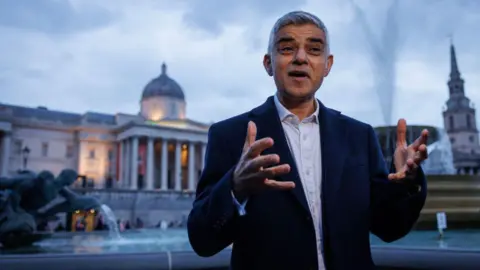
"You've got state actors," London Mayor Sir Sadiq Khan told the BBC. He said they had seen evidence of Russian and Chinese activity, as well as from "extreme right-wing" supporters of the Make America Great Again (MAGA) movement in the US.
"Secondly, we've seen individuals and companies trying to monetise and make profit from division."
He acknowledged the city faces "challenges", but he said these "AI-generated lies" had a real effect, putting off some visitors, overseas students or investors.
"My anxiety is, decent people start believing these lies, this dystopian image of London being in decline, that we're a dangerous city, that there is no law and order," he said.
Social media companies should do more to combat this kind of misinformation, including "amending their algorithms to make sure they're not rewarding poison and division" and labelling AI content clearly, Sir Sadiq said.
Meta - which owns Facebook and Instagram - said it takes "co-ordinated inauthentic behaviour seriously" and has "specialised global teams constantly working to identify and disrupt this type of activity".
"We will take action on any content or accounts which violate our Community Standards, which apply to all content, regardless of whether it is created by AI or by a person," a spokesperson said.
 Getty Images
We also spoke to people behind several accounts cross-promoting or engaging with the 2050 point-of-view videos, which bore out City Hall's conclusion that some were motivated by clicks and profit.
"I mostly post to get a reaction for the sake of engagement which boosts my followers and money," said one, who is paid through Instagram's monetisation scheme based on the ads shown to viewers of their videos.
Another said they co-ordinate with accounts "raising voice against similar issues" but that their online activity is "not politically motivated in any way". Instead, the goal is for other accounts to promote their content "to get as much attention as possible".
Some of the people running accounts with similar content to this, as well as engaging and interacting with the "fake" British patriots, are based in the UK, however.
One person who runs a profile from the West Midlands which posts about "the restoration of Britain's former greatness", told us he co-ordinates with other accounts to push the same political goal. He said they have a group chat on Instagram where they can decide what to post and when.
The accounts they work alongside are based in India, Pakistan and Singapore, as well as Australia and New Zealand, he said.
Prof van der Linden from the University of Cambridge said the "disinformation-for-hire industry" is growing with "paid actors and influencers pretending to be ordinary citizens to manufacture support for an agenda", usually with AI content and bots which attempt to drive traffic.
Research suggests the public are not that good at spotting fakes, with about a 55% accuracy level, said Prof Yvonne McDermott Rees, a law professor at Queen's University Belfast who has studied the impact of deepfakes on trust.
It also suggests that people usually think they are a lot better at spotting fakes than they actually are, she said.
Comments on the AI-generated videos suggest some real people are being taken in. One woman said "keep going" and another said "Never Back Down. Stand Up and Do What You Have to Do", in response to an AI-generated video showing a man at a protest to "Stop the Boats" bringing in migrants.
The video is posted on the "Britain Today" Facebook page, which is based in Sri Lanka according to Meta's transparency tools.
"The more that people see AI content, the less able that they are to discern fact from fiction, then the more likely they're going to be to distrust real content," said McDermott Rees.
"It shouldn't fall on just the ordinary person to have to try and figure out what's real and what isn't."
But Prof van der Linden warned that research also suggests many people do not seem to care if content is AI-generated or not.
"As long as it resonates with their identity and world-view they will often still endorse the content and share it with others because it signals agreement with a larger agenda," he said.
As one commenter on the "Great British People" Facebook page put it: "It's probably AI but the fact is that he is right about everything".

Get our flagship newsletter with all the headlines you need to start the day. Sign up here.
