Why are we given only one chance to have a baby?

 BBC/Bekki Culf
Women in south-west England are only able to access one partial round of NHS-funded IVF despite national guidance it should be three full cycles.
Fertility charity the Progress Educational Trust has said limited NHS fertility treatment in Cornwall, Devon, Dorset and Somerset was "devastating for people affected by infertility".
Sarah Norcross, from the charity, said: "In the South West all the Integrated Care Boards (ICBs) only offer a partial cycle. So regardless of how many embryos a couple may create, only a maximum of two can be transferred."
Representatives of the NHS in Devon, Cornwall and the Isles of Scilly and Dorset said they were committed to "providing access to fertility services within the resources available" while NHS Somerset added: "ICBs have to make difficult decisions on how best to spend limited NHS money."
In vitro fertilisation (IVF) is a fertility treatment which led to the birth of more than 20,000 babies in 2023, or roughly one child in every school classroom, according to data from the Human Fertilisation and Embryology Authority.
Meanwhile, birth rates in the UK are at at the lowest level in nearly half a century.
Official guidance from the National Institute of Healthcare and Excellence (NICE) recommends three full cycles of IVF funded by the NHS.
But research from The Progress Educational Trust has found women in south-west England are only given the chance at one partial round, which limits the number of embryos that can be transferred to two with no embryos frozen.
Alice Draper, from Bridport, said she had four miscarriages before she and her partner were referred to the NHS for IVF.
They tried to have a baby for more than two years, then Alice was offered one round of IVF by NHS Dorset. Five of her eggs were retrieved with one fertilised.
Alice became pregnant but her baby did not survive: "Sadly there was no heartbeat at our initial nine-week scan.
"Unfortunately the NHS had only offered us one round, and due to the fact that only one of our embryos had fertilised, we had no more chances available to us."
Alice said it was difficult to come to terms with their NHS options being so limited.
"Being offered one round is quite confronting, because it feels like you've got one chance.
"Imagine if you were only given one chance in anything that you desperately wanted in your life."
Alice and her partner have chosen to take a year off fertility treatment and said they were moving from a mindset of childless by circumstance, to childless by choice.
"People have heard the expression postcode lottery, and I think in healthcare that shouldn't be it. I think we all have the right to become a parent, as in we all have the right to healthcare," said Alice.
NHS Dorset told the BBC the NICE guidelines were not mandatory: "In line with the majority of Integrated Care Boards in England, our current policy provides funding for one cycle of IVF treatment for eligible patients.
"This reflects the difficult decisions all NHS organisations must make to balance increasing demand for healthcare services with the funding available."
'Cruel to only offer a partial round'
NICE updated its guidelines on IVF in March and now recommends Integrated Care Boards not only offer three full rounds of NHS funded IVF treatment, but should also consider additional rounds if these are not successful.
Norcross said she had been been monitoring fertility treatment across the NHS since June 2024.
She said the policy of offering only one cycle was "really difficult for people". "When you take a step back and think about it that means there is so much pressure on that one cycle and on those two transfers," she said.
Norcross said NICE's recommendation to offer three rounds of NHS IVF had not been been implemented since 2004 which was "devastating for people affected by infertility".
"It's particularly cruel to only offer a partial round – if it could just be made a full round, it would be a great step forward," she said.
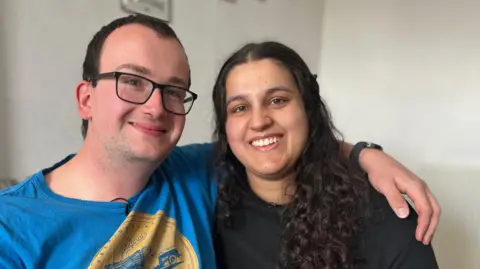
Married couple Angelina and Finley from Plymouth began IVF treatment in December 2024 after being unable to conceive for two years.
They were told a maximum of two viable embryos would be available to them, described in NICE guidelines as a partial round.
Angelina said they found it challenging: "As a young couple you wouldn't think we had to go through IVF, and you don't know what to expect.
"So when we got told our other embryos weren't being frozen, we were like, well now we haven't got a backup plan."
"I think it feels like more pressure, especially on you [Angelina]," Finley added.
They welcomed their baby last November and said they were overjoyed.
"When I first saw her, it was just so worth it. If I could, I would do it all again, without even thinking, she's our miracle," Angelina said.
But if the couple want a second child via IVF they will have to pay for private treatment.
"We were just lucky that it worked the first time, but we'd have to pay for the next one and of course it might not work," Finley explained.
'Policies constantly reviewed'
Fertility consultant Dr Sam Dobson works with both private and NHS patients. He said Angelina and Finley were among the 35% of people whose first round of IVF was successful.
"It takes the average couple two to three cycles of IVF usually to get pregnant, but there's always couples that don't get pregnant," he said.
"It's a really difficult part of the job, because you can't always pinpoint why it's not working."
Dobson said IVF was responsible for millions of births worldwide with "about 2.5 million cycles of IVF a year".
"In the UK, it's approaching 100,000. So if you think about a classroom of 30 children, on average, one of the children is probably born by IVF."
NHS Devon and NHS Cornwall and Isles of Scilly said they regularly reviewed their policies and reiterated the NICE guidelines on IVF rounds were not mandatory.
They added: "Local NHS systems are responsible for determining how services are prioritised based on the needs of their population and available budgets."
"NHS Somerset is currently merging with NHS Bath and North East Somerset, Swindon and Wiltshire and NHS Dorset, and once this process is complete, there will be an opportunity to review the ICB's IVF funding policy alongside the latest guidance from NICE."
If you, or someone you know, have been affected by pregnancy issues, please visit BBC Action Line to find information on organisations that can help.
