Historic lock drained for major repair works

 Canal and River Trust
Major repair works are underway on 180-year-old locks as part of a £355,000 improvement scheme.
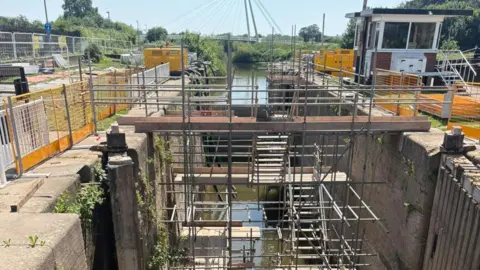
The top and bottom oak gates at the Diglis Small Lock, in Worcester, are being repaired as part of ongoing works to maintain and improve the structure for boaters on the River Severn. The lock has been drained so work can be completed over an eight-week period.
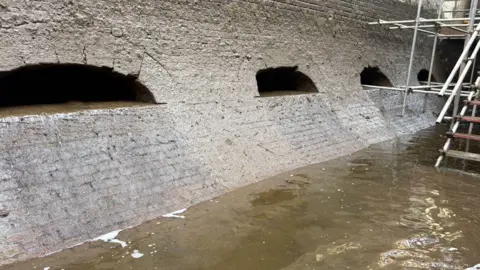
Conservation work was also taking place to the Victorian brick chamber, with new ladders installed to enhance safety, said the Canal & River Trust (CRT), the charity which looks after the waterways.
Mark Abraham, construction manager, said repairs had already commenced on the smaller of the two locks and it was a "big operation".

The CRT said Diglis Small Lock was one of two locks on Diglis Island, the site of a former Victorian lock gate workshop.
It was built in 1844, alongside the larger Diglis Lock, making them the only paired locks on the River Severn.
 Canal and River Trust
Abraham explained how the top gates, which weighed about eight-and-a-half tonnes, and the bottom gates, weighing nine-and-a-half-tones, were being refurbished.
Speaking about the brickwork at the site, he was said it was more than 200-years-old and had been dug out by hand.
"There was no excavators, the bricks were made locally as well, so all the bricks you can see in the chamber were actually made on sight," he said.
"There's got to be... over a million bricks here so somebody's had to make a million bricks for them to actually lay them to get them in."
Abraham described the lock as an "amazing feat of engineering."
"One gate lets the water in so it fills the lock, that goes down, the other goes up the other end and lets the water out," he said.
"It's an ingenious system, simple but effective."
Follow BBC Hereford & Worcester on BBC Sounds, Facebook, X and Instagram.
