Concern over proposed waste composting site

 Charlie Stubbs / BBC
Locals have reacted with concern over plans to build an industrial-scale composting plant on the Shropshire-Wales border, which would only deal with food waste from north Shropshire.
Waste firm Veolia has applied to renovate an abandoned site in Fenn's Bank, Wrexham, into an in-vessel composting facility
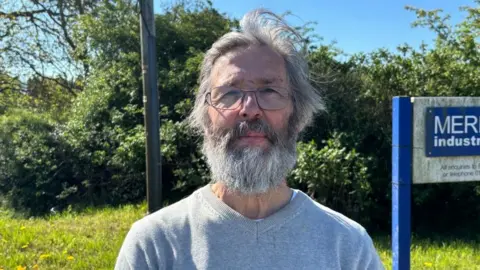
Campaigner Ben Martin said there was "no need" to bring waste material from England to Wales.
Veolia said it had carried out studies by "independent experts which cover the potential ecological impacts of the project, including air and water quality".
Campaign group Bronington Against Waste Facility said it was worried about the effects the facility would have on the Fenn's, Whixall and Bettisfield Mosses, which is an ecological site designated a European Special Area of Conservation.
The group, chaired by Martin, has been campaigning against the plans since October.
Martin said he could not understand how a county as "sparsely populated at Shropshire" could not get rid of its own waste.
"It doesn't sit well. I remember the days when here in Wales the complaint was that our water is going to England, which it still does," Martin said.
"But the idea that clean water is going from Wales to England and 30,000 tonnes of this waste material is being exported into Wales, there's no need to do it."
 Charlie Stubbs / BBC
Fenn's, Whixall and Bettisfield Mosses is the country's third-largest lowland raised bog, covering close to 1,000 hectares of land.
The national nature reserve straddles the Shropshire-Wales border and has numerous designations, including a Wetland of International Importance under the Ramsar Convention in 1997, and a European Special Area of Conservation.
People who live in the Bronington said they were concerned what tens of thousands of rotting food waste would do to the smell and air quality of the village.
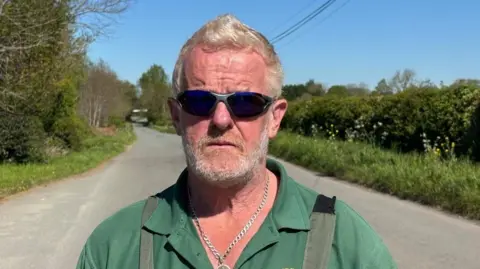
Ian Rowley, who has lived in the house next to the proposed site for more than forty years, said: "I don't really want to move. I love living where I live and I love living in the countryside, but I don't really want to live next to a waste facility that's going to give off noxious gases."
"The water on the site is already contaminated and the leachate that would be created from the rotting compost outside is going to add to that water, and where's it going to go?"
'Potential respiratory issues'
Julie Boam, a former respiratory nurse specialist living in the village, said the plant could have a detrimental effect on locals.
"Even though the modern technologies for waste are out there, it's a proven risk factor that these sites may be emitting gases," she said.
"Particulate matter that are extremely small and ultra-fine can get much further into the respiratory system, right into the airway sacs and can cross over into the bloodstream."
She added children living locally could have the "potential to develop a respiratory issue or a problem with their lungs," as they were still growing.
In a statement, Veolia said: "As part of the planning process, a number of studies have been carried out by independent experts which cover the potential ecological impacts of the project, including air and water quality.
"The proximity of the Fenn's and Whixall Mosses, a special area of conservation, has been specifically considered within these assessments."
Shropshire Council said in its contract with Veolia, it had "no influence" over where the composting facility was located.
Wrexham Borough Council said the application was "under active consideration by the council in light of relevant local and national planning policies".
Follow BBC Shropshire on BBC Sounds, Facebook, X and Instagram.
