Prehistoric fish found in Leeds park

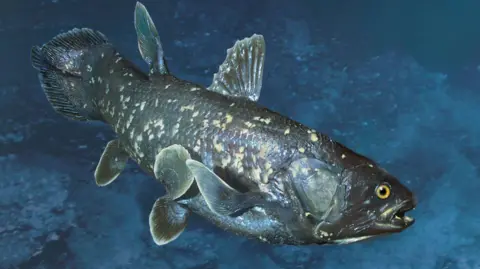 Hoberman Collection/Universal Images Group via Getty Images
The fossilised remains of a prehistoric fish have been unearthed at a Leeds beauty spot.
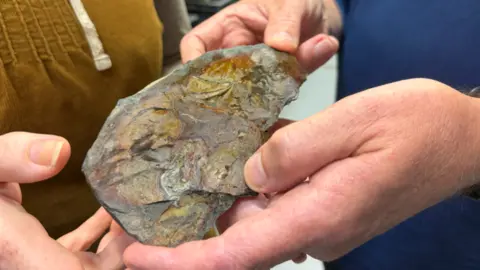
The skull bone of the coelacanth, which was discovered in Roundhay Park, is the oldest example of the species uncovered in the region. It is believed to be around 320 million years old.
Found by Ru Smith, from the Yorkshire Geological Society, the fossil had been frozen in time during an era when the park lay beneath a vast tropical lagoon.
Smith said he made the discovery while splitting open a piece of shale during a geology walk in the park and "knew straight away it was something different and very rare".
 Leeds Museums and Galleries
The fossil dates from a period about 90 million years before the first dinosaurs appeared on Earth.
A living specimen was discovered off South Africa in 1938 - with the species being believed to have become extinct millions of years previously.
Describing the moment he made the discovery, Smith said he had been examining an ancient rock layer in the park when he cracked open a piece of shale.
"There's a bed of freshwater mussels called Carbonicola at one level in the rock, and opening a piece of shale from this bed in my hands I saw something unusual - a distinctive skull bone of a large fish.
"I knew straight away this was something different and very rare."
Experts said the Leeds coelacanth would have been fossilised during the Carboniferous period when Earth was much warmer and the immense supercontinent of Pangaea was forming.
 Leeds Museums and Galleries
Smith described coelacanths as "pretty amazing fish" and added: "That's really the wonder of geology, looking at the rock and time travelling in the imagination to what was a very different world."
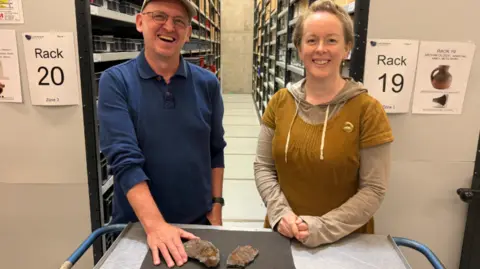
The find has now been donated to Leeds Museums and Galleries and added to the natural sciences collection at the city's Discovery Centre.
The exact location of discovery is not being disclosed in order to protect the parkland and ensure any geology field work is only carried out by members of professional bodies, museum staff said.
Clare Brown, curator of natural sciences, described it as a "remarkable find".
She added: "Responsible and ethical fossil hunting and geology can yield some incredible results and really help us to build a picture of life in prehistoric Leeds and the history that's resting beneath our feet no matter where we may be."
Listen to highlights from West Yorkshire on BBC Sounds, catch up with the latest episode of Look North.
