Work to start to restore river's natural course

 Tweed Forum
The next phase in a multi-decade scheme to restore a river to a more natural course is to begin in August.
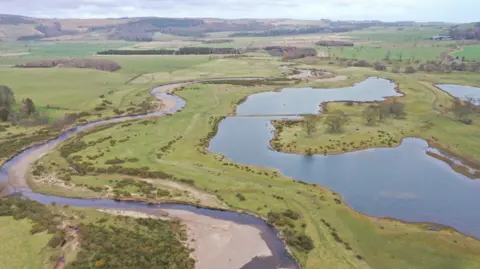
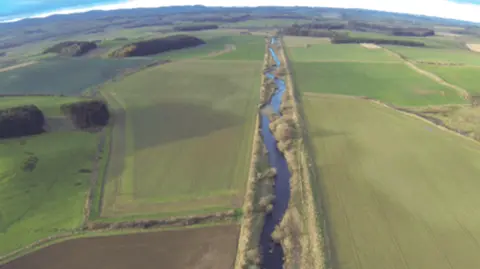
A stronghold for otters and salmon, the River Breamish, which becomes the River Till at Wooler in Northumberland, is classified as being in an unfavourable condition due to changes made over centuries to support agriculture.
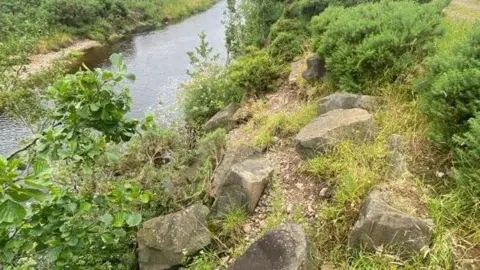
The scheme, led by the charity Tweed Forum, will remove engineering structures which historically straightened the river on a section in the Hedgeley area, north of Rothbury.
Senior Project Officer Craig Marshall said: "We are seeking to allow the river to stretch itself back out across the floodplain as it wants to do, rather than being confined to a single channel."
He said: "Before humans came along rivers didn't flow in single channels.
"Its natural path is to flow through several channels across a floodplain."
 Tweed Forum
The River Breamish and Pow Burn Restoration Project, part of the wider Till Restoration Strategy, focuses on 3 miles (4.9km) of the Breamish and 1.8 miles (2.2km) of Pow Burn, home to a number of protected species.
As well as the removal of artificial embankments and structures such as culverts, new chute channels will be installed to reconnect ponds and wetlands to the river.
 Lifewader
In addition, large trees with roots still attached will be introduced into some of the new channels to slow down the flow of the water and help create the right spawning conditions for the river's population of the UK's endangered Atlantic salmon.
The restored landscape is expected to develop into a mosaic of wetlands providing better habitats for fish, birds, amphibians and invertebrates.
The work, funded by the Environment Agency and Northumbria Water, is expected to cost approximately £200,000.
It will begin in August and last up to 12 weeks with some public footpaths temporarily diverted.
