Ancient cathedral in Britain's smallest city could go bust

 Getty Images
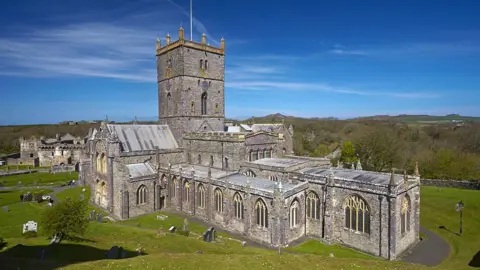
St Davids Cathedral could face insolvency within two years and its financial reserves are "dangerously low", according to a new report.
The 6th Century cathedral in the UK's smallest city of St Davids, Pembrokeshire, is visited by 300,000 people every year.
But a report commissioned by Bishop Dorrien Davies has highlighted serious concerns about its future, with the cathedral's financial position described as the "most critical" challenge.
The Church in Wales said the report should be read as an act of encouragement rather than criticism, and that work had already begun to respond positively to its findings.
According to the visitation report, robust and disciplined planning and financial management is needed or the cathedral's ability to sustain its role is at risk.
The report described the cathedral's current financial situation as unsustainable, with "unrestricted deficits [that] have persisted for seven years" meaning reserves are "dangerously low".
The report warned that these challenges, as well as the loss of diocesan support, could lead the Cathedral to "insolvency within two years".
It also highlighted several areas where practice and culture need urgent strengthening with regards to safeguarding.
The relationship with the community was described as distant and restrained, while the Welsh language at the cathedral was described as minimal.
A shortage of volunteers was also noted as a challenge that has placed "increasing strain on daily operations", with staff often covering multiple roles.
The report said there were several factors that had led to the challenges, including visitor numbers remaining below pre-pandemic levels and donations per person being comparatively low.
It also said the Chapter, the body which runs the Cathedral from day to day, were lacking urgency in their response to the ongoing financial pressures and tend to "defer difficult decisions".
In a statement on the Diocese's website, The Right Reverend Dorrien Davies, Bishop of St Davids, said it was important to stress that the report was compiled to assist and enable, not to criticise for its own sake.
He said action had already begun that demonstrates a positive and constructive response to its findings, adding: "Such scrutiny is not a sign of failure, but of care and hope for the future."
The Church in Wales said the visit was intended to strengthen the cathedral's role and ensure the structures supporting its life were strong enough to maintain that testimony for generations to come.
A spokesman said: "It would be a mistake to fail to perceive the fact that positive developments have already resulted from this visit and that the report appreciates what is already happening.
"Therefore, this visit is offered as an act of encouragement - as an invitation to renew, to cooperate more deeply, and to respond with faithful courage."
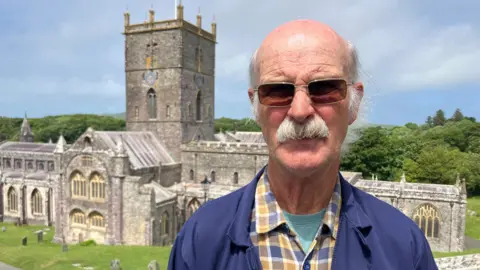
Councillor Malcolm Gray of St Davids City Council said the community was "very concerned" about the possibility of the cathedral facing financial collapse.
"Some are not surprised but a lot are and are quite worried about it really," he said.
"It would be a disaster for this part of the world."
Gray added: "They say St Davids is the jewel in the crown of Pembrokeshire... the cathedral is certainly the jewel in the crown of St Davids, and without the cathedral it would be absolutely unbelievable and unthinkable."
He urged the Church to reflect on internal issues and take responsibility for resolving its financial and organisational problems.
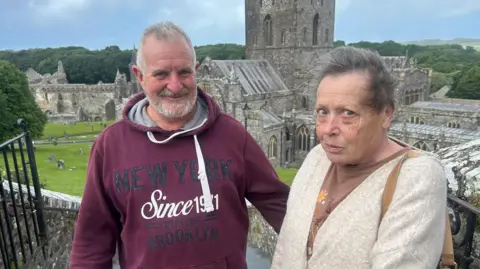
Paul Collins and Lin Palfrey were visiting St Davids for the first time.
Collins, 64, said the cathedral was the selling point, adding: "We thought we'd come and see how beautiful it really is."
He said he was "absolutely horrified" to hear the building could no longer be.
Palfrey added the building was "stunning", adding: "It makes me sad, but you wonder about the management.. was it put in place to actually stop that?"
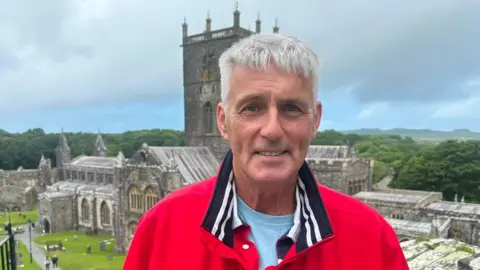
Iain Taylor, from Cumbria, had also never visited the cathedral before.
He said it was "very impressive" with "beautiful woodwork and carvings".
The 69-year-old added: "I know buildings like this are expensive to run.
"I'm glad we made a donation... whether they need a contribution from government I don't know.
"It's very important to maintain our heritage."
Taylor added he hoped the cathedral would be "here for plenty of centuries to come".
