Teen's care caused family 'sorrow and frustration'

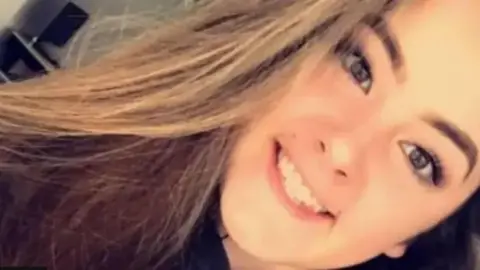 Family Handout
This article contains details of suicide and self-harm
The treatment of a "bright, beautiful" teenage girl who died while in the care of a criticised mental health service has left her family with "profound sorrow and frustration", an inquest has heard.
Emily Moore, from Shildon, County Durham, was found with a ligature around her neck at Durham's Lanchester Road Hospital days after her 18th birthday in February 2020.
Opening the month-long inquest in Crook, senior assistant coroner Crispin Oliver told jurors they would have to determine the circumstances around her death.
Emily's parents said her move from child to adult services under Tees, Esk and Wear Valleys NHS Foundation Trust (TEWV) was "deeply distressing" for their "vulnerable daughter".
'Detained patient'
The coroner said the inquest would look at Emily's mental health issues and treatment from February 2017 when she was 15.
He said it would focus on her experiences at West Lane Hospital in Middlesbrough where she was a "detained patient" from January to February 2018 and March to July 2019 as well as Lanchester Road Hospital.
Both hospitals are run by TEWV.
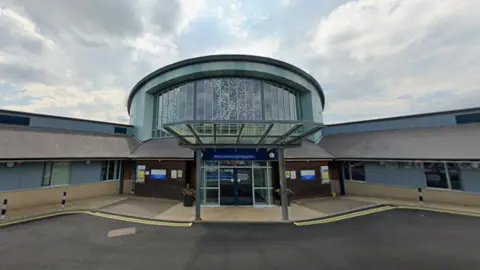 Google
Emily also spent time at a facility run by Cumbria, Northumberland Tyne and Wear NHS Foundation Trust (CNTW), the jury heard.
The inquest opened with a photograph of Emily being passed around the 11 jurors before the framed picture of her in a school uniform was returned to Oliver's desk.
The coroner said the photograph would remain on his desk for the duration of the proceedings to remind jurors what Emily looked like and "who she was as a person".
'Very happy child'
In a statement read to the hearing by their barrister Anna Morris KC, Emily's parents David and Susan said she was a "bright, beautiful girl" with her whole life ahead of her.
The statement said Emily was a "very happy child" but she developed mental health issues as a teenager which made her feel "worthless".
This had come as a "great shock" to the family, the statement said.
Emily's parents said they would get "glimpses" of a future after her illness in which she said she wanted to become a mental health professional or paramedic but she was "never able to recover from her illness."
Her move to adult services was "deeply distressing" for her and she was dead within a week of it happening, Emily's parents said.
They were left living with "profound sorrow and frustration about what she endured".
Her parents said they had only had their daughter for "the shortest time" but she had made them proud.
"She is now the brightest star in the sky," they said.
'Treatment ineffective'
The inquest heard Emily was moved to Ferndene in Prudhoe, run by CNTW, after she had spent about three months at West Lane Hospital.
On 6 February 2020, two days after she turned 18, she was moved to the Tunstall Ward at Lanchester Road Hospital, a facility for adults.
On the afternoon of 13 February she was found unconscious and she was declared dead two days later at University Hospital of North Durham.
Dr Shakeel Ahmed, a consultant child and adolescent psychiatrist for TEWV's community team, said Emily first came to the trust's attention when she took a drugs overdose in March 2017.
He said her case seemed to have developed rapidly and was "severe", with self-harm, suicidal thoughts and a strong sense she was to blame for illnesses in her family.
She was prescribed antidepressants and therapy but treatment had little affect, with Emily eventually admitted to West Lane Hospital with her agreement for a month in January 2018 for observation and to reduce the risk she posed to herself, the inquest heard.
Her clinicians thought she might have a personality disorder rather than a depressive illness but treatment for such conditions in children was "limited" and not available in Emily's area, Ahmed said.
He said doctors were reluctant to diagnose personality disorders in children because their personalities were still developing and not yet fully formed.
'No sides'
The decision was taken to admit her again to West Lane against her will in February 2019 and doctors had "effectively reached the limit of safe treatment" in the community, the inquest heard.
Ahmed said he was aware Emily's family were "not happy" and she was "not making progress" in hospital but he was not involved in her treatment after her admission.
She remained in hospital until her death, the coroner heard.
Oliver told jurors the inquest was "not a trial" and there were "no sides", with no criminal or civil liability to be found.
Jurors had to answer four questions, namely who the deceased was, when and where they died and how they came by their death, the coroner said.
Interested persons included Emily's parents, TEWV, CNTW, NHS England and the Care Quality Commission.
The inquest continues.
- If you are affected by any issues raised in this article, help can be found at BBC Action Line
