'It's a full-time job caring for my family'

 BBC
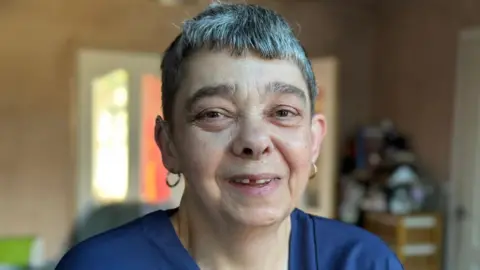
BBC"We're not recognised at all - nobody seems to think about us."
Lynn Kiddy, from Bilborough in Nottingham, has been caring for her parents and sister for 30 years.
The 57-year-old said she would do anything for her family, but she gets £557 a month and a carer's allowance of £85 a week to cover all her expenses.
She said looking after her family "is a full-time job", and deserved more recognition from society.
'We're not unemployed'
Lynn's mother Fay, 83, lives with dementia, her father, Ron, 85, has diabetes, and her younger sister, Sharon, 52, has a number of conditions, but Lynn said everyone tried their best to enjoy happy and active lives.
She visits every weekday morning to make sure everybody is in good condition, before getting on with the housework, checking medication, and anything else that needs doing.
Despite the full-time nature of the work, she said it was "heartbreaking" family carers such as her were not recognised in the same way as agency workers, such as when it came to filling in forms online.
"The form for insurance, like a car or anything like that, they don't cover this kind of care work," she said.
"We go through it, and if you say 'carers', if you tick 'yes' [they ask] 'what firm do you work for, or what care home', [and] because there's nothing there that we can tick, we have to go to 'unemployed'.
"It makes you feel worthless - we're not unemployed."
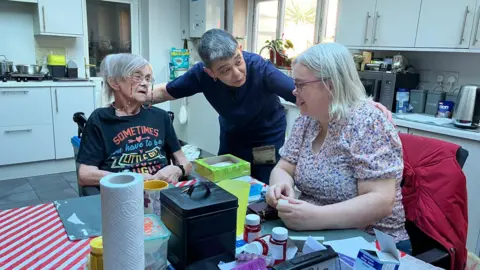
Lynn said changes to benefits meant she now had to claim universal credit, rather than the previous income support system, but said they failed to understand the amount of work she did looking after her family. The hours she puts in means she cannot work those around a full-time job.
"Each month I have to sign in, as if I'm a naughty little schoolgirl signing in a school report, and if I forget, then they'll send me an email," she said.
"They put me on the universal credit,but the carer's allowance went down - why is this?"
Even though she lives nearby with her partner, who receives a state pension, Lynn said she struggled to not focus on her family's needs, which take a toll on her life.
"Even at night, you wake up and you think 'are they okay? Is the phone going to ring?'" she said.
"At times you stand there frustrated, low on energy, drained, and you think 'I can't do this [any] more', but you just get on with it, you get over it.
"Sometimes it gets that bad - when mum's having a bad day with the dementia, and she's in repeat mode - you want to be a toddler, throw yourself on the floor and stamp your feet and that, but you can't do that, you've got to put the adult pants on, pull them up and get on with it.
"Tomorrow might be better, it might be worse, or it might be the same - you don't know, but you've just got to get on with it."
Listen to BBC Radio Nottingham on Sounds and follow BBC Nottingham on Facebook, on X, or on Instagram. Send your story ideas to eastmidsnews@bbc.co.uk or via WhatsApp on 0808 100 2210.
