US denies Iranian report warship was struck by missiles

 Reuters
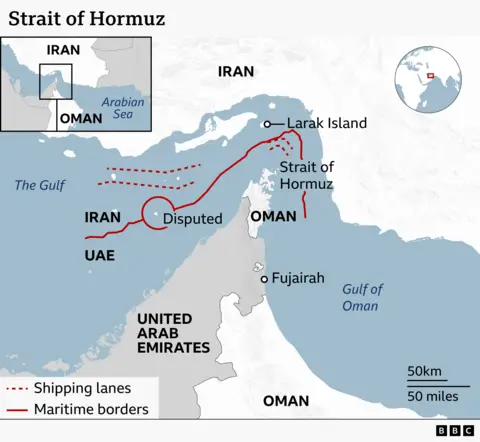
The US has denied an Iranian media report that one of its warships was struck by Iranian missiles as it tried to enter the Strait of Hormuz.
US Central Command (Centcom) said in a statement that "no US Navy ships have been struck" and forces are "enforcing the naval blockade on Iranian ports".
It came after Fars, the semi-official Iranian news agency, said two missiles hit a US Navy boat sailing through the strait after ignoring a warning from Iran's Navy.
Centcom later said two US-flagged merchant vessels had "successfully transited" through the strait.
Earlier, Iran's military warned that it would attack any foreign forces if they entered the strait, "especially, the aggressive US army".
Speaking to Reuters, a senior Iranian official said Iran had fired a warning shot against the US warship to prevent its entry to the strait, adding that it is unclear if there was damage.
Iranian media also reported that it had prevented American and Israeli "enemy destroyers" from entering the strait on Monday.
US President Donald Trump had earlier announced that the US on Monday would begin trying to free merchant ships stranded by Iran's closure of the key shipping channel since the start of the war.
Trump said "Project Freedom" was a "humanitarian gesture" and that any interference would "be dealt with forcefully".
Some 15,000 US service personnel, guided-missile destroyers and more than 100 aircraft would be involved, Centcom said, adding that the US blockade of Iranian ports would continue.
Centcom later said two US-flagged merchant vessels had "successfully transited through the Strait of Hormuz", but did not provide the names of the vessels.
"American forces are actively assisting efforts to restore transit for commercial shipping," it said.
The move comes as the two countries observe a temporary ceasefire, which began on 8 April, and as they work on agreeing on a permanent peace plan.
However a senior Iranian official warned that any US attempt to interfere in the strait would be considered a violation of the ceasefire.
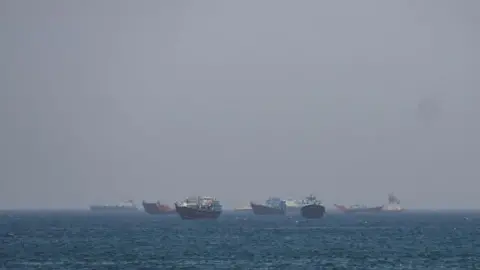
Iran's closure of the channel - which is crucial to oil exports from the Gulf - has seen fuel prices rise globally and also left thousands of sailors stranded on some 2,000 ships trapped by the blockade.
About 20% of the world's oil and liquefied natural gas usually passes through the strait.
In Trump's post on social media, he said "countries from all over the world" had asked the US if they could help free up the ships, describing them as "merely neutral and innocent bystanders".
Trump added the operation will be made on behalf of the US, Iran and other Middle Eastern nations, without listing which countries. He did not provide further details on how the operation would be managed.
He also said that US representatives were having "very positive" discussions with Iran, and that those talks "could lead to something very positive for all".
An estimated 20,000 sailors have been trapped in the Gulf since the start of the war with Iran. There has been growing concern over dwindling supplies and the effects on sailors' physical and mental health.
The United Kingdom Maritime Transportation Operation (UKMTO) on Sunday reported that a tanker had been hit by an "unknown projectile" in the strait, adding that the crew were safe.
On Monday, the United Arab Emirates said a tanker affiliated with Adnoc, its state-owned oil company, was hit in the strait, adding that no-one was injured.
Also on Monday, the Pakistani government said 22 crew members from Iranian container ship Touska - seized by the US last month - will be "handed over to the Iranian authorities".
The BBC was told by a senior official that 15 of them were handed to Iranian officials at the Gabd–Rimdan border crossing in Balochistan.
The official did now clarify why the remaining seven crew were not handed over.
The Touska was intercepted on its way to an Iranian port as part of the US's blockade, with the crew evacuated to Pakistan.
Pakistan said the repatriation of the crew is "a confidence-building measure by the United States of America".
Trump's announcement came after Iranian state-linked media said Tehran had received a US response to its latest peace proposal.
Iran said the response, delivered via Pakistan, was being reviewed, according to Iran's semi-official Tasnim news agency.
The US is yet to formally confirm it has replied to Iran. However, Trump reportedly told Israel's Kan News on Sunday that the proposal was unacceptable to him.
Iranian state media said Tehran's 14-point peace plan asked for Washington to withdraw its forces from near Iran's borders and end its naval blockade of Iranian ports, and for all hostilities to cease - including Israel's offensive in Lebanon.
It also called for an agreement between the two countries to be reached within 30 days.
Iranian state media added that the proposal urged the two warring sides to focus on "ending the war" rather than extending a current ceasefire.
Iranian foreign ministry spokesman Esmaeil Baghaei was quoted by state media as saying that "at this stage, we do not have nuclear negotiations" - a key demand by Washington.
Iran has repeatedly denied it is seeking a nuclear bomb and says its programme is only for peaceful purposes, though the country is the only non-nuclear-armed state to have enriched uranium at near weapons-grade level.
On Saturday, Trump confirmed that Washington had received the latest Iranian peace proposal.
In a post on Truth Social, he wrote that he would review the plan, but that he "can't imagine that it would be acceptable in that they have not yet paid a big enough price for what they have done to humanity, and the world, over the last 47 years".
Speaking to reporters later on Saturday, he said he had been told "about the concept of the deal", adding: "They're going to give me the exact wording now."
Asked by the BBC about whether military strikes against targets inside Iran could be renewed, Trump said it was "a possibility".
"If they misbehave. If they do something bad," he said. "But right now we'll see."
The US president appeared disinclined to withdraw from the conflict entirely, saying "we're not leaving" and "we're going to do it, so nobody has to go back in two years or five years".
The Iranian state-linked agencies said Tehran's latest proposal was in response to a nine-point US plan, which envisaged a two-month ceasefire.
