Trump cancels US envoys' trip to Pakistan for talks on Iran war

 Reuters
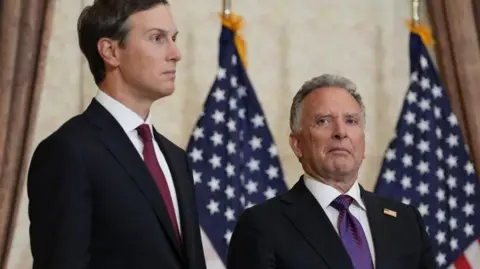
Donald Trump cancelled a planned trip by US officials to Pakistan for talks on the Iran war on Saturday, shortly after Tehran's delegation had left Islamabad.
The US president said special envoy Steve Witkoff and son-in-law Jared Kushner would be wasting "too much time", adding that if Iran wanted to talk "all they have to do is call".
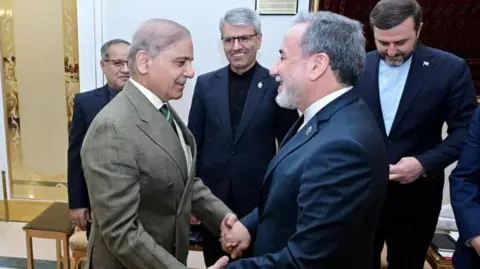
Earlier, Iranian Foreign Minister Abbas Aragchi held talks with mediator Pakistan, saying afterwards he had shared Iran's position on ending the war but was yet to see whether the US was "truly serious about diplomacy".
Diplomatic efforts have stalled despite Trump's extension of a ceasefire that had been due to expire on 22 April to allow talks to continue.
Both sides have been locked in a standoff over the Strait of Hormuz, with Iran restricting passage through the key shipping route in the wake of the US and Israel commencing strikes in February, as well as over Tehran's nuclear ambitions.
The US has since increased its naval presence in the strait - through which roughly a fifth of the world's oil supply passes - to block Iranian oil exports.
The White House had said the Iranians "want to talk" when the trip was announced on Friday, but Iran said there were no plans for a direct meeting.
Trump said the ceasefire would hold on Saturday despite hopes of another round of face-to-face talks fading.
Asked whether the cancelled US trip meant the war would resume, he told news site Axios: "No, it doesn't mean that. We haven't thought about it yet."
Announcing the trip had been called off on Saturday, Trump said there was "tremendous infighting and confusion" within Iran's leadership and that "nobody knows who is in charge, including them".
He wrote on his Truth Social platform: "Also, we have all the cards, they have none! If they want to talk, all they have to do is call!!!"
The White House said on Friday that US Vice-President JD Vance had been "on standby" to join the talks had they proved successful.
He had led the US delegation in the first round of talks earlier this month and his absence from the initial planned delegation perhaps signalled that a major breakthrough was not expected.
Iran's President Masoud Pezeshkian previously said Tehran remained open to talks but that "breach of commitments, blockade and threats are main obstacles to genuine negotiations".
 Reuters
Pakistan has mediated contact between the two sides in recent weeks, including talks between senior US and Iranian officials on 11 April that ended without agreement.
Araghchi, whose trip also includes visits to Oman and Russia, wrote in a post on X that his visit to Pakistan had been "fruitful".
He added that he had "shared Iran's position concerning [a] workable framework to permanently end the war on Iran", but said he had "yet to see if US is truly serious about diplomacy".
Pakistan's Prime Minister Shebaz Sharif said that the pair had shared "a most warm, cordial exchange of views on the current regional situation".
Araghchi is expected to return to Islamabad after visiting Oman, according to Iranian state media.
Washington's opposition to Iran gaining nuclear weapons was cited as a reason for instigating the current conflict, with the US and Israel suspecting Tehran of seeking to develop an atomic bomb.
Tehran has always denied any such intentions, saying its nuclear programme was intended for energy generation, despite having enriched uranium up to near weapons-grade level.
Elsewhere, at least four people were killed in Israeli strikes on southern Lebanon on Saturday, according to the country's state news agency. The Israeli military said Hezbollah had fired rockets at Israel.
Despite a ceasefire between Israel and the Iran-backed militant group, both sides have continued to exchange fire in recent weeks and have accused one another of violating the agreement.
On Saturday, a statement from the office of Israeli Prime Minister Benjamin Netanyahu said the military had been ordered to "vigorously attack Hezbollah targets in Lebanon".
